
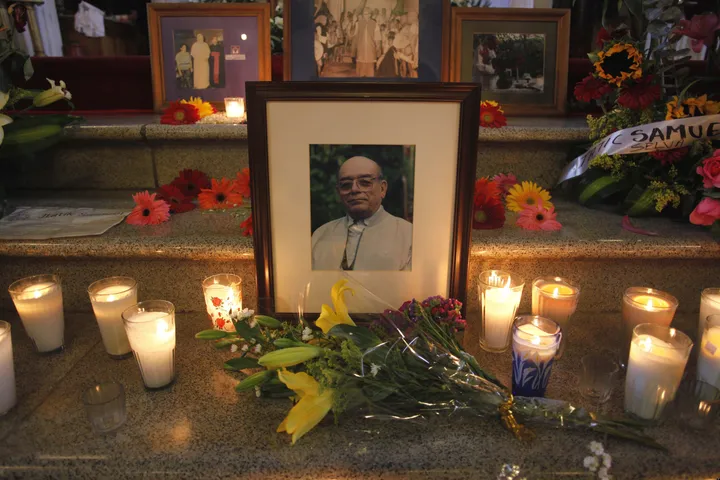
Retired Catholic Bishop Samuel Ruíz Garcia, known as the champion of the poor and indigenous in southern Mexico, died Jan. 24 of complications from diabetes. He was 86.
Bishop Ruiz was a tiny man from a "backwater" state in Mexico. In the eyes of the secular and ecclesiastical powers of the world, he was from nowhere -- and the poor people he represented were barely a blip on the global screen.
But the people of Chiapas transformed Ruiz into the man God was calling him to be -- a fearless prophet, an aggressive shepherd, a man of peace.
In October 1993, during the height of the indigenous uprisings in Chiapas, Mexico, my colleague Julie Polter and I interviewed "Don Samuel," as he was known, when he was in Washington, D.C., to receive the Institute for Policy Studies 1993 International Letelier-Moffitt Award for Human Rights.
Ruíz was the founder of the Fray Bartolomé de Las Casas Center for Human Rights in Chiapas. He headed the Diocese of San Cristobal de Las Casas from 1960 to 2000, and from 1994 to 1998 mediated a commission looking for an end to the conflict between the Mexican government and the indigenous Zapatista National Liberation Army in Chiapas state.
Ruiz was a tireless advocate for the indigenous rights. He learned to speak four Mayan languages and often traveled by mule through his diocese.
To Sojourners he said:
"All over, from Alaska to South America, indigenous people are not only claiming their own rights but offering the values of their cultures to the rest of the world. When the pope was in Santa Domingo he told the Indians that they must offer their values and culture for the salvation of us all. After 500 years of oppression, Indian people are still alive--and not just alive but proposing ideas for the whole culture. They are thinking that they have values in their own culture to offer everyone -- such as keeping commitments; justice, not only for their own change but the change of governments as well; reconciliation to be worked out within the community. These are some of the values they want to offer."
Additionally, in the 1960s, Ruiz attended every session of the Second Vatican Council. Tom Quigley, former policy adviser on Latin America to the U.S. Conference of Catholic Bishops, said Bishop Ruiz became better known internationally through his active participation in 1968 at second general conference of Latin American bishops in Medellin, according to the National Catholic Reporter. "He was a bishop from a nowhere place, but it became known ... and became the center of an awful lot of what was happening in Latin America," Quigley said.
Following the Second Vatican Council that ended in 1965, Ruiz and others sought to make the Catholic church more accessible to indigenous communities, a trend especially strong in Latin America where "liberation theology," which favors the poor reading the gospel in light of their own spiritual and material liberation and organizing for structural justice on their own behalf, took root.
Embracing that movement, Ruiz organized a network of rural catechists, or lay Bible teachers, who fanned out across Chiapas to even the most remote hamlets, allowing Indians to participate in church worship in ways never before possible to them.
"Peace for a Christian is an ongoing task; but peace goes hand in hand with justice," Ruiz told LA Times in 1998. "There can be no peace if there is no justice. Justice means bringing down from their throne those who are privileged and elevating those who are humble to the same heights."
Bishop Raúl Vera López told the Mexican newspaper Excelsior: "Don Samuel was a man who lived and experienced the contradiction, a person whose actions were discussed and condemned by a section of society, but for the poor, and those who have worked with him for many years, Don Samuel was a bright light."
Politicians, prominent journalists and even a group of campesinos wielding machetes emblazoned with Bishop Ruiz's name attended the Mass in Mexico City, according to NCR.
U.S. Secretary of State Hillary Clinton, visiting Mexico Jan. 24, said of Ruiz, "My colleagues say he was a tireless mediator that searched for reconciliation and justice through dialogue, and that is exactly the legacy we must honor and the example we all must follow."
In 1993, Sojourners asked Bishop Ruiz what the face of Jesus looked like in his communities. "It is not really Christ risen," he said. "It is still the Passion. He is on the cross, suffering, but not without hope. When we see people with hope, we know there is still the possibility for change. We can see the pain of Christ in the community, but also the hope."
Among the candles and flowers surrounding Ruiz's body as it lay in state in the Cathedral in Mexico City, banners were hung on the walls from Las Abejas de Acteal, an indigenous Christian pacifist group founded in partnership with Bishop Ruiz, which read: "We will never forget," "We will continue your legacy, Jtatik," and "The seed planted in Chiapas is now a grand tree that produces much fruit." Bishop Ruiz will be interred in the Cathedral in San Cristobal, Chiapas.
Read more:
The Legacy of Las Casas: An interview with Bishop Samuel Ruiz by Rose Berger and Julie Polter
Theology and Revolution In Mexico by Joe Nangle, OFM
A Faith to Move Mountains: A Special on Mexico (Sojourners, May 1994)