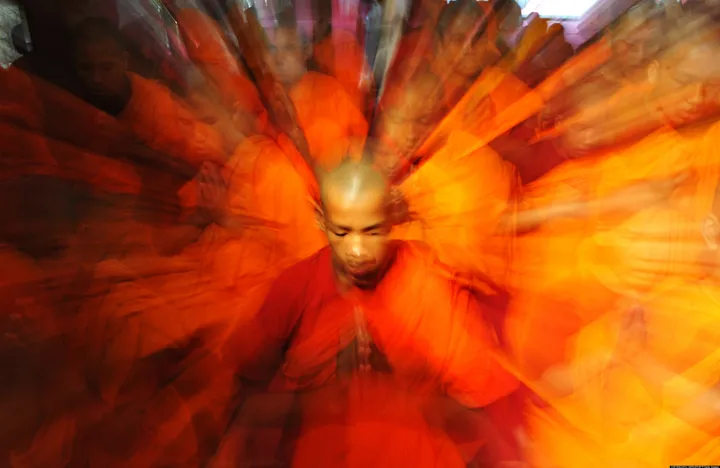
Today, all over the world, Zen Buddhists are celebrating the day of the Buddha's enlightenment. Known in Japan as "Rohatsu" (literally, the 8th day of 12th month) this Bodhi Day marks the defining event in the legend of Shakyamuni Buddha: his enlightenment experience.
After sitting through a night of doubt and temptation -- in the form of the many kinds of mental obstacles that cover the whole gamut of unskillful thoughts and images that the human mind is heir to -- Shakyamuni Buddha looked up as the planet Venus came into view, and gazing at this morning star, broke through the agony of the nightlong struggle, and realized the nature of the self, the cause of mental suffering and its remedy.
In honor of this momentous awakening, many Zen Buddhists sit in meditation for an entire week's retreat, culminating with an all night sitting on Dec. 7 into the dawn of the 8th, watching their minds. As the minutes, then hours, go by, the mind becomes quieter, and they are able to bear witness to the marvelous quality of being that Shakyamuni experienced: an embracing of reality as it is in each moment. In a sense, this very intense annual ritual helps each of us to realize that it is not so much what happens to us, but how we respond to what happens that determines whether or not we create suffering -- our own and that of others.
The legend says that as he gazed at the morning star, he said, "How marvelous, I, the great earth, and all beings are naturally and simultaneously awakened." This phrase teaches us the great lesson of interdependence, that we are not separate from all that is, but rather we are interconnected, a piece of the grand whole of the universe. And at the same time, this very piece, this "I" sitting here is an integral and vital component of the whole. When we take care of this "I", we can take care of the whole universe.
So, even if we cannot devote a week or a full night but are only able to meditate for a few minutes on Bodhi Day, it can be a reminder of the wisdom that is naturally available to us, the wisdom of cultivating our minds and recognizing our relation to the whole.
BBC - Religion: Interfaith holy days by faith
Buddhism and Bodhi Day: enjoying the holiday season | Japan: Life ...
Buddhist Holidays and Festivals
Gautama Buddha - Wikipedia, the free encyclopedia
If you are interested in writing about Buddhists check out the Mind and Spirit page at lifeasahuman.com http://lifeasahuman.com/category/mind-spirit/
there are lots of insightful articles in there.
thanks
Let's take a leaf from the teachings of the Zen Master Hui Neng to celebrate the enlightenment f the Buddha. Let us enjoy a moment of peace and tranquility. Let us keep our mind in silent retreat even for a few minutes.
( why to NON-buddhists ? ... because, without nonbuddhists there wouldn't be buddhists ... ☯ )
very nice article for celebrating it too ... thank you huffpo
Don't forget practice, as well. Enlightenment don't come easy ;)
Namaste
Happy Bodhi Day!!!!!!!!!!!!!!
The 'mind' is as restless as a Monkey, the Buddha taught.
Who you are... what you think of as 'yourself' is constantly changing.
The 'self' comes... and the 'self' goes.
One moment you are angry... the next moment you are laughing.
Who are you?
... comes the cessation of that.
Hmm... when will all this talk cease?
I watch the water going down the drain.
I am calm and control my mind like a noble thoroughbred horse.
Taking a lamp I enter my cell
Thinking of sleep, I sit on my bed
I touch the wick, the Lamp goes out.
... Nirvana
after the fire you will get cold. then go back to chopping wood and carrying water
perfect reMinder
;)
I go to the refuge of the Dharma
I go to the refuge of the Sangha (community)
The 'Sangha' is the embodiment of all of the Buddhas' experience and wisdom. What happens when people practice this... are they truly happy or not? Cheerful or not? Buddha wanted us to leave a perfect example of his teachings. A teaching that walks, talks and can laugh.
The Sangha (community) is a living example of The Buddhas' teachings.
The first 'Sangha' was a radical institution. Open to every cast (remarkable for the times in which the Buddha lived) to both Men and Women.
The Buddha was part of a culture 'deeply suspicious' of women at the time. Many things were impossible for them.
By ordaining women as Nuns', the Buddha gave women the chance to escape the drudgery of daily life. Life was so hard for women at the time that entering the Sangha was a liberation... as we know from their 'heart rendering' poems.
So freed, so freed, so thoroughly freed am I...
From my pestle, my shameless husband, and his sun-shade making...
My moldy old pot with its' Water Snake smell ... aversion and passion I 'cut with a chop'!!!
... having come to the foot of a Tree... I meditate. Absorbed in the Bliss ... what bliss.....!
Difficulties come from within...
When 'we' experience unexpected things from 'within' our own mind... dangerous and skeptical doubts arise.
Bliss... Nirvana (the Buddha taught) could be found in the fleeting moment through the practice of 'meditation'.
The Buddha taught his followers how to come to terms with their own 'roiling' thoughts and desires by paying attention to them. By becoming 'aware and mindful'.
form is the interaction of vitality and substance. emptiness is pure awareness. it is not empty in the sense of not existing but empty of consciousness being the flow of thoughts and only pure awareness.
the I that observes consciousness is that pure awareness. ie the god within.
consciousness is the manifestation of pure awareness. that which is form is real but temporal.
“The world is a manifestation of the Real and therefore is itself real.”
Sri Aurobindo (1872-1950)
A 'non-traveler'.
Trapped in a gilded cage (in the Abrahamic sense).
Ananda, in bitter tears, prostrated himself with his head, knees and elbows on the ground, knelt and brought his two palms together, saying: After I left home to follow the Buddha, I merely relied on His transcendental power and always thought that I could dispense with practice since He would bestow Samadhi upon me. I did not know that He could not be my substitute and so lost (sight of) my fundamental Mind. This is why, though I joined the Order, my mind was unable to enter the Tao. I was like a destitute son running away from his father. I only realize now that, in spite of much listening (to the Dharma), if I do not practise it, I shall come to nothing as if I had not heard it, like a man who cannot satisfy his hunger by merely speaking of food. World Honoured One, I am caught by the two hindrances because I do not know the (real) nature of the still and permanent Mind. May the Tathagata be compassionate enough fully to reveal to me that wondrous Bright Mind... and so open my Tao eye.