Last week, we held out the promise that their might just be banquet table prepared for you, but you can't get there if you are holding onto a handful of weevily peanuts. We also promised that this week, we would take a closer look at how you can begin making the transition from weevily peanuts to the banquet table of life.
We asked you to prepare a list of what you have created so far in your life and then rank those creations in three tiers: the top tier are those creations you wouldn't trade for anything; the second tier includes items that are OK, but not great; and the third tier includes those creations that you would really rather let go of in favor of something much more satisfying.
Today, we want to look at what you have created in so far in your life by working with something called the Wheel of Life. The Wheel is simply a way to graphically examine where you are in your life on a number of dimensions. Here's a first look at the Wheel:
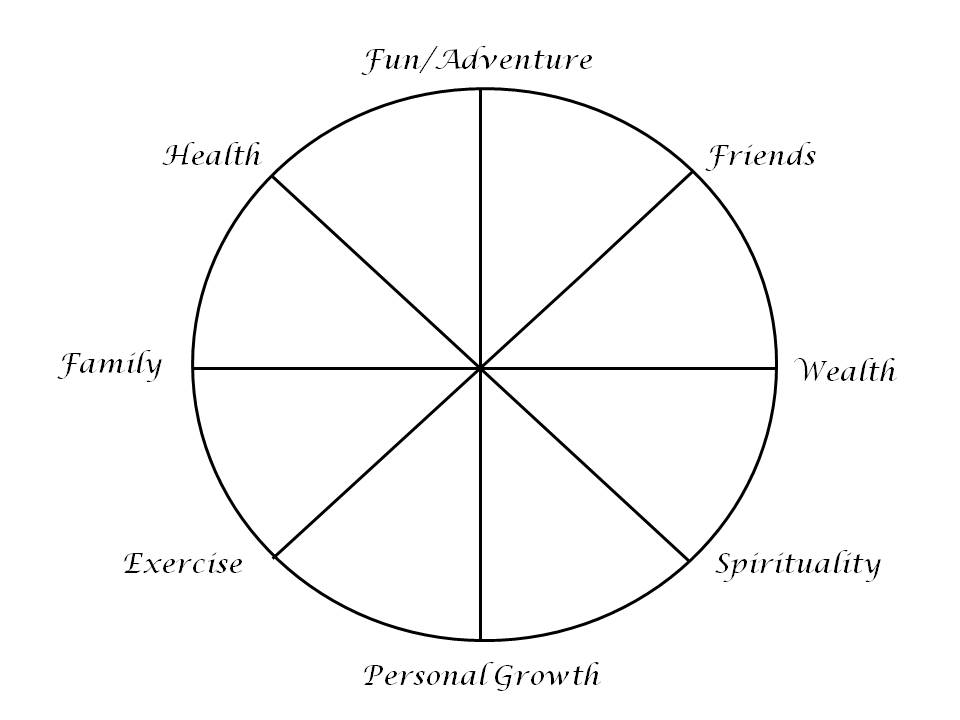
You can feel free to re-label any of the dimensions. I have simply taken the liberty of providing some of the more common ones I see in my coaching work.
To work with the Wheel, look at each dimension as though the center of the wheel represented zero and the outer edge of each "spoke" represented 100 in terms of how satisfied you are with each area.
The first step is to simply place a dot on the line somewhere between zero (the center) and 100 (the outer edge of the circle) for each of the eight elements. Take your present experience of health, for example. If you were completely satisfied with your health, then you would place the dot all the way out at the edge of the circle; if you were only 50% satisfied, then you would place the dot on the Health line about halfway between the center of the circle and the outer edge. Do that for each of the eight elements.
Once you get all eight dots in place, go ahead and connect them. You might wind up with something that looks like this:
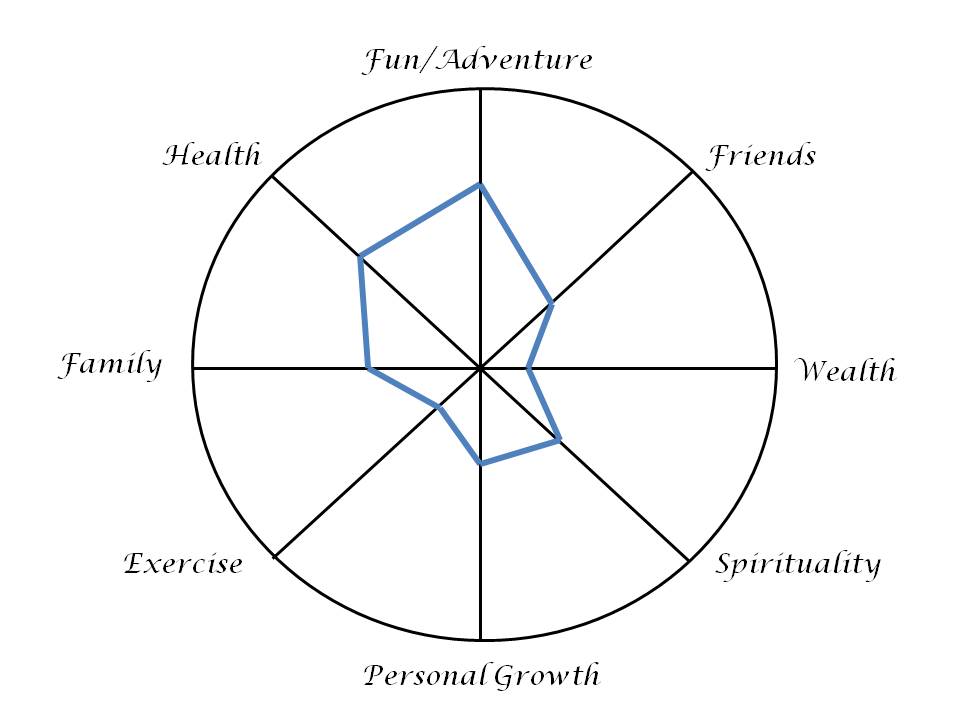
You probably can already see why we call this the Wheel of Life. If your connected dots wind up forming something pretty irregular, like the image above, then imagine this misshapen wheel were on your car or your bicycle. How smooth would the ride be? Not very!
So, what does the shape you created suggest about your life, about how smooth the journey is right now?
What does the shape of your Wheel suggest about where you place your focus? How much time and energy are you placing in the various areas? What is the relationship between focus and time spent working on the area and how much satisfaction you experience?
If you aren't placing much time or energy in one of the areas, it might stand to reason that the wheel is a little out of balance in that area. And that could be just fine with you - as long as you don't mind the bumpy ride. You could be consciously choosing to sacrifice family or friends in favor of career right now. Again, that's fine as long as you know what you are doing and don't mind the trade.
For some of us, one or more areas will be sharply lower than others, and apparently out of our control. If you just lost your job or have encountered a serious health issue, it will be more than understandable that the area is pretty low on the scale.
The real question becomes: what can you do about any one of these areas? What can you do about the relative balance of whole Wheel?
Lopsided wheels seem to be normal, regardless of economic conditions. The value of the wheel is to help you understand where you might benefit from additional focus and work. As you look toward 2009, consider what your Wheel looks like now and what you would like to it to look like a year from now.
With additional clarity on how you would like the Wheel to change, you can begin to make progress, realistic progress, in one or more areas. No matter what the state of the economy, it will still be up to you to do what you can to improve upon your current situation. The same thing goes for any other area that seems out of balance - what can you do that might make a difference? Even a small difference?
For the moment, just take some time with each of the eight areas and start imagining how you would like things to change over the next year. You don't have to have it all figured out yet in terms of how you will get there - you just need an image or vision of what improvement would look like.
Resist the temptation to dismiss this apparently simplistic advice by stating something so far removed from your current reality that anyone would dismiss the idea. If you are homeless and broke, it probably won't help to say that you want to become a billionaire by the end of 2009. However, without some kind of dream or imagination that's bigger than today, you won't find the motivation to do what you actually can do to make a difference.
Next week, we will work with the Wheel and your chosen areas of improvement, and show you some ideas on how you can go about making improvement, even if the current economic rollercoaster continues its wild ride.
After all, wouldn't it be nice to start taking some control over how you are being impacted? In the words of our President Elect, "Yes we can." And you can too!
I'd love to hear from you. Please do leave a comment here or drop me an email at Russell (at) russellbishop.com.
***
If you want more information on how you can apply this kind of reframing to your life and to your job, about a few simple steps that may wind up transforming your life, please download a free chapter from my book, Workarounds That Work. You'll be glad you did.
Russell Bishop is an educational psychologist, author, executive coach and management consultant based in Santa Barbara, Calif. You can learn more about my work by visiting my website at www.RussellBishop.com. You can contact me by e-mail at Russell (at) russellbishop.com.