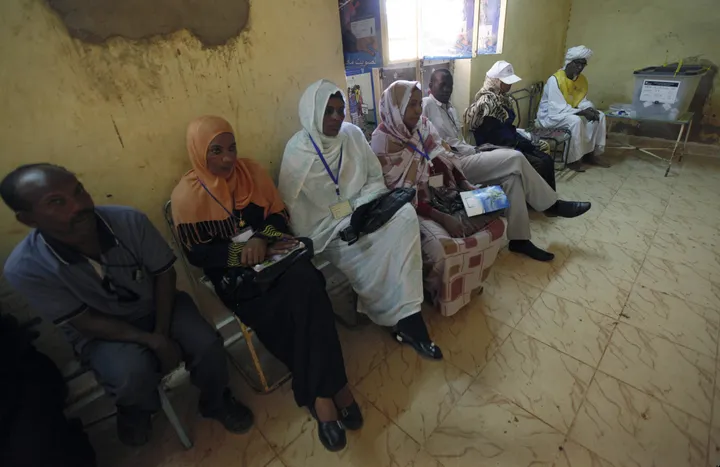
The referendum on independence for Southern Sudan has come off with minimal violence, and it seems that Sudan's president Omar Hassan Al-Bashir will accept the inevitable outcome: Southern secession. The Obama administration is rightfully pleased with how the referendum has been carried out, but this is not the time to let up. A peaceful resolution to the North-South conflict may be possible, but there are many issues that are not yet resolved, and the situation in Darfur remains unstable and threatening to those living there in camps for displaced persons. We must urge the White House to stay engaged.
Some in the West, such as the Guardian's Simon Tisdall, have proclaimed that "Sudan's rehabilitation has begun." Tisdall seems so sanguine, in fact, that he even implies that "setting the much misunderstood Darfur situation to one side," Bashir is not really the bad actor that "right-wing American" activists portray him to be.
With all due respect to Tisdall, I ask: What?
Is there anything to be misunderstood about the organized slaughter in Darfur of as many as 450,000 men, women and children, the rape of tens of thousands of women and girls, the displacement of millions and the undermining of humanitarian groups trying to get them food, water and medicine? And how should we interpret the intense and sporadic outbreaks of new violence in that area in the last several weeks?
Is genocide something we can paper over as Tisdall suggests?
I wish I could be so optimistic -- Tisdall should be commended for breaking new ground in implying that I and my activist colleagues are "right wing" -- but the facts prevent me from sharing in his premature excitement over Sudan. It is naïve to assume that Bashir's cooperation with the referendum is anything other than real politik. Indeed, the Sudanese president has plenty of reasons, besides goodwill, to play nice. Not long ago, fellow activist John Prendergast offered a few:
- The sanctions and embargoes imposed on Sudan by the West have put a dark cloud over his regime, and those who have dealt with him personally have said that he desperately wants legitimacy;
- The International Criminal Court (ICC) has issued a warrant for Bashir's arrest for crimes against humanity, which according to Article 16 of the ICC's charter can be deferred by the U.N. Security Council on a yearly basis;
- The Khartoum government has run up a 35 billion debt and has been angling to be included on the International Monetary Fund's list of Heavily Indebted Poor Countries, which would qualify Sudan for debt relief;
- If war were to break out in the South, much of the oil and Chinese investment in infrastructure could be vulnerable; and
- The U.S.'s longtime support for Southern Sudan's self determination has created a reason for Bashir to worry about a scenario where a free Southern Sudan becomes a model democracy in the West's eyes while Northern Sudan remains a pariah state. Bashir wants to create the perception that his government has its act together as well.
If respecting a previously-signed treaty that mandated this referendum can sufficiently demonstrate that he is a "misunderstood" actor, then Bashir has won. But given his track record, the bar should be set much higher. Human rights abuses must end immediately and the Government of Sudan must allow for open expression; it must welcome the growth of civil society; it must do all it can to ensure that any future elections are free from violence and intimidation; and it must stop undermining humanitarian workers and peacekeepers trying to do their jobs. Since his party's re-election last summer, Bashir's government seems to be failing on all of these counts.
According to the Sudan Human Rights Monitor, here are just a few examples:
- In early August, the government-affiliated Central Council of Journalists moved to cancel the membership of any journalist who is a member of either of the two independent unions that are far more outspoken about free press issues;
- A few days later, government officials intimidated an employers' union hall into pulling the plug on its plans to host a meeting of the Sudan Womens' Solidarity for Darfuri Women forum and a government agency canceled the forum the following week;
- Also in early-September, National Intelligence and Security Services (NISS) agents arrested two members of the Communist Party for distributing statements that objected to the increase of food prices in Eastern Sudan;
- In early-September, Sudanese authorities in the eastern part of the country confiscated and later razed a building owned by an environmental protection NGO; and
- In late-September, the NISS arrested a women's rights activist/journalist and reportedly held her without food or water for eight hours as she was interrogated about her dealings with the ICC;
- In early October, a student was arrested in Khartoum by the NISS after attending an event organized by the Student Campaign to Support South Sudan Separation. According to reports he was severely beaten, his genitals were squeezed with sharp metal objects and his life was threatened; and
- On October 27, two students affiliated with the Sudan Alliance Party were arrested by NISS agents, taken to a remote area near the Red Sea and tortured after criticizing a student union led by members of Bashir's NCP.
As the Sudanese government continues to intimidate journalists and prevent the organizing efforts of activists and civil society groups, its army continues to undermine the security situation in Darfur, which once again seems to be deteriorating. In addition to a September attack on a Darfuri village that killed dozens of civilians, an ongoing spate of isolated attacks on IDP camp leaders, and violent lootings of aid convoys by Sudanese army troops, 21 people died in late January during clashes between Darfuri rebel groups and the Sudanese army. The army has also recently raided two refugee camps without warning the joint United Nations-African Union (UNAMID) peacekeeping force -- a protocol it has agreed to follow before entering camps. It then prevented UNAMID personnel from entering the camps.
Now, even if we were to crawl under a rock and ignore one of the world's worst humanitarian situations, we would still be left with the situation between North and South Sudan. The referendum took place, people were allowed to vote, and Bashir seems to be standing by his word that he would recognize the South's independence. But how will the borders be drawn? What about the disputed Abeyei region, where the population remains bitterly divided? What will be the framework for sharing revenue from the oil fields in the South? What will be the terms for the South to use the oil pipeline, which runs through Northeastern Sudan to the Red Sea? And what will be the status of Southerners living in the North and vice versa?
These questions do not represent intractable obstacles, but there will be fierce disagreements and there is a critical need for an honest, top-level diplomatic effort to help navigate this nuanced terrain and broker a final deal. In the lead-up to the referendum, President Obama and his team proved capable of playing such a role.
Please join me in asking the White House to keep up the good work and to remain committed to peace in all of Sudan, including Darfur.