"How do you respond when you see this chart?"
That was the question Scott Reed, Executive Director of the PICO National Network, asked a room of about 25 pastors and rabbis who had gathered in Washington, D.C. for the first meeting of the new National Clergy Leadership Council.
"How does it feel to be faith leaders during such a time?" he asked.
A few people had seen this already during a presentation by Josh Bivens, an economist at the Economic Policy Institute and author of the recent book, Failure by Design: The Story Behind America's Broken Economy, but it was brand new to me. It took me, and others, a few minutes to digest what we were seeing here. One by one we commented about what we thought caused this. We tried to explain it, justify it, and rationalize it. Then Scott said something that stopped me cold in my tracks.
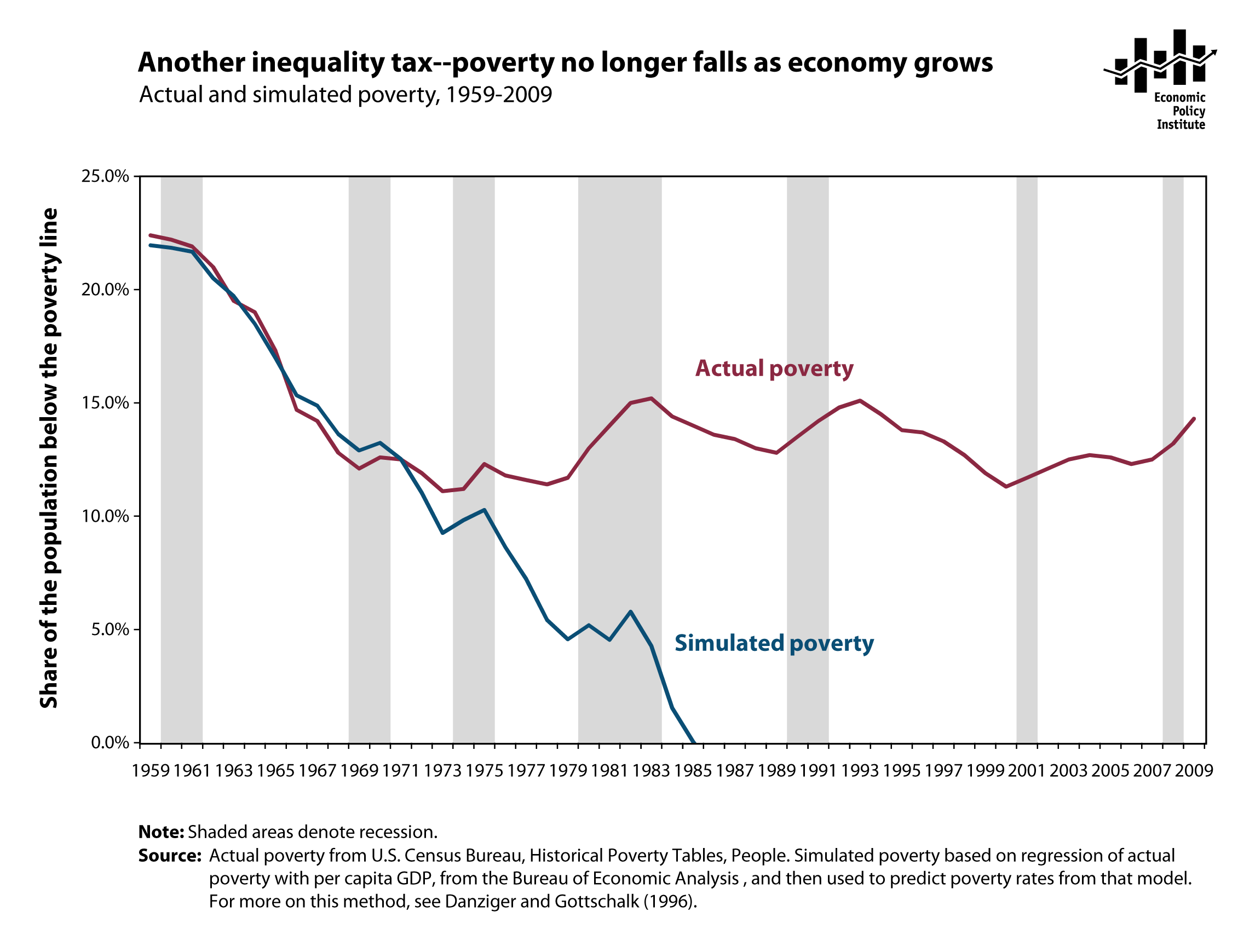
"This happened on your watch!"
Indeed it had. In fact, PICO was founded in 1972 to organize the religious community to address just such injustices in our country; at precisely the time these two lines diverge. That realization touched something in me. What had happened to religious communities during this time? Had we completely fallen asleep?
In the ensuing days since I first saw this chart, here is what it has come to mean to me.
Everything under the red line in this chart represents the economic and social pain that has intensified in our families and our communities. As a pastor I am witness to this every day, just within my congregation. Young couples unable to afford to buy a home as their parents did at the same age, college graduates unable to find work, let alone pay off their school loans, individuals and families unable to afford health care, losing their homes to foreclosure caused by unemployment or underemployment, individuals working longer hours or multiple jobs just to keep pace with an economy that has already left them behind.
This chart reveals that the economy used to work for all of us. There used to be a social contract that ensured that every person had access to the peace, security and freedom provided by fair earnings for hard work. This contract has been dismantled by years of policy making, which explicitly favors corporations and the very rich. It is no longer true that if you work hard you can afford to buy a home, send your kids to college and retire when you are 65 or 70.
More chilling still, this picture indicates that apparently a 13-15 percent poverty rate (and we all know that the real story of pain often starts at 200 percent of poverty, or more) is an acceptable threshold for our country. I think of this as the wreckage of runaway capitalism. Every machine produces waste. The 15 percent of our population that lives in poverty is just the natural consequence of deregulated, runaway capitalism, which has been elevated to our new national religion. Bivens and others are trying to tell us this is not inevitable. Not at all. We have chosen this path. Just as we chose, in the post-war years up until the early 70s, that capitalism would work for everyone.
The outrageous budget proposals being put forth by certain law makers in the past week, including dismantling Medicare, drastically weakening Medicaid, and cutting other social programs at a time when the elderly, poor and middle-class need them most, are nothing more than a thinly veiled attempt to solidify what Paul Pierson and Jacob C. Hacker call "winner-take-all politics" in their book by that name. Late Friday night lawmakers and White House officials declared they had reached an agreement on the budget. I'm afraid to look closely. I'm afraid we've learned nothing from the economic collapse of 2008 and the slow erosion of the middle class for the past 30 years. Maybe tomorrow, I'll read up on all of it. But today, I want to weep and repent.
The Hebrew prophet Jeremiah said of the politics of his day:
"Among my people are the wicked who lie in wait like men who snare birds and like those who set traps to catch people. Like cages full of birds, their houses are full of deceit; they have become rich and powerful and have grown fat and sleek. Their evil deeds have no limit; they do not seek justice. They do not promote the case of the fatherless; they do not defend the just cause of the poor. Should I not punish them for this?" declares the LORD. "Should I not avenge myself on such a nation as this? -Jeremiah 5:26-29
His words ring relevant today. Where has the moral voice of our nation been during the past 40 years? What has been the response of our religious institutions? Most of the blame falls to churches -- especially since so many are arguing for a Christian America -- but all religious institutions need to look long and hard at this question. While we've been promising heaven in the by-and-by, people's lives have slowly unraveled in the here and now. We have allowed the gospel to be co-opted to an ideology that is diametrically opposed to the vision of the Jesus and the prophets. It is time for people of faith to stand up for pure religion -- "to look after orphans and widows in their distress and to keep oneself from being polluted by the world" (James 1:27).
If you are a religious leader who is as troubled by this as I am, I invite you to become a part of this growing conversation to create a just economy that works for the poor and middle class. Don't stand aside reasoning that someone else will speak up. These dire times call for loud and clear voices.
Follow Ryan J. Bell on Twitter: www.twitter.com/ryanjbell
Poverty in the United States - Wikipedia, the free encyclopedia
Poverty Facts - National Poverty Center | University of Michigan
More Americans living in poverty - US news - Life - msnbc.com
US Poverty: Past, Present and Future | The Nation
U.S. Poverty - Brookings Institution
Poverty USA -- Catholic Campaign for Human Development -- A hand ...
Capitalism is best regulated by consumers. Government should regulate it beyond those boundaries.
Every church I have ever attended has tried to reach out to, and help, the less fortunate. Every single one of them (and I have attended many). I think that you are confusing government-sponsored programs (welfare, government housing, etc...) and church-sponsored programs (local food shelves, etc...), It is kind of silly to blame organized religion for political decisions to reduce government-sponsored programs.
Politically, I am pretty conservative and I am a Christian. Like many conservatives, I do not support most government-sponsored social programs because I believe they consistently exacerbate the problems they are meant to address. However, like most Christians, I strongly support church-sponsored programs to help those in need. I support these types of programs with my time and my money because I believe they are very effective.
I believe that most people who think like I do, do so because of the very different outcomes that are associated with government- versus church-sponsored social programs.
Organized religion because of its strong voice has a great influence on political decisions. To say you give support "because of the very different outcomes" indicates you have not volunteered in any government program. I know a county in Texas that its non-profit has just lost government money to feed home bound and senior citizens (budget reductions). The non-paid director asked the largest churches for money to feed 50 citizens and was told they needed the money for their building fund. I give to the non-profit and not that church.
Now, what can we do about it?
http://www.bls.gov/opub/mlr/2010/05/art1full.pdf
Labor costs in India’s organized manufacturÂing sector
"CompensatÂion costs in India’s organized manufacturÂing sector were 91 cents per hour for all employees in 2005; this amounted to about 3 percent of hourly labor costs in the U.S. manufacturÂing sector, but was above BLS estimates of labor costs in China..."
http://www.bls.gov/opub/mlr/2009/04/art3full.pdf
China’s manufacturÂing employment and compensatiÂon costs: 2002–06
"Both employment and compensatiÂon costs in China’s manufacturÂing sector increased rapidly from 2002 to 2006; employment increased more than 10 percent during those 4 years, to 112 million, while compensatiÂon costs increased more than 40 percent, to $0.81 per hour worked..."
The Obama administraÂtion is planning to abolish the BLS's InternatioÂnal Labor Comparison Program that produced those reports:
http://www.manufacturingnews.com/news/10/0212/BLS.html
Obama Puts BLS's InternatioÂnal Labor Comparison Program On Chopping Block
It's on page 12 of this White House document:
http://www.whitehouse.gov/sites/default/files/omb/budget/fy2012/assets/trs.pdf
TerminatioÂns, ReductionsÂ, and Savings...
The decline in proverty follows the beginning of the Great Society by only a couple of years. It seems likely that the ongonig poverty rate is due to the progressive poilicies more than capitalism.
Unfortunately, the chart does not provide sufficient data to determine the root cause. However, in no way does this chart support Mr. Bell's conclusions that capitalism is to blame.
Specific to this article, and the included chart, there is not sufficient evidence to blame Great Society programs for ending the longer term trend of reductions in the level of poverty. I think, though, that you have to agree it is interesting that poverty levels stopped declining shortly after the impelmentation of the Great Society.
I want to stress my original point. Mr. Bell reaches a conclusion in his article, based on the referenced chart. However, the data included in the chart in no way supports his conclusion.
These are darker ages than the 16th Century during the Cruzades abroad and at home since the Roaring 20's, 1929 Stock Market Crash, and the Lessor Depression.
America need to quit voting for the lessor of 2 evils and find a leader who like JFK can speak truth so clearly all must listen and act.
It is time as you say, that America live the "Establish Justice" of the first sentence of the Constitution.
http://noir.bloomberg.com/apps/news?pid=newsarchive&sid=asU.b_fCjHTE
Wachovia's Drug Habit - Bloomberg.com
Unless the financial criminals are prosecuted and punished, they will do it again. They must be have fear of loss of both money and freedom.
AbandonmenÂt of the Rule of Law can be used as an excuse for anything from vigilante justice to another attempted coup d'etat, both bad things.
http://www.counterpunch.org/nasser10032008.html
Alan Nasser: FDR's Response to the Plot to Overthrow Him
"Perhaps the most alarming slice of twentieth-century U.S. political history is virtually unknown to the general public, including most scholars of American history..."
The U.S. has worse income inequality than Egypt!
http://8020vision.com/2011/02/05/what-feeds-a-revolution/
What feeds a revolution?
"...Worth noting: The real US unemployment rate is about 16%, when considering the more comprehensive U6 Rate. The US has the highest income inequality of all the countries considered in the list above. The US ranks with Rwanda and Uganda. For more on that, see the recent 8020 Vision article When Does the Wealth of a Nation Hurt its Wellbeing?
I am glad Blow listed food as one of the metrics to consider. There is a proverb that governments ignore at their peril:
“Lo que separa la civilizaciĂłn de la anarquĂa son solo siete comidas.”
(Civilization and anarchy are only seven meals apart.)
—Spanish proverb..."
Contrary to the author's assertion that we are responsible for this current social malaise, it is the doing of key institutions and powerful players. The people though sovereign in formal terms are not the crucial players but the pawns in this absurd game. The question that the author should address is that once the fundamentals of poverty are understood from their systemic roots, where do we go from here? What are the possibilities for social change through individual initiative and the formation as well as maintenance of a political praxis?
“Never doubt that a small group of committed people can change the world. Indeed, it is the only thing that ever has."
It is incumbent upon us to consider the historical limitations in building a mass movement:
(1) organizations become established eleemosynaries or other types of endeavors lowering their sights from their original aspirations.(Trade labor movement is one example)
(2) organizations when they expand in membership and funding become fragmented -- too many players with their own agendas.(Witness the sectarianism that gave birth to a myriad of left formations in the 1960s).
(3) successes are often not repeatable. They are Utopian solutions for a target population in a specific location and thus not applicable to overall policy. (Hale House comes to mind)..
(4) when the goal is becoming a presence in legislative bodies, the focus shifts from the goal at hand to the pursuit of attaining power (Note the Murray Bukchin and Daniel Cohn-Bendit debate over Germany's Green party).
(5) if a mass movement achieves real power (i.e., majority of both houses of a legislature) then it becomes identified with the interests of the state and its hegemonic pursuits. An example would be the Thermador after the October revolution (the rise of Stalin).
This leaves the questions posted in the remarks above wide open. Any takers?
And there is no tax on annual appreciation of Stock Account, but savings account are taxed as income. Imagine that?
Then of course we can talk about income tax which is also injust, but not without the above FIRST.
Thank you so much for reporting to us on this. I am at the brink of tears every day, paralyzed by what is happening. And what's worse, I am keeping thinking how to save my skin and forget about the rest. I hope we don't grow tired and hopeless and afraid. How do you help yourself, any tips?
Samir
Samir