I wish that film and TV writers could care as much about solidarity and justice on screen as they care on the picket lines.
By going on strike, the stage and screen writers are participating in an American tradition of people joining together, recognizing their shared fate and taking action. On the streets of the picket lines, it's evident to the writers and to those of us watching that the policies and practices that affect one writer affect all writers, and the fate of our nation's creative writers affects all of us from our living room couches to the theaters.
But if you turn on your TV today or sit for a matinee at your local cineplex, you'd wonder whether it's an entirely different crop of folks holding the pens behind the scenes. After all, much of the shows and movies they write promote extreme greed, competition and the notion that we have to pull ourselves up from our individual bootstraps --- NOT that we're all in it together, in solidarity. While most of us in real life, like the striking writers, have learned that we can't succeed without the help of others around us, most reality TV shows from American Idol to Survivor tell us that the only way to the top is fierce competition against one another. Meanwhile shows like Desperate Housewives tell us that selfishness is good and there's no such thing as too much greed and status --- mind you, the same greed that is keeping the Hollywood execs from sharing the wealth with writers. And in countless movies, writers resort to racist and homophobic "humor" that helps further divide our country rather than unite us together.
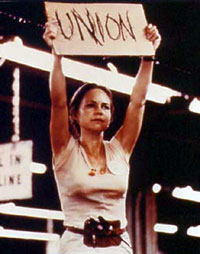
Unions are a powerful force for shared action in our country, when moneyed and elite interests trampling on the many below. But the size and power of unions has been declining in our go-it-alone, hyper-individualistic culture. Remember Norma Rae? When's the last time you saw a character from a TV show who was part of a union, linking arms with others across race and ethnicity for the shared cause of justice and fairness?
There are exceptions --- films that show how we're connected to each other across race and nationality, that show how the gap between the rich and the rest of us is ruining our nation, that show how we all do better when we all do better. But sadly, these shows are far and few between, swallowed up in our hyper-individualistic, greed-is-good, consumer culture --- the very culture the writers, together, are now fighting.
When the strike ends and they pick back up their pens, I hope Hollywood's writers will tell more stories of connectedness, equality, community and solidarity that will help create a better future for all of us --- including the writers themselves.
Sally Kohn is the Director of the Movement Vision Lab
Read more about the strike on the Huffington Post's writers' strike page.
Want to reply to a comment? Hint: Click "Reply" at the bottom of the comment; after being approved your comment will appear directly underneath the comment you replied to
.
The WGA has given TV executives and TV viewers a GREAT opportunity. The best TV shows ever were made during the 50's, 60's, 70's and 80's. Bring them back. Ernie Kovacs, Steve Allen, Mary Tyler Moore, The Dick Van Dyke Show, Jack Paar's Tonight, Sid Caesar, The Bob Newhart Show, Johnny Carson's Tonight, The Wild, Wild West, The Jack Benny Program, That Girl, The Avengers, Carol Burnett, Sonny and Cher, Jackie Gleason, Kraft Television Theater, Studio One, Philco Playhouse, Playhouse 90, Armstrong Television Theater, Rowan & Martin's Laugh In, The Ed Wynn Show, The Saint, The Rifleman, Knight Rider, The Six Million Dollar Man, Mission Impossible, Superman, and on and on. Nothing created since even comes close (except Seinfeld). Make these classics the new stable for prime time TV on all networks. Bring back the best TV ever produced - and everybody wins, both young and old. After several months of seeing these classics, maybe, just maybe, the standard for acceptable TV will increase from its current toilet-level.
.
On the screen would be great - "Roseanne" really the last mainstream entertainment that spoke truth to power, did so more so than I had remembered; startled me when watching it again in reruns on Nick at Nite maybe a year back. But those characters are near invisible in today's television landscape which has turned almost exclusively to upper middle class concerns (I vainly wish that everyone in TV would spend more time figuring out what we're gonna do when Bill Moyers doesn't do the marvelous things he does anymore, but, I pray that's far off in the future). But hey, solidarity on the streets would be good too. The WGA crossed Teamster picket lines without so much as blinking an eye during the Teamster strike some years ago. When the janitors struck studios a coupla years back, there was no flurry of posts to any nationally read blog I could recall, certainly nothing even on the WGA website. The janitors merited one or two callous jokes in writer's rooms about how the trash cans were going to get cleaned out, but were otherwise invisible. In fairness, both examples pre Mr. Baitz's Hollywood tenure; but unfortunately, the institution has not proved more noble than the sum of its members, and has, of late, not shown any interest in reciprocating.
Blaming the writers for what turns up on film screens is a bit like blaming Santa Claus for what happened during Hurricane Katrina. The Networks & production company executives are the ones calling the shots about what topics are and aren't off-limits, and which shows get picked up to go on television. These executives all work for massive corporations, and they're not going to rock the boat by producing film & tv about average folks rebelling against the system or going out on strike -- they don't want to get fired and pilloried by the Fox News Channel.
Isn't Desperate Housewives supposed to be a *dark* comedy? Meaning, isn't it supposed to parody selfish suburbia? I don't think it's about supporting this way of life; it's about holding up a mirror to the viewer.
In fact, any good movie/show that shows greed, extreme competition, bigotry effectively puts a mirror up to the public. And the villains usually get their comeuppance. After all, what is a "Hollywood" ending without them? Even the more indie fare may not have that happy ending, but should leave the audience with a sense of unease. Believe me, writers have a conscience about what they are putting on paper. It's really a reflection of the viewer on whether the interpretation is positive or negative.
I am absolutely on your side, jonrobin (and I love your show and am going to miss it)--but the lady has a point.
How many people out there on that line (the ones who aren't starving) sold their souls to get their shot at Hollywood? And what kind of karma do you have when you are complicit in feeding a mindless audience hours and hours and hours of idiotic violence and vapid situational comedy for the purpose of making money, all the while dumbing down the nation?
I want you to win this, and then I want you to stand up and tell those pimps in the studios what you will and will not do as artists. Think about the writers in the 30s who made such a difference to the public consciousn
Writers have a responsibility to humankind. Yes, they should be paid equitably, but they should also be respositories of honor and truth and class. I don't think it's too much to ask that you draw the line at destroying civilization for the bottom line and a bunch of tasteless studio overlords. You have rare gifts--don't pour them out for nothing.
We write them. They just don't buy them. Go Mighty Writers!!
So do I. So do I. I had no idea how hard it could be, coming from the theatre - no idea - particularily on network television, which is fueled by fear, and ratings. On Brothers & Sisters, the show I created and am exec. producer on, we have done one thing I AM proud of - insisted on the notion that hetro and homosexuality have parity in the America of today, an idea which the audiences seem to like. We try to talk about our war and our politics. Not easy. And we follow Desperate Housewives, and the mandate (sensible) is that we hold onto that audience. Ok. The fight for content in that arena is one thing, and it has been better fought by Norman Lear and Aaron Sorkin for instance than me, thus far.
But it's not the point, and you know that. There are so many people out there who have so little, out there on the picket lines. Right now. People I love who have not earned any money in two or three years, but have been living on savings while writing. This fight is about the future of how they and many others will live and be paid for their work in an emerging electronic market. It is bad enough that the labor movement fills Americans with terror today, but to be lectured by someone who knows the dimensions of the problem - not today, ok, please - not today, no scolding and moral superiority. I take the point, but my feet are tired, and I have a very long way to go until this is over. The right thing for you to do is express support.
And frankly, I suspect that you know that. Wanna talk about how crappy TV is and how apolotical movies are - maybe as more and writers have more and more control in this new marketplace, and work outside the system -- they will be emboldened. But for now, a simple "I am on your side", will do.
Posted November 9, 2007 | 12:10 PM (EST)