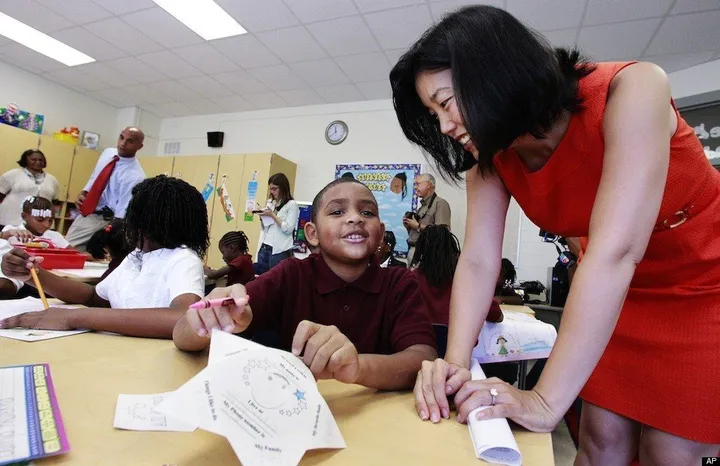
Like everyone else who does education for a living, I read that Michelle Rhee is launching a new national advocacy organization, Students First. And after checking out the site and hearing how she articulates its purpose, I see some reasons to feel hopeful -- and many more reasons to feel deeply concerned.
First, the good news: It's hard to argue with Rhee's four "we believe" statements for the organization. Who doesn't believe all children deserve great teachers? Who would argue with the idea that students should not need luck to get a good education? Why not start allocating public dollars where they can make the biggest difference? And who would deny the need for more parental involvement and increased efforts to engage the entire community? So let's all hop on the Rhee express, right? Well, maybe.
It's also clear Ms. Rhee understands which advocacy efforts have been most successful and what sort of work we might therefore expect from Students First: "From the National Rifle Association to the pharmaceutical industry to the tobacco lobby," she explained in the Washington Post, "powerful interests put pressure on our elected officials and government institutions to sway or stop change. Education is no different. We have textbook manufacturers, teachers' unions and even food vendors that work hard to dictate and determine policy. The public-employee unions in DC, including the teachers' union, spent huge sums of money to defeat Fenty... but there is no big organized interest group that defends and promotes the interests of children."
To this end, Rhee intends to build an army of one million supporters and raise a total of one billion dollars -- in a year. Clearly, this is not someone unwilling to think big and in that sense, all of us need to match her sense of urgency and passion.
The danger, however, is if that urgency, passion and power gets deployed in the service of a myopic set of well-intentioned, misaligned ends. And based on what I can see from the website and gauge from her interviews, Michelle Rhee still believes the current way we're evaluating the success of our students, teachers and schools is sufficient for the brave new world of education she hopes to help usher in.
As I have written many times previously, I am not suggesting our current measures of school effectiveness -- third and eighth-grade basic-skills reading and math scores -- are irrelevant. Basic skills literacy and numeracy matter greatly, and we should take note when, as was recently reported, the latest international comparisons on these metrics reveal we remain, despite all the efforts of the past decade, either average or below average in every significant category.
At the same time, these reports should stop surprising us. The deeper problem, counterintuitive though it may seem, is that the more we focus on test scores -- and focusing on test scores is a core message of Rhee's particular brand of advocacy -- the less likely we are to improve the quality of our public schools.
What we are doing is falling in love with the illusory allure of removing the thermometer, dipping our head in ice water, retaking our temperature, and declaring Mission Accomplished. What we need is a different vision for the future -- one that takes the best aspects of our increased emphasis on measurement and data-driven decision-making, and also reconnects us to the deepest truths about powerful teaching and learning -- that it is relational, individualized, non-linear, and a pathway to the development of the higher-order skills we all need to feel successful in college, our careers, and our lives.
Consequently, I wish Michelle Rhee would use her influence to help a million Americans urge their elected officials to pass policies that will usher in a new era of school improvement, one that is grounded in three core conditions:
If Rhee urged us all to help ensure that those conditions were met, I'd feel less concerned about some of her other objectives. Teachers would have more meaningful information about the extent to which they were (or were not) creating optimal learning environments; parents would have more useful information to consider before choosing a school for their children; and policy makers would (perhaps!) start to develop a more nuanced understanding of education and (perhaps!) embrace the paradoxical, creative tension that undergirds the learning process: on one hand, it can never be reduced to a few numbers or a set of techniques; and on the other hand, it can still benefit from a fuller focus on measurement, school improvement, and mutual accountability.
Help us advocate for those things, Michelle, and then I agree we'd be working together to create a system that, truly, puts students first.
Follow Sam Chaltain on Twitter: www.twitter.com/samchaltain
Sabrina Stevens Shupe: How Do Successful School Systems Treat Teachers?
Holding students hostage while the adults argue
Fanned
Do you really think there should be less emphasis on rote memorization? Do you really think the US educational system has that much of an emphasis on it? I am not mitigating the need for creative, expansive thinking. Compared to the educational systems in other countries, we are at the forefront of this type of thought.
When we have students in middle school who still cannot do basic multiplication, or high school students who do not understand how to subtract negative numbers, how can you possibly state that rote memorization should count for less and less? If this is the current state of schools, how can you expect students to develop higher-level thinking processes if they cannot grasp the basic fundamental requirements needed in education?
I know you are a former history teacher - and I'm not saying that students should remember the date which World War I started. But when only 25% of Oklahoma high school students can name the US' first president (http://www.news9.com/global/story.asp?s=11141949), we clearly have a problem in rote learning. For children, the development of rote memorization is needed before other thinking skills can be developed - students must be able to identify what information is pertinent and what is not. They must be able to develop priorities, study skills, and learning habits, but all of these cannot be done if they do not even know how to memorize basic information.
Thanks for taking the time to write. I'm not arguing for an eradication of rote memorization, precisely for the excellent points you bring up. I am arguing for balance in our system, which we sorely need, and which, I contend, would create more learning environments where teachers are both skilled and empowered to engage kids in a number of different ways. I am confident from what I have seen first-hand and learned from other countries' approaches to this same riddle that if we did that, we'd see improvement in both the sorts of foundational rote learning information you speak about, AND the higher-order thinking skills that can put that learning to optimal use.
http://www.seedfoundation.com/index.php/about-seed/beliefs
and
Michelle Rhee could not possibly work with teachers because she does not respect them.
She will fade away, just like other PR packages have over the years.
People have started hundreds of these on-line groups that StudentsFirst members can join. I didn't think my little application was a big deal.
In the brief proposed mission statement, I said that if we truly aim to put learners first, then the first thing students need are quality teachers. Nobody disagrees -- quality teachers are the key to maximizing student achievement, and nobody mistakes the value of an effective educator. I said A.C.T. was dedicated to accountability and rewarding people strictly in accordance to their value in the learning process.
Having never stated any direct objection, my application to be one among hundreds of their little online groups has now been placed in permanent "pending" status.
Who does Michelle Rhee plan on giving that billion dollars to? Bureaucrats, fund-raisers and political lobbyists? Those folks have nothing to do with success in the classroom. I can tell from their reaction to my little group that StudentsFirst is doomed to failure.
Again, thanks and fanned!
http://www.examiner.com/ward-5-in-washington-dc/dcps-chancellor-michelle-rhee-talks-about-taping-students-mouths-video
http://www.washingtonpost.com/wp-dyn/content/article/2010/12/11/AR2010121102836.html
It would encourage more to do this, like a Peace Corps BUT it would be for Education. The biggest part of the problem is we place more value on how someone throws a football, or looks on TV or their "talent" (as in American Idol...and other 'reality shows') instead of learning. Face it, we have a high anti-intellectual problem in this country, that needs to change as well.
Yes, I could also address the expectations of WHO would go to school, for what, and how long. But that is another treatise.
I am an excellent teacher. The student teaching program I was part of was great. 95% or more of the teachers I worked with were very good or excellent.
I have an idea you have very limited or no experience observing teachers at work.
How can we legitimately expect to hold all public schools to the same standard of academic performance if we are unwilling to fund all public schools in equal measure?
If that constitutes not "getting it," then count me guilty.
with a 250 word limit this is difficult. first one must come to understand two things. systems and variaition within those educational systems. then one must discover the special causes and systemic causes of variation with that educational system you are measuring.
pay for performance based on test scores is a cop out and profound ignorance on so many levels. leadership is more than the carrot and stick approach. we cannot buy our way out of this crisis.
http://www.ihi.org/Ihi/Files/Forum/2005/Handouts/A12B12AConversationwithDrDeming.pdf
this above link is a good start. when I posted it before no one commented on it so I take it no one read it. paradigm paralysis thing.
It will show quick results, which Americans love, then over time it will create the same results as we have seen on Wall Street and our banks. Teachers are but one significant variable of many in the educational process. Pay for performance treats them as the only significant variable.
Now some teachers may indeed be a special cause of being an outstanding teacher so their approach needs to be studied to see if their knowledge can be used throughout the system. This takes time, patience, and knowledge of how to analyze that data. Americans want it now; yesterday if possible and pay for performance has the ability to appear to give quick results.
I.e. teachers learn to teach to tests, fudge data, etc. the human mind has unlimited potential of how to beat the system.
Pay for performance has a fundamental flaw. It uses average as an evaluation point and those teachers below average are told to shape up or ship out. No matter how good the results there will always be half of the teachers that are told to shape up as they are “below average” in their performance. This is demoralizing and creates an atmosphere of fear and distrust and profound stress and eventually fudging the data to save their jobs.
Education takes into account the aesthetic, the ethical, the scientific, and the technological among other things ....
You are looking at a post-positivist model which is just one limited model of understanding curriculum, pedagogy, and praxis ...
She is not an educator, she was a teach for america volunteer for 3 years ... she is a self-serving egotist. Her work at DC public schools got her fired .... also did she put students first by protecting her boyfriend from child molestation allegations?
She is nothing but a neoliberal liar ... seeking to destroy public education for profit ... and her own profit at that.
As for Teach for America volunteer, I consider that a plus. Some of the best and the brightest from the top schools in the country are doing this -- because they care. And neoliberal liar -- that's just idiotic, so I'll ignore it.
http://www.examiner.com/ward-5-in-washington-dc/dcps-chancellor-michelle-rhee-talks-about-taping-students-mouths-video
http://www.nbcwashington.com/news/local-beat/What_Was_Michelle_Rhee_s__Damage_Control__for_Kevin_Johnson_-70647202.html
http://www.annenberginstitute.org/vue/summer09/Darling.php
Scroll down to the paragraph that states: Indeed, there are no external standardized tests used to rank students or schools in Finland, and most teacher feedback to students is in narrative form, emphasizing descriptions of their learning progress and areas for growth (Sahlberg 2007). As is the case with the National Assessment of Educational Progress (NAEP) exams in the United States, samples of students are evaluated on open-ended assessments at the end of the second and ninth grades to inform curriculum and school investments. The focus is on using information to drive learning and problem solving, rather than punishments."
Teachers and students engage in what is known as action research (or teacher as researcher) etc etc etc ...
High stakes testing is an industry ... it has little to do with accountability but, a heck of a lot to do with accountancy (enumeration and indeed capital) ...
There are all kinds of ways to access students that are not from high stakes tests (which only test the test and have nothing to do with learning or knowledge ... ) student progress can better be evaluated through portfolios, and other measures ....
Until we are willing to address the nation's shameful "haves" and "have nots" economic model - one that showers $$ upon affluent schools and leaves others to fail, then there is no legitimate way to hold all public schools to the same standard of academic performance.
My enduring goal is that my students nurture their natural curiosity and that they view themselves as learners. My students have made AYP for the past 6 years but I was happier to see them checking out nonfiction books at the library that dealt with topics that we had covered in class... They were inspired and wanted to learn of their own volition, and that is what I consider to be academic success, the likes of which Rhee never realized during her 3 year stint as a novice teacher.