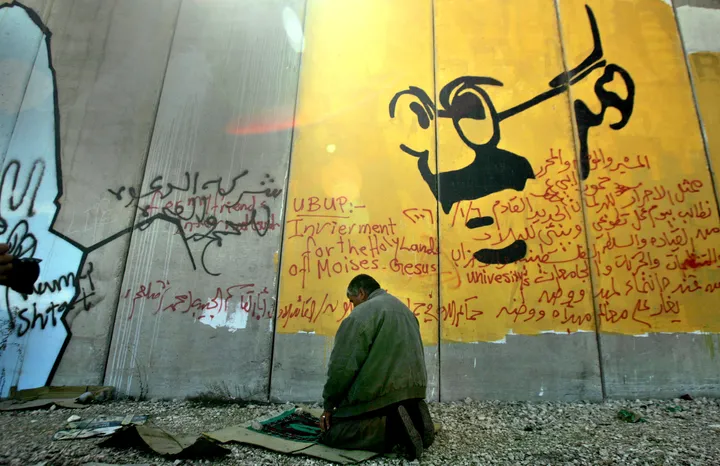
I was 12 years old when I was introduced to Gandhi. My uncle Mubarak returned from India with four big heavy boxes filled with books. All same size and shape with warn-out green covers. These books included all the writings of Gandhi. They filled two book shelves, double the space taken by the Encyclopedia Britannica. What attracted me in the boxes was a comic book of the story of Gandhi from his childhood to his death. I read the comic book over and over. At a young age, Gandhi became a comic book hero.
Gandhi became a real hero through the work of Mubarak, who started the Palestinian Center for the Study of Nonviolence in Jerusalem. Mubarak traveled from one Palestinian village to the other promoting nonviolence in the same way Gandhi did in India. As he spoke of Gandhi, he never said we need to do what Gandhi did; he emphasized the uniqueness of our own heritage, culture and condition under Israeli occupation and how we were to develop our own approaches to nonviolence and not copy others. In 1988 Mubarak Awad, who became known as the "Palestinian Gandhi," was arrested and deported by the Israeli authorities.
Over the years I continued to study Gandhi, reading more of the big green books that now sit on two shelves in my office in Bethlehem. I have also traveled to India twice. Once with Arun Gandhi, the grandson of the Mahatma, and the second to participate in a conference to commemorate the century celebration of one of Gandhi's most famous writings, Hind Swaraj. There I was honored to give a talk in the presence of His Holiness the Dalia Lama.
As a Palestinian, there are many lessons learned from Gandhi. One important lesson was in seeing nonviolence not only as a tactical and pragmatic tool of resistance but also as a holistic and spiritual approach to life and living. Gandhi was not only passionate about ending the British colonial rule of India, he was also passionate about uprooting the cause of violence in every aspect of one's life and relations. This is not easy for people who live under daily suffering and oppression, but in my work in nonviolence in Palestine, I now believe that my own liberation as a Palestinian is not only about ending the Israeli military occupation, but also about addressing all aspects of violence -- be they political, social, economic or environmental. Nonviolence is not a tactic to be taken out of the box when it seems fit to use. It is a way of life.
Another important lesson I learned was in understanding that nonviolence is not mere passivity, and it is not surrendering to the powers that be. "Nonviolence is the most active force in the world." For Gandhi, nonviolence is bravery -- that "no matter how weak a person is in body, if it is a shame, he will stand his ground and die at his post. This would be nonviolence and bravery."
Nonviolence is about creating tension, confrontation and standing for ones justice by exposing the injustice of the other. Gandhi called for mass protests, demonstrations and boycotts. He challenged directly the structures of oppression without insulting or demonizing those who were the oppressors. This was an important lesson for me as a Palestinian: to engage in activities that expose the injustice of the Israeli occupation without insulting a single human who belongs to the system of oppression. Gandhi took this one step further by also explaining that in creating such tension one should never lose vision and purpose. So often I find myself caught in the action where it becomes the means and the end, forgetting that there is a greater purpose to keep my eyes on.
Another important lesson I learned from Gandhi is that nonviolence is the expression of the power of love and compassion. He said that "it is nonviolence only when we love those that hate us. This is the grand law of love." If my engagement as a Palestinian in nonviolence does not have in it the expression of love to those that hate and persecute me, then I cannot call such actions "nonviolent."
Gandhi was not a saint; he experienced daily struggles and challenges in his work and life. He probably made more mistakes than any other leader of his time, but he woke every day fully committed to ending violence and bringing about real peace and he knew that such transformation would not take place until he committed himself to being the change he wanted to see in the world. This is the greatest lesson I have learned as a Palestinian: to be the change that I want to see take place, not only in Palestine and Israel but in the world.
I will be in Washington, D.C. participating in Global Voices of Nonviolence on Sept. 21. This event is hosted by Catholic University of America and EthnoGraphic Media. You can participate from anywhere in the world online through Beliefnet. To find out more about this event visit LittleTownOfBethlehem.org
Follow Sami Awad on Twitter: www.twitter.com/Sami_Awad
Paul Brandeis Raushenbush: Celebrating Gandhi's Birthday by Imagining Nonviolence in the Middle East
Palestinian nonviolence: Is the Budrus model still viable ...
Palestinian nonviolence relies on global non-silence | Yousef ...
Israel and Palestine: Here comes your non-violent resistance | The ...
Budrus: Shooting the Palestinian Gandhi | Change.org News
BBC News - Budrus: A Palestinian story of non-violent protest
1: WHO will guarantee that an independent Palestine will not be used as a staging area for attacks on Israel?
2: WILL the Palestinians actively promote peace and non violence against Israel and help Israel defend itself from other Arab/Islamic terrorist?
I think you can see where all my questions come from and can anticipate additional ones yourself...
http://www.washingtonpost.com/wp-dyn/content/video/2008/06/27/VI2008062703016.html
If you lie down with dogs, you will wake up with fleas, and everyone knows what eventually happens to fleas.
"Non-violence means co-operation when it is possible, resistance only when it is not."
That has changed every aspect of my life. It changed how I dealt with the school during IEP meetings for my son, how I deal with neighbors that are difficult and even how I deal with my sons and husband. It made me a better person as well. It means I have to look for ways we can find agreement BEFORE I go off on a tangent. I have to look for areas of agreement when I get mad about something. I have to look for areas of agreement when I have to deal with my sister-in-law. I don't always succeed, but at least I try. Knowing how much it changed MY life, I am sure this same change is part of the writer's life as well. I hope someday we ALL learn to live with non-violence in our hearts. Our children's world will be better for it.
2nd ONLY to GANDHI IMO, but I do not compare 10 to 9.99 or 10 to 7.5 for that matter
I agree with everything, except "Gandhi was not a saint; he experienced daily struggles and challenges in his work and life"
Many Saint have real jobs, work in business and like Gandhi work in politics.
So many think Christ taught to be a WIMP and Float Away into Spirit. No Buddha, Krishna and Christ taught each person to become SPIRIT but bring that AWARENESS of Spirit back into you PHYSICAL MATERIAL world until the Flesh died and the SPIRIT SHINNED ON
Buddha's final stage Nirvanna was Krishna's Samadhi and Christ's Revelation
All becoming the ONE SPIRIT of the Universe.
Obviously you are not there yet. Not being personal at all
"arhat, (Sanskrit: “one who is worthy”) , Pali arahant, in Buddhism, a perfected person, one who has gained insight into the true nature of existence and has achieved nirvana (spiritual enlightenment). The arhat, having freed himself from the bonds of desire, will not be reborn.
The state of an arhat is considered in the Theravada tradition to be the proper goal of a Buddhist. Four stages of attainment are described in Pali texts: (1) the state of the “stream-enterer”—i.e., a convert (sotapanna)—achieved by overcoming false beliefs and doubts regarding the Buddha, the teaching (dhamma), and the order (sangha ... (100 of 309 words)
Very few spiritual Masters have achieved this state. For sahaja samadhi, the Supreme's infinite Grace is required. Sahaja samadhi comes only when one has established inseparable oneness with the Supreme, or when one wants to show, on rare occasions, that he is the Supreme. He who has achieved sahaja samadhi and remains in this samadhi, consciously and perfectly manifests God at every second, and is thus the greatest pride of the Transcendental Supreme."
The author is lying when he says this. As his Holy Land Trust website makes clear, the organization considers all of Israel to be occupied territory. It says, "We recognize that the Palestinian people are experiencing the repercussions of 60 years of occupation". In other words, the Trust denies Israel's right to even exist. Therefore any mention they make of wanting to work with Israel is at best disingenuous.
I have also read Gandhi's collected works. He said that lying, such as the author is doing here, is committing violence against the Truth; and, to Gandhi, Truth is God.
However, returning to your point, most Israelis by far favor the two state solution, and are afraid only that they will not get an end to the conflict with the establishment of a Palestinian state in the WB and GS. A non-violent campaign (i.e., one that is solely non-violent, not one mixed with terrorism) would, in my opinion, do much to convince them otherwise.
The first palestinian intifada was primarily a non-violent, civil disobedience movement that met extremely violent response from the Israelis.
So before you demand non-violence from the Palestinians, let's put things in proper perspective.