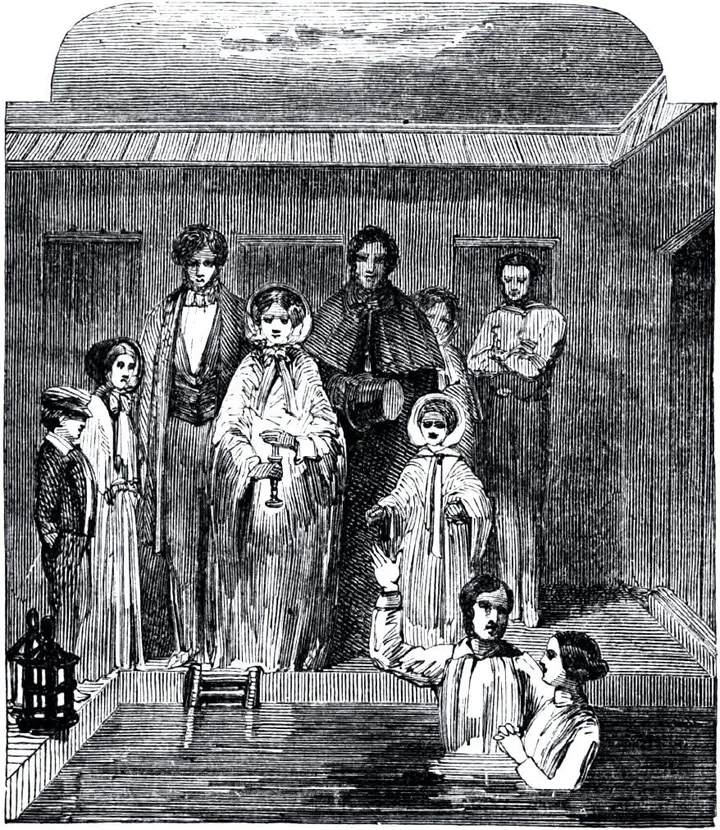
Mormons are known for many things, from their love of corporate attire and organization, to their almost uncanny cheeriness, to their scandalous history of polygamy. They are also known as the chief sleuths of genealogy in the modern world. There is a purportedly dark side to their interest in the personal side of world history: the rituals performed for deceased individuals identified through genealogical research. Best known among these rituals is a version of the familiar Christian rite of baptism. Called "baptism for the dead," Mormons have performed such baptisms since their founding prophet introduced the practice on the banks of the Mississippi in the early 1840s. In this rite, Mormons receive baptism "for and in behalf of" a deceased individual and are themselves immersed, just as they were at their own baptism into the Mormon Church.
In one caricature, Mormon baptism for the dead is merely the bizarre extremity of the proselytizing juggernaut of the Mormon missionary program. Even if you managed to turn down those boys in white shirts and black name placards in life, this caricature goes, they will have their way with you in death. There have been more extreme caricatures over the years, including the stunning and idiosyncratic claim that Mormons actually immerse corpses, but by and large outsiders have seen the practice as a strange and insensitive expression of Mormon exclusivism. In context, though, this ritual has rather different meanings.
Mormon baptism for the dead is at least two things.
First, it is a solution to what some scholars call Christianity's "scandal of particularity." By this they mean that Christianity claims that salvation comes only through Christ. If that is true, though, what about those who had no conceivable way to hear of Christ, let alone to confess him? What justice is there in a Gospel that arbitrarily denies heaven to people merely by token of their place of birth? Joseph Smith and his Latter-day Saints answered emphatically, "None." The Mormon solution to the scandal of particularity was not that Christ is unnecessary, but that Christ can be brought to everyone in the afterlife. While the notion offends many modern ears, the solution has a sort of ambitious coherence.
Second, baptism for the dead is a reflection of early Mormon ideas about the nature of family and human relationships. Though in the 20th century Mormons emphasized a more Victorian interpretation of these beliefs, early Mormon beliefs about family were stunningly universal. The family of heaven encompassed essentially every human being in early Mormon belief. Mormons understood baptism as the mechanism by which individuals were adopted into that vast family of heaven. On this view, baptism for the dead represents the hope that all of humanity will be united in the afterlife as one harmonious family. Mormons, rather than looking down at the damned with pious glee, are exploring every possible avenue to get the supposedly damned into heaven. That they employ the very physical rite of baptism to unite the human family reflects more than anything the assiduously literal and physical bent of Mormon thought.
With this context -- baptism for the dead is fundamentally inclusive and universalizing in conception -- it is little wonder that the Latter-day Saints would perform baptism for all the dead whose names they manage to uncover in the world's archives. This enthusiasm, mixed with historic insularity, has led to controversial episodes in which Latter-day Saints have performed baptism on behalf of Jews, including victims and survivors of the Holocaust. While the chastened LDS Church eliminated the entries of such individuals from their records and forbade further such baptisms, a trickle of individual Mormons -- with more enthusiasm for their own religion than empathy for a people for whom forced conversion is a bitter thread in a long history of brutal religious intolerance -- have continued to perform intermittent baptisms on behalf of the Jewish dead.
Mormons have protested that their rite does not convert the dead, it only facilitates such conversion should the dead choose to accept it. They emphasize that they see their rituals as enabling rather than restricting choice. Debates over the Mormon practice of baptism for the dead demonstrate a lack of empathy -- the capacity to imagine the world as the other group does -- on both sides. Mormons have not always understood why their explanations do not satisfy critics. Latter-day Saints should strive harder to understand where and when their answers are not persuasive. They would do well to consider what forced conversion has meant for Jews over the centuries. On the other hand, outsiders would do well to try to imagine the universalist impulse underlying Mormon baptism for the dead.
Baptism for the dead - Wikipedia, the free encyclopedia
Elie Wiesel calls on Mitt Romney to make Mormon church stop proxy ...
Mormonism's Baptism for the Dead | Catholic Answers
Mormon church apologizes for proxy baptism of Wiesenthal's ...
by Chimamanda Ngozi Adichie
by Ramona Ausubel
by Helene Wecker
Published on April 23rd, 2013
By Kate Atkinson
dont think you explained THOSE ones there partner
======================================
http://en.wikipedia.org/wiki/The_Nine_Billion_Names_of_God
To believe that, you have to believe that God has no way of dealing with silly human issues such as what do do about people who died, for example, before Christ's birth.
http://mormoncurtain.com/index.html
A site where you can see what ex-Mormons have experienced.
Have they also gone into the Vatican and baptised Pope John Paul II, Peter and all the Saints so that they may have the chance to see the light and hear the "true faith"?
Jewish leaders were assured that this baptism of proxy would stop. Hindus also say leave our people alone. Catholics say leave our people alone. I do not believe that most people understand that no, they are not simply "praying" for people, they are going through the actual submersion of a person who has taken the name of the person they are trying to show the true way to salvation.
Don't you think that God accepts his children to him? You do one kind thing in your life and you are going to be saved (Fr. Rock, SJ, my priest).
Glad I have my locked gate and they can't get up here to knock on my door to attempt to convert me. Some of my neighbors are not so fortunate and they are relentless in their going boldly after people.
When we lived in Saratoga, two missionary young men came to give me the word. I told them up front that I was Catholic and happy in my faith. They came back with, "but, when you die, don't you want to be in Heaven with your husband?" to which I replied, "I believe that when we get to Heaven, we will be like the angels and saints and there won't be any need of the husband and wife thing." They never came back. Thank God.
Who cares if the Mormons are practicing a particular rite meant only for a deceased person's benefit?
I am hugely critical of Mormon belief and doctrine, but this means absolutely nothing.
also duly noting 'rediculous' is another insult, you are busted and neutralized.
People's connection to their personal religious beliefs are quite strong whether they are a Christian, Jew, Muslim, Hindu, agnostic or atheist. Their attitudes shape who they are and how they present themselves to the world.
For Mormons to, without the consent of the individual, use that persons' name and identity for their own religious purposes is nothing short of spiritual identity theft. They show no respect for the person or their religious beliefs and are, pardon the pun, hell bent on using that person whether they want to be used or not. More than once I have heard Mormons say, "What do you care? If you don't believe in it, it doesn't matter."
The reason it matters is IT'S UNAUTHORIZED USE OF A PERSON'S IDENTITY! It's like saying, "Why do you care if I use this person's Social Security number." They don't have the right.
My personal religion has been important enough to me that I have taken beatings from loving members of other religions because of it. I don't appreciate the idea that I have to deal with the idea of someone hijacking my information for their own purposes.
Eccl. 9:6: “Their love and their hate and their jealousy have already perished, and they have no portion anymore to time indefinite in anything that has to be done under the sun.”
Isa. 26:14: “They are dead; they will not live. Impotent in death, they will not rise up.”
So the LDS can spin their wheels all they want, the fact is it's a waste of energies!
Gen. 3:19: “In the sweat of your face you will eat bread until you return to the ground, for out of it you were taken. For dust you are and to dust you will return.”
Eccl. 9:10: “All that your hand finds to do, do with your very power, for there is no work nor devising nor knowledge nor wisdom in Sheol [“the grave,” KJ, Kx; “the world of the dead,” TEV], the place to which you are going.”
What is the condition of the dead?
Eccl. 9:5: “The living are conscious that they will die; but as for the dead, they are conscious of nothing at all.”
Ps. 146:4: “His spirit goes out, he goes back to his ground; in that day his thoughts [“thoughts,” KJ, 145:4 in Dy; “all his thinking,” NE; “plans,” RS, NAB] do perish.”
John 11:11-14: “‘Lazarus our friend has gone to rest, but I am journeying there to awaken him from sleep.’ . . . Jesus said to them outspokenly: ‘Lazarus has died.’” (Also Psalm 13:3)
Is there some part of man that lives on when the body dies?
Ezek. 18:4: “The soul [“soul,” RS, NE, KJ, Dy, Kx; “man,” JB; “person,” TEV] that is sinning—it itself will die.”
Isa. 53:12: “He poured out his soul [“soul,” RS, KJ, Dy; “life,” TEV; “himself,” JB, Kx, NAB] to the very death.” (Compare Matthew 26:38.)
part1