
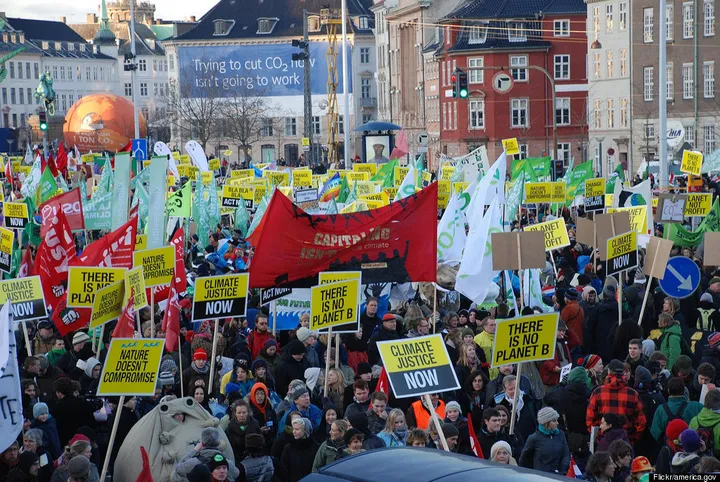
An earlier version of this article is cross posted on The Tyee, "B.C.'s Home for News, Culture and Solutions."
On Saturday, after the first week of the UN Climate Conference in Copenhagen, Connie Hedegaard, president and chairwoman of COP 15 (and Denmark's minister of climate and energy), and Yvo de Boer, executive secretary of the United Nations Framework Convention on Climate Change (UNFCCC), responded to questions on the relative progress of the climate negotiations.
During that Q & A, I popped the following question to Ms. Hedegaard and Mr. de Boer: "In your experience, do leaders comprehend the potential impact of popular despair on civil society should these negotiations fail to deliver a substantive climate agreement?"
Hedegaard responded immediately. "Almost certainly," she said. "That is why the price of political failure is so high."
As Wallace might say, "Cracking sound bite, Gromit."
Nevertheless, I felt dissatisfied.
Cut to Sunday night. At a private gathering hosted by Yale University, Rajendra Pachauri, Chair of the Intergovernmental Panel on Climate Change (IPCC), said, "Political leaders still do not grasp climate change." He questioned whether "the structure of nation states" would make it impossible to act at the required level of urgency. He advocated mass grassroots pressure from civil society to protect the lives of the vulnerable and the innocent.
If Pachauri is correct in stating that the basic threats of climate change aren't grasped by the political leaders of our day, then it's not plausible that leaders, as Hedegaard suggested, "almost certainly" understand the impact that popular anger, despair, anxiety and depression may have on the functioning of civil society in the years following COP 15.
In contrast, almost every Western intelligence agency -- and the U.K.'s Chief Scientific Adviser John Beddington -- has formed a consensus that around 2030 civil disobedience will impact democracies in developed countries, with middle-class uprisings prompted by food and employment insecurity. In part, that's because seeds for civil strife have been planted already as a result of two decades of inaction and posturing on the climate file.
Ole Mathismoen is the environmental correspondent at Aftenposten, Norway's newspaper of record. Mathismoen said, "I've covered the climate issue since 1989 and the language they are using today is the same language they were using then."
Given this state of affairs, we can almost count on major disruptions of civil society, including mental and physical health and well being, as climate change impacts converge with structural vulnerabilities in our economies, and in our political and civil institutions.
To sum it up, the UN climate conference won't deliver the deal that wise leaders know is necessary not just to safeguard ecological health and bio-cultural diversity, but also to protect the well being of civil society.
Hang on to your hats, people. Something's rotten in the state of Denmark.