
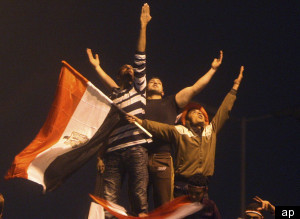
 Whatever their rivalries, the authoritarian leaders of the Middle East did not want to see Hosni Mubarak removed from power. When you are a dictator - even with the title "King" - the forced departure of another dictator is not the kind of precedent you want set.
Worth noting is that this group of Mubarak loyalists was joined by Israeli leaders as well. Though frequent in their exhortation of democratic values, Israeli officials offered a degree of praise for Mubarak at a time when hundreds of his own people were dying in protests against his regime.
The challenge for Israel is that much of its foreign policy has depended on the continuation of other dictatorships. Whether it is Egypt, Saudi Arabia, or Jordan, Israel has come to depend on having nondemocratic neighbors who rely on US patronage. Israeli policymakers fear that if these autocratic rulers are removed from power, Arab majorities will select leaders who are hostile to Israel.
When the stability of your external environment depends on the repression of others, your external environment is inherently unstable. Practically Israel's entire relationship with Egypt has depended on good relations with two men - Hosni Mubarak and Omar Suleiman. But Mubarak is now long gone, and Suleiman may soon be as well.
Poof - there goes 30 years of diplomatic strategy.
An oft-highlighted Israeli fear is that the Muslim Brotherhood will overtake other voices in Egypt and establish an anti-Israeli government. But as recently reported in the Jewish newspaper The Forward, scholars see the Muslim Brotherhood as having only the support of some 15 to 20 percent of Egyptians. So long as secular Egyptians have sufficient time to organize new political parties, the likelihood of an Egyptian regime run by the Muslim Brotherhood is low.
But even if the Muslim Brotherhood managed to gain political power, so what? They formally renounced violence in 1970, and for forty years, they have stuck to the plan. Al Qaeda's second in command, Ayman Al Zawahiri, even criticized them for doing so. Despite thousands of their members being imprisoned and possibly tortured by Mubarak's regime, the Muslim Brotherhood has not attacked the Egyptian state. Would it make any sense for a hypothetical Muslim Brotherhood government to pick a fight with a nuclear armed Israel?
Instead of fearing the politics of Arab democracy, Israeli officials should take this as an opportunity to understand why so many Arabs are so critical of their neighbor. Yes, anti-Semitism is a real factor. But it would be wrong to see Arab societies purely through this lens. After decades of watching the Israeli Defense Forces militarily oppress the Palestinian Arabs of the West Bank and Gaza, Arab citizens of neighboring countries have a deep well of anger to draw from.
The path to draining this well is simple - though not easy. Israel must make peace with Palestinians and let them live lives of economic opportunity and political freedom. That means ending settlement construction in the West Bank, entering final status negotiations with the Palestinian Authority, and yes, making peace with Hamas.
As reported by Reuters last Christmas Eve, Hamas has already taken the first step by offering a long term truce. But is the offer real? There is only one way to find out. To put it in a different context, if the Taliban proposed a long term truce in Afghanistan, would US officials give it serious thought? Not only is the answer yes, but it is precisely the strategy the Obama Administration desires to stabilize Afghanistan.
For these scenarios to come to fruition, Israel needs to take the sentiments of neighboring Arab societies seriously. That is most likely to happen once those neighboring societies have the freedom to choose their own leaders. And that is why Arab democracy is good for Israel.