
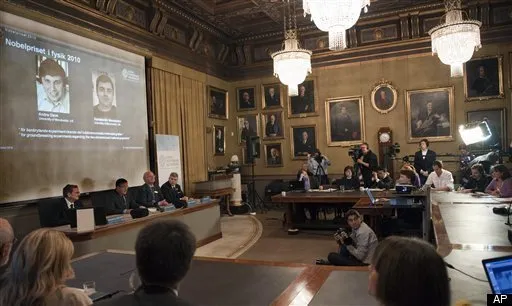
When the Royal Swedish Academy of Sciences announced the Nobel prize in physics for 2010, it wasn't for something like a high- tech lab product or any uncanny theoretical construction. It was meant for a "Scotch tape technique" that created graphene, the thinnest material ever created. The $1.4 million prize will be shared by Andre Geim and Konstantin Novoselov, both Russian born, currently working at University of Manchester, UK.
The Swedish academy statement reads, "Carbon, the basis of all known life on earth, has surprised us once again." The thin flake of carbon, the duo created in 2004, just as thick as an atom is exceptionally strong and it conducts electricity like copper. It's transparent and outperforms any other material in heat conduction. Such properties enable it to surpass silicon as the basis for computer chips and create a host of new materials that could alter the present-day touch screens to solar cells. The graphene components could be packed more closely on a chip than silicon, making it smaller and efficient. The potential miniaturization could even surpass the world of nano technology.
The negligible thickness of the graphene makes it appears like a two dimensional lattice of atoms. Many thought that it was practically impossible to create such ultra-thin materials. But Andre Geim and Konstantin Novoselov originally used adhesive tape to rip off Graphene layers from graphite, another form of carbon most commonly used in pencils.Thus the sticky tape and pencil generated a wonderful material that has a variety of practical applications. This exotic material will also help the scientists to study the pure theoretical foundations of physics such as Quantum weirdness. The graphene provides an opportunity to study the layer of atoms in a way that was impossible in the recent past.
The carbon nano tubes and bucky balls, both are different versions of carbon atom arrangements, have already surprised the scientists with their unusual properties. The graphene, the latest addition from the carbon family, has exhibited something previously unknown to science -- so thin, yet so strong and conducting. Even the creators of graphene can not fully comprehend what it will bring.