iPhone app iPad app Android phone app Android tablet app More

Featuring fresh takes and real-time analysis from HuffPost's signature lineup of contributors
Sarah Stierch

GET UPDATES FROM Sarah Stierch
 

SOPA Blackout: Why Wikipedia Needs Women

Posted: 01/18/12 11:50 AM ET

Do you know who Ada Lovelace is? She is considered the world's first computer programmer. I never would have known that the first computer programmer was a woman, if it wasn't for one website: Wikipedia. It's the site many people go to seeking quick biographical information -- in my case, what Lovelace looked like, her legacy. But today, if you click on Lovelace's name above, you won't have access to the Wikipedia page linked to it. You'll have to click around among Google search results to get a broad view of different accounts and opinions of her to make sure you have a complete, balanced picture. Looking Lovelace up on Wikipedia today isn't possible for a two very important reasons: SOPA (Stop Online Piracy Act) and PIPA (Protect IP Act).

As a female contributor to Wikipedia, since 2004, I've come to terms with my geekiness. I have written over 200 articles for Wikipedia -- on subjects ranging from the history of small towns in Tennessee to artist Louise Nevelson (and yes, I have a life!). But I've also had to recently come to terms with something not as fun as my geekiness: Only 9 percent of people who contribute articles to Wikipedia are women. Face this reality: We're the 6th most popular website on the Internet, and the majority of the content on it has been written by men. That includes articles on menstruation, vaginas ... oh, and Ada Lovelace. Her article was written by guys too. Don't get me wrong, we appreciate those guys who care about quality educational content, especially about our private parts. But wouldn't it be great if those articles were written by women?

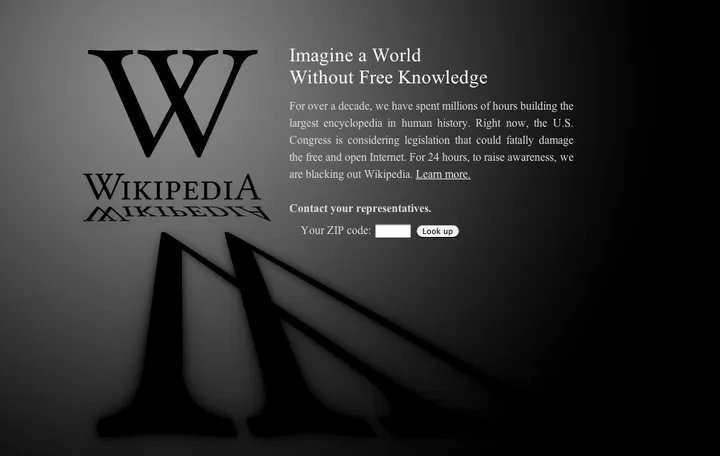
As I write this at 11:15 pm on January 17, I watch our team of staff and volunteers slowly black out Wikipedia, and I realize something: We 9 percent are losing our voice on the 6th most popular website in the world during this blackout. Meaning that if Wikipedia was to "go dark" forever, the implications would be devastating, not only on a broad level, but also with regard to the representation of women online. While women may contribute to Facebook more then men, our voices get heard there only by family and friends -- and their friends and friends of friends, if we're lucky. Women don't get heard as users of Google, the most popular website on earth (and neither do men, for that matter). But in contributing to Wikipedia, women not only get heard, we help build the site. We participate. Whether it's the content we write or the photographs we take -- we can control and curate what Wikipedia shares. Through our voices (neutral, of course, this is Wikipedia, after all), we can represent the voices not being heard: the voices of women who aren't currently represented as well on Wikipedia -- feminists, musicians, scholars -- on subjects women enjoy. It's not that this subject matter isn't represented, it is just represented poorly. For example: For a long time the article "hairdresser" redirected to the article about barbers. Recently, I and a team of editors helped create the article and write the history of hairdressers. Oh, and the article about fashion? It doesn't even mention Coco Chanel. Wikipedia isn't complete if everyone isn't contributing, and everyone isn't.

So what can you do to make Wikipedia a stronger, more diverse landscape of free information? First, help us get past this sensitive situation regarding potential censorship by the United States government. SOPA and PIPA would allow the federal government to control user generated content online -- meaning that websites like Wikipedia and others, which rely on your contributions, could be permanently "blacked out" or have user-generated content removed if the feds get their way. Second, contribute to Wikipedia! Get involved in the community: write or help improve an article about a subject you love, throw an editing party with your friends, and realize that your contributions really do make a difference. Large or small, they are read by millions of visitors a day. Imagine what your contributions to the world's free encyclopedia could do for other women reading.

And if for no other reason, do it for Ada. Do it for the women who have came before us -- on behalf of them. Share their stories so that other generations will discover quality content, for free, online, about these amazing women. Do it for those women who are exploring their sexuality for the first time, or perhaps learning about their partner's newly diagnosed illness. Do it to learn more about culture and about what inspires you.

SOPA and PIPA have been developed to deprive us, regardless of gender, of control over one area of our lives where we still can have control -- what we contribute to the Internet. If we cannot control where our voices are heard and what information we share, what does that mean for generations after us? Wikipedia was founded on the principle of sharing free knowledge with the world. If that's not empowering, what is?

 
Do you know who Ada Lovelace is? She is considered the world's first computer programmer. I never would have known that the first computer programmer was a woman, if it wasn't for one website: Wikiped...
 
 
  • Comments
  • 44
  • Pending Comments
  • 0
  • View FAQ
Comments are closed for this entry
View All
Favorites
Bloggers
Recency  | 
Popularity
Page: 1 2  Next ›  Last »  (2 total)
05:43 AM on 02/07/2012
Hello,i found your blog through search,yours blog is excellent and a nice blog...

The contents are nice &will grow higher in future...

thanks,

http://www.reifen.ms/
HUFFPOST SUPER USER
MissTake1989
Equal means equal, hypocrites.
03:44 PM on 01/26/2012
"Face this reality: We're the 6th most popular website on the Internet, and the majority of the content on it has been written by men. That includes articles on menstruation, vaginas ... oh, and Ada Lovelace. Her article was written by guys too."

There are NO EXCUSES here, ladies.

There is no patriarchy. No glass ceiling.

There is nothing to stop women from contributing...and there is no one else to blame.

"Don't get me wrong, we appreciate those guys who care about quality educational content, especially about our private parts. But wouldn't it be great if those articles were written by women?"

Why?

The quality of one's thinking is determined by one's "plumbing"?
photo
HUFFPOST SUPER USER
OnlinewithZoe
Openly feminist, Openly bi, Openly Buddhist; OPEN
04:30 PM on 01/23/2012
One day I discovered I am on WIKI. I have no idea who wrote it. When I went to computer school (1986) 20 of the 23 in my class were women and the teacher was a woman. It seemed like this one industry would have a majority of women. What happened?
10:20 PM on 01/22/2012
Being a teacher, our students are not allowed to use Wikipedia as it's not a credible source. While it may be fine for recreational use at home, we expect better from our students.
This user has chosen to opt out of the Badges program
photo
shortguy54
Short, balding, brilliant... (well, maybe not so)
01:05 PM on 01/21/2012
I have long become incapable of surprise, but it continues nevertheless to full me with wonder: How does they do it? How can it be that such an productive, intelligent and otherwise reasonable woman simultaneously lament that only 9 percent of Wikipedia articles are written by women (A valid complaint. Get off your butts, ladies!) while insinuating that it's somehow the men's fault?
10:44 AM on 01/21/2012
Personally, I'd love to see wikipedia put out of it's misery. It is the single worst place to get empirical peer reviewed information. It's really nothing more than an opinion based website. If a million people got together and wrote in the moon is made of blue cheese, that's what it would say. Most people assume wikipedia is fact based when in reality it's opinion based.
This user has chosen to opt out of the Badges program
photo
shortguy54
Short, balding, brilliant... (well, maybe not so)
12:59 PM on 01/21/2012
Wikipedia does have its weaknesses. Above all, it does not represent a peer-reviewed scientific standard. But then again, it doesn't claim to. Wikipedia is good for facts, and the more trivial the facts, the more valuable it is, because you just can't get the knowledge elsewhere. It's not so good for controversial subject or the arcana of high science. But if you're advanced enough that you need, for example, the math-laden details of string theory, don't whine that you can't find the real stuff in Wikipedia. You know where to find it. Go to the library and read up on it there!
I consult Wikipedia multiple times a day, and I enjoy it and benefit from it so much that I am glad to make a modest donation each and every month. I encourage you and everyone else to do the same!
05:59 PM on 01/19/2012
"But wouldn't it be great if those articles were written by women? "

Are you suggesting that gender differences affect quality of output? How sexist!
12:26 AM on 01/20/2012
I took offence to that, like men can't be experts in the female body or something.
photo
HUFFPOST SUPER USER
Hydra8
CEO, Monkey Business
02:47 PM on 01/19/2012
A great article that points out the need for Women to become more involved in the world of politics, to take back the control of their lives and put pressure on government to do the same. Women have always been leaders in standing up for what's right, and what is terribly wrong. SOPA was just a rushed, huge mistake in the wrong direction.
12:45 PM on 01/19/2012
I would gladly contribute to Wikipedia if I were paid. I'm not sure how guys do it, but I feel that the time I take away from my kids should be either to earn money or for fun/me (or both).
01:28 PM on 01/19/2012
I understand! Wikipedia actually doesn't really "support" paid projects, as it can produce conflict of interest on a website that relies on neutrality in our content. One issue many women do point out is that they don't have time due to family obligation (despite having time to blog, Facebook and Tweet! Go figure ), and that's totally understandable. There are also other websites too in the Wikimedia project - a photography website (Commons), a quotes website (Wikiquote) that allow for quicker contributions that have an equal impact. If you're interested in seeing how marketing groups can work with Wikipedia, a new Facebook group has formed: http://www.facebook.com/groups/crewe.group/ Thanks for reading and sharing your thoughts! I hope you'll consider finding a way to even bring the smallest edits into your work flow while online :)
This user has chosen to opt out of the Badges program
photo
shortguy54
Short, balding, brilliant... (well, maybe not so)
01:07 PM on 01/21/2012
I speculate that many (male?) Wikipedia contributors do consider their work for Wikipedia as "for fun/me".
09:03 AM on 01/19/2012
When I teach teenagers about IT I tell them about Turing, but also about Ada. They've possible heard of Marie Curie but not that she was the first to have two nobel prizes, but they've rarely heard of Ada even though she is the first programmer and possibly more.. She's buried close to me. She was the last person squeezed into the Byron vault below the church in Hucknall. She joined Byron's family and a father she is thought never to have met. She had a meme of a life taking after her mum in loving maths. I frequently ask the mixed class how remarkable it is that she's female and famous. I'm surprised that many have never noticed that historically humans were nearly all male. Is it good or bad that they havent noticed?
photo
HUFFPOST SUPER USER
Sandra Muoz
03:29 AM on 01/20/2012
It is bad and showcases all these centuries of "males-only" mentality. Gladly this is changing. Slowly, but it is. Time for the history and perspectives of women to be told.

I recently did become aware of this as well and am near to my 30s!
This user has chosen to opt out of the Badges program
photo
shortguy54
Short, balding, brilliant... (well, maybe not so)
01:09 PM on 01/21/2012
"She's buried close to me." Are you buried too? Ack! Zombie!
06:39 PM on 01/18/2012
I loved the entry about Louise Nevelson, thanks for writing it.
I will definitely contribute more to Wikipedia after this blackout, it has really made me realize how important Wikipedia is.
10:32 PM on 01/18/2012
Great to hear that Rose! I do hope you will participate - and feel free to say hi to me on my talk page if you need any help: http://en.wikipedia.org/wiki/User:SarahStierch See you on Wikipedia =)
photo
HUFFPOST SUPER USER
Sandra Muoz
03:29 AM on 01/20/2012
Me too! I am IN..
04:39 PM on 01/18/2012
Thanks for sharing this important perspective on the role of women in developing content for Wikipedia. I hope your post inspires more women to get involved with the project!
10:34 PM on 01/18/2012
Thanks! The work that you do is just a great - improving content on Wikipedia with your students and showing them the importance of sharing their research, knowledge and media with the world. Thanks for being a major influence on my work too, and helping me build the confidence to share my voice with the world.
02:54 PM on 01/18/2012
Only 9 percent of people who contribute articles to Wikipedia are women. It's the 6th most popular website on the Internet, and the majority of the content on it has been written by men. That includes articles on menstruation and vaginas. While we appreciate those guys who care about quality educational content, especially about our private parts, wouldn't it be great if those articles were written by women?
02:32 PM on 01/18/2012
I don't understand why it would make any difference AT ALL what gender the author of an article is/was. I am a female Wikipedia editor who has written dozens of articles about men and about military history. Was that inappropriate of me to delve into a male-oriented subject area? I have written articles about women in history and about romance novels in collaboration with male editors.

I don't care who writes what as long as the result is a neutral, informative, well-written article. Wikipedia will benefit from the addition of female AND male editors who can do that.
04:52 PM on 01/18/2012
I completely agree; you can see what I wrote below in reply to Joe. I believe any contributions about any subject matter by women can only improve the Encyclopedia, but it's also not a secret that "women's subject's" (which are defined generally by individual) are often poor in quality and lacking in reliability. If I can inspire one woman to write or contribute about *anything* she wishes, then I will feel like like we've won. Thank you, of course, for your contributions to Wikipedia - and yes, WP:Military could use it's own "equal" gender contributions! :)
05:28 PM on 01/19/2012
You say you agree with what Karen said, and throw out the complete opposite. And what are you talking about, influential feminists not having articles written about them? There's an entire portal covering feminism exclusively with literally dozens of articles covering all aspects of feminism; most of those articles are very well written and cited. And fashion? Just look up the index of fashion topics; you have twenty-nine articles just covering fashion styles from the twelfth century to today - and that's not even getting into materials and numerous other articles covering fashion. Why is it that feminism always has to turn every single nuance of every single subject into how oppressed and/or under-represented women are - no matter how inane the claim?
12:47 PM on 01/19/2012
I think it's fair to say that not having women write as many articles influences which subjects get put up. Women as a group have different interests and career specialties.
photo
HUFFPOST SUPER USER
Sandra Muoz
03:34 AM on 01/20/2012
Basically you are missing half of the World´s brain...