Traditional banking is about selling money you have. Finance, unlike traditional banking, is about the money that is not there. Thus finance is getting from whatever amount of money you have (10 thousand or ten billion) to its doubling, tripling. This means that pumping taxpayers money into the financial system is giving finance more grist for its mill: leveraging.
We have had five bailouts since the 1980s, the decade when the new financial phase took off. Every time taxpayers money was used to pump liquidity into the financial system, finance used it to leverage. That is what finance does. We can't hold it against finance. But we can chose a non-financial solution to the crisis.
It is almost irrational to give finance the instruments to do more of what has brought us to the brink. The prior bailouts each contributed one more element to the unsustainable leveraging we have now reached. The high level of financializing of our economy is reflected in the relation of financial assets (which is to say, debt) to GDP. It has now reached 450% to GDP, according to the recently released McKinley report. Futher, the complexity of this inverted financial pyramid is almost impenetrable. An example is the incapacity of the Treasury to estimate the cost of rescuing AIG -- first estimated at $40 billion by its management, it wound up at $121 billion. Unwinding the credit insurance on Lehman cost far more than the Treasury had estimated, reaching $360 billion.
Yet another indication of this irrationality comes from the participation of the Federal Reserve in this financial "solution": the Fed is now leveraged at a ratio of 50 to 1, a historic high. It looks like a hedge fund, and a very speculative one at that. This puts the federal guarantee system at risk -- for instance, it undermines the capacity of the government to guarantee people's bank deposits.
Re-routing the remaining 350 billion of the bailout money approved by Congress becomes urgent. As of now the first half has been used to feed hungry financial mouths: one third of payments made to the beneficiary banks wend to pay dividends to shareholders; somewhat less went to pay executive bonuses, and the rest went to AIG. So much for the hope that injecting $350 billion into the financial system would get them to make loans to households and small firms.
Now that these basics have been taken care of, the beneficiary banks are ready to do more of what got us here: use the remaining US$ 350 billion to do some leveraging. The IMF recently produced some interesting data showing the extent to which financial leveraging has caused the greater acuteness of the current crisis compared with the other 3 major crises since the 1980s.
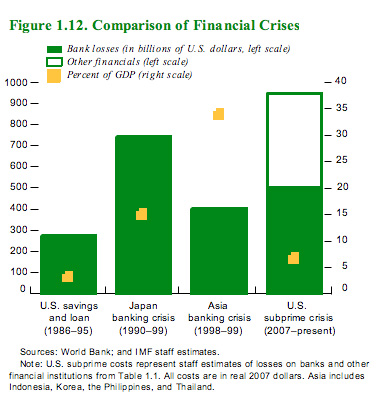
This shows that financial leveraging added another whopping 20% to the underlying banking crisis, thereby bringing the current financial crisis up to an equivalent of 40% of global GDP, compared to earlier crises, which rarely went beyond 20%.)
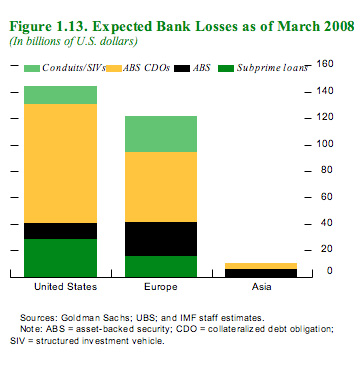
The IMF data also show the extent to which Asia is in a very different position than the US and Europe. Its emergent crisis is economic rather than financial. The stock markets declines are to be distinguished from the leveraging that has fed our crisis -- the outstanding US$ 55 trillion credit default swaps for which there is no money. (Not to mention the $640 trillion in outstanding derivatives). Stock market declines indicate the shrinking resources available to meet all these outstanding amounts.
What would happen if the solution to the financial crisis would emphasize growing the economy -- making sure that a wide and diverse away of (especially) small -- and medium-sized firms are put into fast-track activity. This would raise the demand for workers, especially since a large share of small firms are labor-intensive and small to medium firms account for the largest share of employment in most economies. This would in turn raise household demand which would feed back into all kinds of economic sectors. And so on...
So what would be the mechanisms, the conduits, for transferring tax payers money into small and medium-sized firms that could bring about economic growth, rather than merely being a transfer of money. This will vary across national economies. But let me suggest that in most economies, doing infrastructural work is not a bad starting point. And I am not thinking of building huge dams and major new bridges. That is mostly work that only a few large global engineering firms are able to do. There is so much more people-oriented infrastructural work that needs to be done: building and/or repairing the basic infrastructure of large stretches of cities and towns, cleaning up toxic fields, expanding public transport systems, just to mention a few.
Once a government has decided to put billions into an economy as an emergence measure, it can begin to work on such needs, needs which cannot easily be met through market mechanisms. As these projects get under way, they activate market mechanisms directly increases in demand for inputs from other firms, increases in labor demand and hence in consumer demand, which in turn further feeds demand from firms for more inputs and more workers. This is a very indirect process for growing an economy. Indeed, quite a few more financial firms would have gone down, and credit would be tighter for a while if the government had decided to put that vast amount of money into the rebuilding of infrastructure, from small to large-scale labor intensive projects. But in the long run, we would be in the business of economic growth rather than financial leveraging.
The US government has resisted putting money into the economy even where it is urgently needed -- such as strengthening the 700 bridges that are known to have a faulty design and are likely to collapse sooner or later, causing potentially large-scale injury and death. These are the bridges that have the same flawed design as the Minneapolis bridge that collapsed. Yet the US government has not addressed this, has not even started. And now it has decided to put $700 billion into the financial system. Imagine the multiplier effects across small and medium enterprises and households of that kind of money input. Instead it has put it into money firms, hoping that these will start lending.
Saskia Sassen is the Robert S. Lynd Professor of Sociology and Member, The Committee on Global Thought, Columbia University. Her recent books are Territory, Authority, Rights: From Medieval to Global Assemblages ( Princeton University Press 2008), and A Sociology of Globalization (Norton 2007).
(AP) TEGUCIGALPA, Honduras — Ousted President Manuel...
The nation's largest insurers, hospitals and medical groups...
HAPPY FOURTH OF JULY! The American flag has been painted on bathing...
If it's a rainy weekend and you want to channel that summer feeling, you can rent...
***SCROLL DOWN FOR VIDEO OF PALIN'S RESIGNATION SPEECH...
I wish Hunter S. Thompson had lived to see this. As Hunter said, "When the going gets weird, the...
Anyone who is in any way surprised by Sarah Palin's announcement today that she will...
Reporters are beginning to piece together an explanation for Sarah Palin's...
The first lady's garb is a great way to gauge what's hot for summer style. Michelle...
As Jon Stewart pointed out last night, Mark Sanford is the luckiest man in the world:...
Alaska Governor Sarah Palin has...
I'm liveblogging the latest Iran election fallout. Email me with any news or thoughts, or follow me...
During his interview with ABC's This Week on Sunday, Vice President Joe Biden made...
The Cruise family is down under at the moment, and Sunday Tom, Katie and Suri went to the stage production...
A long weekend, parties, crazy hats, fireworks, and fun...
DENVER — Casket makers catering to natural burials have offered biodegradable coffins made of...
Want to reply to a comment? Hint: Click "Reply" at the bottom of the comment; after being approved your comment will appear directly underneath the comment you replied to
Since TRICKY Adjustable mortgages are the root cause of this CRISIS we should find ways to bypass the Mortgage Banking System using technology! The Internet databases and computer software are being considered by Fannie and Freddie to deliver Low Fixed Rate Refinancing loans (my suggestion is the Fed Rate +2% or 3% and the Fed Rate is 1%). 98% of the application can be automated followed by manual review at the end by Fannie/Freddie representatives. This service can be offered in libraries for those not having internet access.
This circumvents the Mortgage Banker Association Banks which are blocking the reworking of the existing "TRICK" loans as they have to take losses. At the very least this new direct approach forces them to either rework these old "TRICK" loans or have a "Walk-Away" which is even more costly to them.
See Saskia Sassen's Profile
yes, what you propose should be one key component in a program to support the effort by households to get a mortgage to buy a house:
"The Internet databases and computer software are being considered by Fannie and Freddie to deliver Low Fixed Rate Refinancing loans (my suggestion is the Fed Rate +2% or 3% and the Fed Rate is 1%). "...and yes, it would save on those excessive financial fees that allow credit cards and banks to rake in billions of dollars from consumers.
Thank you! I have been posting this idea on HP and other sites since mid-September and it is good to know it is being considered by Fannie and Freddie!
See Saskia Sassen's Profile
3) Several of you make the point that there is also a cultural dimension the making of this crisis. As Thermodynamics puts it: "The media seem to be presenting our current mess as only one thing. There are several factors contributing to this perfect storm. Some are cultural changes."
And a dimension that comprises a lot of little thingies in between:
Check out PhilipTaylor"s list of EXCESSIVE FINANCIAL FEES
4) A lot of you picked up on the infrastructure bit, and added your own. I liked Over50WhiteWoman "s : "I see green businesses as enterprises.." and I defintiely agree with you; I should have explicitly brought-in greening!
Thanks for the reference and Yes this is a Cultural THING as Thermo... said!
It is the Culture of "GREED" by Wall Street and Washington!
Now it is Replaced by a Culture of "Serving the People with Smart Government" while addressing the prevention of extreme levels greed from ever gaining control again!
A key, often unstated, flaw of the 'flood up trickle down' theory is that not only wealth flows upward, but power. The few with power will then use it to further enrich and entrench their position. At its core, the theory is a thinly disguised argument for plutocracy.
No matter how good the proposed 'economic' solutions may be, they will not be implemented without a re-alignment of power, and the military and corporate institutions that now hold power.
As long as we are creating infrastructure wish lists, don't forget the social 'infrastructure'. ( e.g. more teachers and teacher aides to improve the teacher / student ratio, and more school health workers and food service workers to improve health and diet, and reduce obesity).
See Saskia Sassen's Profile
1) Several of you dealt with debt and its many particularities.
sposton says : "I don't know if the nation can simply let our financial institutions go bankrupt but I know that we should not just fork out the money to the people who have brought us this disaster"
Yes, it is tricky. Households and firms need the option of debt. Debt doesn"t have to be bad. We need a financial system, not only banking. By now finance is wired throughout our economic system
Traditional banking probably would need some extra help to develop and get a profit on mortgages for low-income people and loans to low-profit small businesses. There is a role for finance, for leveraging¦ a bit. But what has been happening over the last decade is an abuse of the capabilities of finance.
See Saskia Sassen's Profile
2 ) Some of you used great images to describe how we should act::
JacqueItch"s :: " intelligently treating the crying infant by ignoring it and healing the weakened mother. Restored, the strengthened mother can effectively again feed and nourish the baby, and the baby can again be well."
And to describe how we shouldn"t:
cduvall "¦..The free market "leave it to Wall Street" crowd sound like a bunch of medieval blood letters. "The patient got sicker? We probably just need to bleed her some more!"
Michale32086"s
"It's like giving heroin to a heroin addict and expecting that it will cure them..."
See Saskia Sassen's Profile
RESPONDING TO comments on::::
A Bad Idea: Using a Financial Solution to the Financial Crisis
Posted November 20, 2008 | 08:17 PM (EST)
Trying to catch up as I was on a very long 15 hour flight...so here comments on your comments --and thanks for really adding information and interpretation to what remains, in the end, a sort of very messy puzzle --our current financial crisis.
From Saskia Sassen:
Nov 21, 08
1) Several of you dealt with debt and its many particularities.
sposton says : "I don't know if the nation can simply let our financial institutions go bankrupt but I know that we should not just fork out the money to the people who have brought us this disaster"
We (households or firms) need debt in our lives.
Traditional banking could go quite a ways towards developing mortgages that allow low-income people to buy a house, or developing specific types of loans for small businesses. Secondly, I also think there is a role for finance, for leveraging a bit. But what has been happening over the last decade is an abuse of the capabilities of finance. Note that the sub-prime mortage crisis is a made in the US crisis (that spread due to interlinked financial markets and foreign invstment in US mortgage-backed-securities. Many of the credit-default swaps instruments were also invented in the US. The US has an ineffective regulatory frameworks for certain components (not all) of finance.
"It is almost irrational to give finance the instruments to do more of what has brought us to the brink. The prior bailouts each contributed one more element to the unsustainable leveraging we have now reached."
Well said ... I also like "What would happen if the solution to the financial crisis would emphasize making sure that a wide and diverse away of (especially) small -- and medium-sized firms are put into fast-track activity. This would raise the demand for workers, especially since a large share of small firms are labor-intensive and small to medium firms account for the largest share of employment in most economies. This would in turn raise household demand which would feed back into all kinds of economic sectors. And so on...
So what would be the mechanisms, the conduits, for transferring tax payers money into small and medium-sized firms that could bring about economic growth, rather than merely being a transfer of money"
The answer let automotive and any other industry fail. This would cause them to be broken up and offer a smaller financial footprint. Remember the demand for prodducts would still be there. Just not as currently concepted.
Excelent article!
I can't believe we are giving 700B to credit swap speculators!
"A credit default swap (CDS) is a credit derivative contract between two counterparties. The buyer makes periodic payments (premium leg) to the seller, and in return receives a payoff (protection or default leg) if an underlying financial instrument defaults.[1] CDS contracts have been compared to insurance, because the buyer pays a premium and, in return, receives a sum of money if a specified event occurs. However, there are a number of
differences between CDS and insurance; the
buyer of a CDS does not need to own the underlying security;
in fact the buyer does not even have to suffer a loss from the default event.[2][3][4]"
Think about that. It's off track betting on the market.
CDS's are NOT unlike the characteristics of "Illegal Naked Shorts" so should also be made illegal! Under Bush&Company the SEC did not enforce "Illegal Naked Shorting" so even if a law was on the books it was not enforced. How do force a Government Agency to enforcing the Laws of the Land including Regulations? I guess you can't if the Administration is corrupt.
So just passing laws or regulations on CDS's is not enough! You must have clear penalties for an Administration Not enforcing laws. The Constitution is clear that the Executive Branch must enforce the Laws of the Land, but without prosecution that has no "BIT" and so Future Administrations have the option to violate this Constitutional Requirement. Perhaps one of the best chances of preventing this from happening again is to hold the Current Administration responsible for this Constitutional violation with both investigation and punishment. Of course, if Bush forgives via pardons or other actions all in his administration prior to leaving office there is very little hope of that!
It seems like the multiplier effect of income was instead used to create a multiplier effect of credit, which resulted in multiplying everything by negative amounts, instead of positive amounts which is what the multiplier is supposed to do. The result is huge negative numbers of dollars, -64 trilllion, -450 trillion, these might as well be considered infinite amounts of debt. One thousand billions is one trillion, its truly frightening to contemplate what it will take to get the US out of the red. It sounds totally impossible.
Markets work (more or less) when buyers and sellers know what they are trading. A stock is an abstraction I can understand. Sliced and diced securities are incapable of being understood. There is no need to regulate such markets; there is a need to ban any instrument for which you need computer algorithms to understand. We are now paying a price of injecting into the markets financial instruments that cannot be deciphered. This goes against the very idea of informed markets. Derivative of a derivative of derivative is derivative of a financial meltdown.
I don't know if the nation can simply let our financial institutions go bankrupt but I know that we should not just fork out the money to the people who have brought us this disaster. If anything most of these troubled institutions should have been outright nationalized. All equity in such companies should be wiped out and then government has a much simpler task of disposing of the assets in a responsible manner and create a new framework for future financial sector. At the same time the government should create its own alternative entities to provide credit directly where it is needed in the real economy.
"Top of the marnin' to ye, lassie! ;-) ;-) Or I should say 'evening,' rather, because me don't like what happens to my business with the comin' of the marnin' light! Timmy O'Swindle here, and I am what used to be called a 'leprechaun.' Today, I call myself a 'financier.' My now highly-respectable job is making money out of nothing at all."
Ahem.
What America needs right now is exactly what China and India and all those "other" countries need right now: a genuinely strong America that produces the things that it wants to consume, right within its own borders, while emphasizing BOTH domestic AND foreign supplies.
As you so-correctly say, we can't look for a solution from my "Timmy O'Swindle," no matter what he may call himself these days. Money is not a "thing." It's an indicator, or a proxy. It's a medium of exchange, and to have that actually be meaningful, well, you have to have 'exchange.' And "the consumer" is only the tip of the iceberg of that vast system of 'exchange.'
So, unfortunately, are the 'small and medium-sized businesses' you speak of. They have to have something to sell-to, and that is usually "a bigger business," not to each other and certainly not to the consumer. Every big factory in a city was surrounded by a hundred smaller ones. It's still that way in China today... trouble is, not here.
Dr. Sassen was correct in saying that finance was acting on their own behalf and not on behalf of the nation and its national security interests. We are in a national security crisis due to the actions of the greedy banksters, who are getting cash transfusions from one of their most sacred own: Paulson and Cash and carry. This has been a totally planned disaster to continue to take from the Treasury and the Fed through low interest rates. They leveraged out the nation in order to obtain great personal wealth.
It is time to invest in an exportable real economy based upon alternative energy technologies, as well as other products. BushCo will not stop until that UHaul pulls up behind the White House to remove them.
http://eye-on-washington.blogspot.com
The author's main point is exactly correct, and can stated as simply as this: The overall problem is too much debt, and the answer the government is coming up with is more debt. That's why the markets continue to tank--this solution is not going to work.
Those of us who believe that government has a sensible role in the management of the overall economy--a role that was ignored during the past eight years--now have to come up with a new understanding. The market itself is going to have to work to correct our economic problems, and that's going to be painful, and that's going to take time.
BTW, there are those who say that the health care problem can be put off until larger issues are addressed. These people are fools. Our disfunctional health care system is at the heart of our economic doldrums. The health care problem is something the government can and should address NOW to help the overall economic situation. It should be Obama's TOP priority.
Banking is about leveraging but our bank got to leveraging the money so many times that is start out solvent they leveraging like diluting something with water it get so thin that it is no longer useful. The only way to slow this cycle down is through regulation therefore any tax payer money put in to prime the pump does not do any good it only thins out after short time. This is most simplest way to describe the system.
Wow! Factual, erudite and true! There is no chance that the pillagers in D.C. would let you be heard.
Here is where we are: DEPRESSION ( 10% decline in REAL GDP in 09),... good chance for major war either in Iran, old Soviet sphere or Pakistan,..... millions will die.
All a direct result of the boy "king" Bush allowed to tap-dance for 8 years.
"Traditional banking is about selling money you have. Finance, unlike traditional banking, is about the money that is not there.Traditional banking is about selling money you have. Finance, unlike traditional banking, is about the money that is not there."
You have this wrong. Banking is about the creation of money by an accounting entry called a "credit" that finances economic activity. That economic activity is either production (farmers) or consumption (suburban suv drivers). There is a nefarious use of bank credits and that is referred to as "speculation" that drives asset prices into bubbles. When interest rates were at negative real rates (the Grnspn era as well as now) funny money loans for speculation were rampant (no interst expense...money was essentially free).
Finance is the art, the methodology of using leverage (borrowing money, bank credits) to afford housing for the masses. If we were all conservatives we would pay cash for our houses, but then there would not be many houses. (can you see this?)
What we are observing now is the massive unwinding of trillions worth of speculation financed by bank credits (money). As hedgies and mutual fundies are forced to unwind, they must sell their margined assets which causes the fall of asset prices (stocks, houses) and this selling requires trillions in liquidity that do not exist. As a loan is repaid the money used to repay it disappears, it is expunged by dint of the reverse of the accounting entry that created it. As these trillions of liquidity disappear from the system, enter uncle Ben and the Goldman Hank to inject liquidity into the market. There is a liquidity fire going on and it is keeping Ben and Hank busy all the time. The unwinding is apporaching and end and when house prices finally hit their low it will back to the boring same old same old.
Good posts, Henry.
The hedges were as leveraged as the investments they were hedging. The most risky investments, the sub-prime mortgages, were heavily insured and propping up the whole house of cards. Ultimately, the sub-prime hedges, effectively the only line of defense, were over-subscribed and overwhelmed.
The sub-primes are too entangled to be isolated and the damage has now spread to the rest of the market. It is now not a matter of actively unwinding the market but a matter of passively waitng for the various contracts to expire and hoping there is sufficient momentum in the market to carry us there.
"Traditional" banking cannot issue credit against money it doesn't hold. It leverages the money it does hold by issuing some proportion of it (about 75 to 80%) as secured loans, the interest on which becomes its operating capital and profit.
"Modern" investment issues unsecured credit. It hedges its exposure to credit defaults by insuring against them. It maximises its profit by indirect insurance: in other words, it hedges its exposure to losses as cheaply as possible by insuring other, higher-risk credit; effectively shielding unsecured credit with other unsecured credit (that they need not even own).
An investment bank is driven to leverage its liquidity to the hilt because the more credit it issues the more money it appears to be making. The more money it appears to be making the more secure it looks. The more secure it looks the easier it is to borrow cheap money. In atom bomb terminology we would call it an irresistable imperative to achieve critical mass.
You must be logged in to reply to this comment. Log in or