
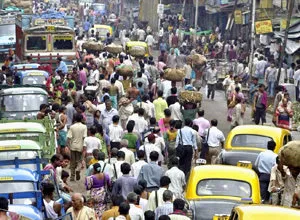
The Mumbai attacks are part of an emerging type of urban violence. These were organized, simultaneous frontal attacks with grenades and machine guns on at least ten high-end sites in the central business district.
Then there are the gangs in Rio de Janeiro that every now and then announce they will take over a major central area of the city from, say, 9 to 5: the result is shuttered shops and empty streets. If the police try to respond, it is open warfare, and the police rarely win -- this is asymmetric street warfare for which the police are not trained. After 5 pm the gangs withdraw.
It is easy to see all of this as resulting from inadequate policing or crime waves, as is often said.
But that is too simple. There is a deeper transformation afoot. It is still rare but it is popping up more frequently. It is as if the center no longer holds. Cities seem to be losing the capacity they have long had to triage conflict -- through commerce, through civic activity. Confronted with a similar conflict the national state has historically chosen to go to war. In my new research project I am studying whether cities are losing this capacity and are becoming sites for a whole range of new types of violence.
Further, the new asymmetric wars have the effect of urbanizing war. This brings with it a nasty irony: when national states go to war in the name of national security, nowadays major cities are likely to become a key frontline space. In older conventional wars, large armies needed large open fields or oceans to meet and fight, and these were the frontline spaces.
Today the search for national security may well become a source for urban insecurity. The War on Terror shows us that cities become the theaters for asymmetric war, regardless of what side of the divide they are -- allies or enemies. Think of the attacks in Madrid, London, Casablanca, Bali. And then there is the US conventional military aerial bombing: it took only 6 weeks to destroy the Iraqi army and take over. But then the asymmetric wars set in, with Baghdad, Mozul, Basra, and other Iraqi cities the sites of conflict... for years. In fact, in Mumbai the attackers took hostages, evidently selectd by whether they were Americans or British -- clearly related to Bush's declaration of war on Iraq.
The traditional security paradigm based on national state security does not accommodate this triangulation. What may be good to protect the national state apparatus may go at a high (increasingly high) price to major cities and their people. In the dense and conflictive spaces of cities we can foresee a variety of forms of violence
Finally, we should add the new kinds of crises that may result from the major environmental disasters that are looming in our immediate futures. These will further challenge the traditional commercial and civic capacities that have allowed cities to avoid war when confronted with conflict. These crises could feed the violence that can arise from extreme economic inequality, and racial and religious conflicts. This will be felt particularly in cities because of the often extreme kinds of dependence of cities on complex systems -- apartment buildings, hospitals, vast sewage systems, vast underground transport systems, whole electric grids dependent on computerized management vulnerable to breakdowns. A major mock experiment by NASA found that by the fifth day of a breakdown in the computerized systems that manage the electric grid, a city like New York would be in extremis.