More

Featuring fresh takes and real-time analysis from HuffPost's signature lineup of contributors
Saumya Arya Haas

GET UPDATES FROM Saumya Arya Haas
 

What is Voodoo? Understanding a Misunderstood Religion

Posted: 02/25/11 09:33 PM ET

Editors Note: While this article uses the AP Style spelling, 'Vodou' is considered a more appropriate spelling by the author and other scholars.

Before I answer any questions, I have some for you: What do you know about Voodoo?
Where did you get that impression?

Voodoo probably isn't what you think it is. It might be easier to start with what Voodoo isn't:
Voodoo isn't accurately portrayed in most movies, TV shows and books. Even some documentaries and non-fiction books are misleading. Voodoo isn't a cult, black magic or devil worship. People who practice Voodoo are not witchdoctors, sorcerers or occultists. Voodoo isn't a practice intended to hurt or control others. Most Voodooists have never seen a "Voodoo doll" (unless, like you, they saw it in a movie).

Voodoo isn't morbid or violent. Voodoo isn't the same everywhere. Not everyone who practices Voodoo does it in exactly the same way or agrees on exactly the same things. (This document only represents my understanding of Voodoo. I can't speak for everyone!)

So, what is Voodoo?

Voodoo is a religion that originates in Africa. In the Americas and the Caribbean, it is thought to be a combination of various African, Catholic and Native American traditions. It is practiced around the world but there is no accurate count of how many people are Voodooists.

Voodoo has no scripture or world authority. It is community-centered and supports individual experience, empowerment and responsibility.

Voodoo is different in different parts of the world, and varies from community to community. This is mostly about Voodoo in New Orleans and Haiti.

Voodoo embraces and encompasses the entirety of human experience. It is practiced by people who are imperfect and may use religion for their own purposes.

What do Voodooists believe?

To understand what they believe, you have to first understand how a Voodooist sees the world. Those who practice Voodoo believe that there is a visible and an invisible world, and that these worlds are intertwined. Death is a transition to the invisible world, so our predecessors are still with us in spirit. They watch over and inspire us.

In addition to our ancestors and loved ones we knew in life, there are the Lwa, which can also be understood as archetypes of human personalities (such as Ogun the warrior) and others that embody more specific concerns or localities (such as Marie Laveau in New Orleans). Each Lwa is actually a family of similar types (i.e. there is more than one Ogun; more than one way to be a warrior). Voodooists develop relationships with the Lwa to seek their counsel and help with concerns in the visible world. In some ways this is not dissimilar to the secular practice of studying and honoring remarkable historic figures. For example, someone who wishes to effect social change might find inspiration from Martin Luther King Jr. or Mahatma Gandhi and feel a kinship with them. They may read their books, keep a poster of them on the wall, place significance on their day of birth or death and try to live by their example. In a similar fashion, a Voodooist develops a relationship with particular Lwa, seeks to understand and embody the principles they represent, connects spiritually in order to affect personal transformation and manifest this energy in the visible world to help the living.

Like Catholic saints or Hindu deity figures, the Lwa are familiar and accessible whereas the "great good God," although loving, is distant, and somewhat above individual human concerns.

Voodoo has ordained clergy, Hougan (priests) and Manbo (priestesses) that make a commitment to a spiritual path and can offer guidance when needed, but it is believed that each person is responsible for their own actions and capable of self-actualization. Voodooists especially places value on the strength of community for support and enrichment.

Just as there are differences within other faiths, there is great variation within Voodoo beliefs and practices. In places and times where conditions are very desperate, Voodoo is often focused on survival. In my New Orleans community, many Voodooists feel that part of religion is service to their community, so there is an emphasis on healing and social activism. We also have many artists and musicians in our community, further reflecting New Orleans' unique cultural spirit.

If Voodoo is just another religion, why does everyone think it's scary?

Racism clouds our view of Voodoo. It is rooted in slavery and intricately connected to this hemisphere's political and social evolution. Voodoo was first practiced in America and the Caribbean by slaves of African descent, whose culture was both feared and ridiculed. Slaves were not considered fully human. Their religion was dismissed as superstition, their priests were denigrated as witchdoctors, their Gods and Spirits were denounced as evil.

One of the only successful slave revolutions in modern history occurred in Haiti in the late 1700s. Slaves of African descent overthrew European rulers and took control of the country. Many slaves were Voodooists, and some of their military leaders were priests who inspired and organized their communities to fight for freedom. The Haitian Revolution provoked fear in other European and American colonies that were reliant on vast numbers of slaves as plantation labor. The imagery and vocabulary of Voodoo (and other Afro-Caribbean religions) became threatening and ingrained in those cultures as something horrifying, associated with bloodshed and violence. It was brutally repressed in most places. It became taboo.

Over time, American culture became fascinated by this mysterious tradition and began to depict it in movies and books as sensationalized horror. "Voodoo" practices were dreamed up by Hollywood; most of the disturbing images fixed in our minds are something we saw in a movie. Hollywood created a mythology that we have taken as truth. "Voodoo" has become part of modern folklore as something evil that can hurt us.

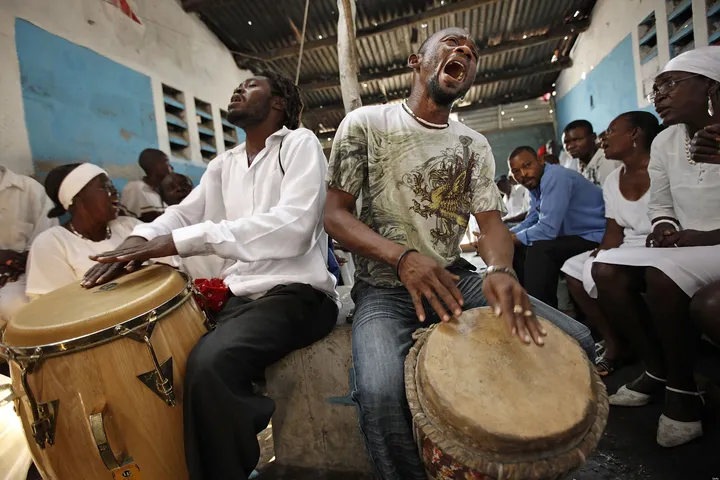
But Voodoo is widely practiced in Haiti, and it is still relevant in politics there. Politics and religion make a controversial mix. In that regard, Voodoo is the same as any belief system. In the U.S., many Voodooists are afraid of how they will be treated so they hide their religion. While this is understandable, it also reinforces suspicion that they practice in secret to conceal something bad or violent. Fear begets fear.

We aren't always aware of the origins of our beliefs; now and then we need to reassess what we know and how we know it. There were times in our nation's history that other groups (e.g. Jews, Catholics) were similarly reviled. It's only through education and getting to know those with different beliefs that we can overcome our fear and realize that they are ordinary people who enrich our communities.

This is a short post on a complex subject; stay tuned, there's more to come!


Follow Saumya Arya Haas on Twitter: www.twitter.com/nsomniasaum

Editors Note: While this article uses the AP Style spelling, 'Vodou' is considered a more appropriate spelling by the author and other scholars. Before I answer any questions, I have some for you: Wh...
 
 
  • Comments
  • 143
  • Pending Comments
  • 0
  • View FAQ
Comments are closed for this entry
View All
Favorites
Bloggers
Recency  | 
Popularity
Page: 1 2 3 4  Next ›  Last »  (4 total)
photo
HUFFPOST BLOGGER
Wes Isley
Writer and interfaith minister
12:18 PM on 03/01/2011
Thanks for this article. It's been a rewarding discovery to read about real vodou, and the little I've learned has been inspiring and even spiritually challenging. I look forward to learning more.
HUFFPOST SUPER USER
savvy7
A closed mouth gathers no foot
08:43 PM on 03/02/2011
There are quite a few religions in the Caribbean and South America which sustained the African captives of the Diaspora. They are based on a mix of African beliefs and Christianity, and are known as Voudon, Santeria, Pocomania and Candomble. At least, those are the ones I've heard of, there may be more. They were shunned because of the African connection and aren't well known, but if you're a student of other people's faiths, they are worth looking at.
10:53 AM on 03/01/2011
I find the lack of knowledge on this thread disappointing! If one doesn’t understand a certain religion, culture, belief system, or anything else, it is as simple as Googleing it! Vodou has a rich and vibrant history rooted in mystery due to the amount of oppression that is directed at this tradition. There is no evil, no Satan, no black magic. Some of the most spiritual and enlightened people i have even meet are people who practice an Afro-Diaspora religion. Vodou that is practiced here in the USA originates from a mixture of traditional African beliefs, European CATHOLISCM and magic (k), as well as Native American beliefs and practices. This is a tradition of change, of love, and of growth. The Lwas here to help all that come to them, resembling how the Saints work in Catholicism.
10:28 PM on 02/28/2011
"This is a short post on a complex subject; stay tuned, there's more to come!"

I appreciate it and found it interesting and informative. You have piqued my curiosity.
photo
Tennys Daughter
A fool and his money shall soon perish
01:37 PM on 02/28/2011
If Voodoo is the religious preference for Haiti and New Orleans; I suggest they find another avenue to God, obviously voodoo is not it because historically Haiti and New Orleans are two of the most economically distressed countries and cities in our hemisphere.
considerthis
I try my best
10:12 AM on 03/01/2011
voodoo doesn't "pay off" so it's not a "good" path to god? Do you think you're on the "correct" path? I'm not a voodooist and I'm offended
10:58 AM on 03/01/2011
The effectiveness of a religious tradition and what it means to those who practice it can’t be summed up in how big it makes their wallets! Some may apply that to their own personal beliefs, and that’s fine, but it is disrespectful to do that to others…
HUFFPOST SUPER USER
American Air
12:34 PM on 02/28/2011
If there was a voodoo priest and a baptist evangelical priest that needed to be saved and I could only save one, I would save the Voodoo priest!
photo
HUFFPOST SUPER USER
William D Simpson
08:27 AM on 02/28/2011
What is voodoo? Humanism. Just another religous ideal that believes fallen humanity can approach creations GOD on their own terms. Ah, NOT!
photo
HUFFPOST SUPER USER
SilentSolidarity
So what do you need? Besides a miracle.
08:02 PM on 02/27/2011
Sacrificing a chicken in your home is indeed a unique/individual experience, if you will.
10:29 PM on 02/28/2011
A fairly common event especially in the average midwestern farmhouse. Then you eat it.
considerthis
I try my best
10:14 AM on 03/01/2011
which movie was that in?
photo
HUFFPOST SUPER USER
SrAN
1st time proud pagan mom since May 16
06:11 PM on 02/27/2011
Thank you for this article. I am Pagan and can say from personal experience that it is important to end the stereotypes that are tagged to other non-mainstream religions/nonAbrahamic religions. Too many times people have many misconceptions about certain practices and religions and are fearful of people who practice said beliefs. Many times that fear translates as hate and we have seen throughout history how that goes.
And to all of you out there who dont see the point of understanding this or any other religion, just try to be open minded. Religion is here, it is practiced and we all live in the same world together. Maybe if we all tried to just understand each other, without trying to convert each other, the world would be a better place.
10:30 PM on 02/28/2011
"I am Pagan"

What does THAT mean? Is it even more poorly defined than voodoo?
considerthis
I try my best
10:15 AM on 03/01/2011
so what's it to you? It doesn't matter if you don't know what it means, as long as SrAN does.
photo
HUFFPOST SUPER USER
SrAN
1st time proud pagan mom since May 16
01:46 PM on 03/01/2011
Pagan is a blanket term, much like the term Christian, which means polytheistic and not holding to an Abrahamic dogma.
HUFFPOST SUPER USER
logicanada
Blogger, radio co-host, writer, editor, voice-over
01:51 PM on 02/27/2011
It's ALL voodoo.
11:10 AM on 02/27/2011
The people who practice the voodoo
Frighten the religious ones who do
Find it quite odd
That the same God
Created their own sacred doo-doo

O'Nostra
09:22 AM on 02/27/2011
Voodoo believes in God, God as a spirit. And Voodoo knows there are good spirits and bad spirits, ev 1l ones, in this world. The 2 forces. Good and Ev il. Where our belief system in God, in the spirit comes from, its roots Africa. Other nations, worship their gods, sun, stars, moons, pagan goddess Diana, in Athens, etc. Abraham came from Africa, but Africa was much larger then toady also. And other Nations, stole through their wars, etc, their lands, changed boundary lines, name their stolen lands as their own, renamed them also. Jesus speaks of the marriage, go to Ethiopia and understand how they celebrate the marriage still today, before after. Fits in with what Jesus did, while on earth. Jesus calls us his bridegroom, in the marriage feast in Africa, the groom comes for the hand, leaves then returns, later to marry his bride. A sacrifice also is offered, blood, etc,  when marriage proposal takes place, when one ask for the hand in marriage, interesting. Saw on documentary, about Africa etc.
09:12 AM on 02/27/2011
Yes, Africans sang their praises and worships to God. And the oldest church of God, is not in Rome either. But in Africa. The Psalms were song,  They give praise, worship, repent and tell God of their troubles, in asking for help, against their own enemies. and yes in the OT Ethiopians are mentioned over 3,500 times, they were Ethiopians, mentioning all the different tribes. 
Voodoo, was defined by man, and men of great power, gave voodoo its meaning, definition, right?. Told what to think, were we, why? . Called it bad why? To control the masses, that were preaching their own belief system. Now like gnostic, also told was heresey, we are finding out not bad at all, and is now being redefined its meaning,  believed in God also. but went against those of power, was to maintain that power, control over the masses.
09:01 AM on 02/27/2011
Those who control the message know they control the power? Or Haiti problems, were a test upon those who boast of their own self righteousness?  He did say, do not think if you follow me, you will not suffer, for I to have suffer, and HE suffered, HIMSELF, because for the salvation of others. Who are really God's chosen people? could it be those who are suffering greatly, like HE did? All have been given a purpose, a work to do, which serves others.
What one calls,  blessed, but not be so blessed at all, in the EYES of God? Not till every gentle is in. Those who are first will be last, and those who are last will be first, the -Meek shall inherit the earth. that means the poor physically, but not poor spiritually. Today we to would call Jesus poor, Moses poor, $$$ wise, and would say why did they also suffer so greatly. It was not because they were bad either, or deserved it either.
The rich are here to serve the poor, but in the end the poor shall save the rich. Blessings have nothing period to do, with money. What ones blessings are, they are to become and given to others as their blessings. For God said. All have been given to, so no one can boast. So do not boast, or judge, what we think the MIND of God is. For God works in mysterious ways, but know all are tested, of our true LOVE and FAITH in HIM.
photo
Cori527
Gay democrat agnostic vegetarian!
12:22 AM on 02/28/2011
"could it be those who are suffering greatly, like HE did?"

Just picking this little part out to comment on: If you're referring to the so-called trials and tribulations of Jesus, I'd just like to point out that millions of people across the planet had far, FAR greater burdens that they endured for a far longer period of time for a far less grand purpose or reward. Your average severe burn victim has a greater burden. So, before you think of the great sacrifice of your "christ", look out your front door and see the greater trials and tribulations of ordinary humans who suffer far, far more in the name of their own obligations and families than a simple crucifixion ever caused.
08:01 AM on 02/28/2011
Looking out the front door, but do not see balls and chains around anyone necks thou, or standing naked on stage, being sold to the highest bidder, torn stolen from out of their own country leaving all families behind never to see again etc etc etc etc what has been done to them ? In the millionsssssssss and for thousands of years. Ordinary humans yes suffer, but walk freely where ever they want. Still a better life then anyone who ever gone through slavery ever.  A crucifixion, was the worst agony of death, for any human being and to have it done to you, without any cause and to do so, freely for the salvation of others, was not simple task. They say until one has walked in another shoes, does one not know the pain suffering as gone through.
One needs to know the difference is to go through it themselves, for we only know what we know, and what  we truly know, is NOTHING.
I belief if one goes back and wants to taste slavery, the full of it, for thousands of generations, we will exchange, happily it for our sufferings, trials and tribulations, for they do end, but slavery did not.
ThinkCreeps
Seriously, it's time.
07:33 AM on 02/27/2011
Piffle? Cant? HooHa? All of the above?
photo
goddessNdiva
Internet surfer extraordinaire.
07:32 AM on 02/27/2011
We all have our beliefs. Thank you for the insightful article.