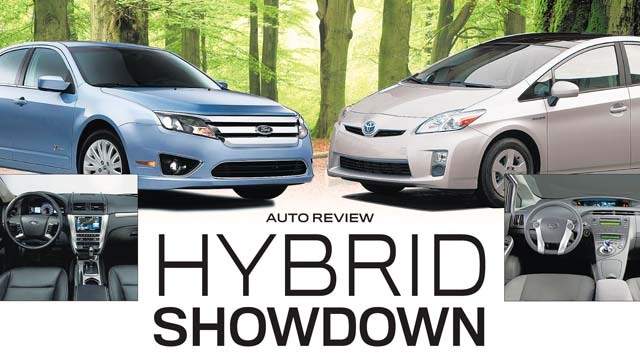
As the number of different hybrid models available in the U.S. approaches a baker's dozen, one has to wonder if these machines will ever really take off. To me, they already have, but others still remain on the fence.
Automotive industry experts will point out that hybrids as a group remain a very low percentage of overall sales and sales are directly impacted by the price of gasoline. If gas prices climb, so will sales for hybrids. Seems logical.
However, Toyota Motor Co. has reported selling over 1 million Priuses and as the number of hybrid vehicles grows, the number of people buying them will increase. Also makes sense.
Additionally, hybrid has become synonymous with green, and consumer thinking has changed
dramatically over the past three years. It was back then that many people were discussing the return on investment -- ROI -- citing that the additional cost of a hybrid would never be recouped through gas savings.
It was the empirical approach that technically is correct but never included the emotions of buying a hybrid. Sure, a Honda Fit or Chevy Cobalt cost less than any hybrid, and they provide good gas mileage and decent driving dynamics. Buy one of those, save $10 grand over a hybrid and you'll never spend the difference because of gas mileage.
Logic and emotions rarely equate well.
Gas-only cars lack the same connection a hybrid creates, whether it be a Prius, a Fusion or a Mercedes.
The gas-only cars never give you that silent start or electric whirl a hybrid rewards you with every day.
Additionally, if a carmaker wants to earn a reputation as a green car company, it seems essential that they offer a two-mode gas electric hybrid. Many still do not.
Thursday, I picked the best hybrid car for consumers for The Detroit News. There shouldn't be too much surprise that the winner was the Toyota Prius: 50 mpg cleans up on the competition. It's 5 mpg better than the No. 2 performer, the Honda Civic hybrid, and more than 10 mpg than most of the competition.
What struck me about all of the hybrid offerings -- and they span in price from under $20,000 for the Honda Insight to more than $100,000 for the Lexus 600h -- was the high quality, good price and excellent performance of so many of these machines.
For the money, you cannot buy a more technologically advanced automobile. Most have starting prices under $30,000 and most push 40 mpg. Their emissions are cleaner than regular gasoline cars and some are starting to outperform even diesel models on the highway.
In the coming year, there could be as many as another half dozen two-mode hybrids, as well as some of the first affordable all-electric cars to arrive in the U.S.
For green car consumers, there has never been a more exciting time.
Hybrids may not hit high volume numbers for years, but they demonstrate that quality over quantity will move a vehicle into the mainstream much faster than just about anything else.
Follow Scott Burgess on Twitter: www.twitter.com/AutoCritic
Kimbal Musk: Tesla Motors to Open Gallery in Boulder, Colorado
The store will open with a reception on Oct. 23. And I have five tickets to give away. But for a few twists of fate the gasoline engine we know today might have just been a small footnote in history.
Scott Burgess: Early Odds for Green Car of the Year
For the 2010 model year consumers have lots to choose from, but my odds on favorite for this year's award, which will be handed out Dec. 3 at the Los Angeles Auto Show is the Toyota Prius.
Steve Parker: Plug-In Hybrid Prius in US in 2012, Says Toyota
"Toyota Motor Corp. has joined the growing ranks of automakers planning to bring advanced battery-powered vehicles to consumers in the next few years."
Steve Parker: Nissan Leaf EV - Be first to see it in person!
Nissan has announced a US national tour of their new pure EV, Leaf, and its first American public showings begin November 13th in southern California....
Want to reply to a comment? Hint: Click "Reply" at the bottom of the comment; after being approved your comment will appear directly underneath the comment you replied to
Future hybrids can be powered by Energy from Collapsing Hydrogen Orbits - ECHO.
.aesopinst itute.org
Hydrogen is the simplest atom: one electron revolving around one proton. Imagine an atom of Hydrogen enlarged so much that the proton is as big as a golf ball and you’d find the circling electron three hundred yards away!
It has been discovered that Hydrogen’s electron orbit can be made to collapse, becoming a much smaller sphere. A tremendous amount of energy is thus released.
One barrel of water can yield as much energy as two hundred barrels of oil - just by making clever use of ECHO.
ECHO is expected to make possible a Self Powered Internal Combustion Engine - SPICE. A SPICE in a hybrid car may need to be fueled by only one gallon of water each 1,000 miles. In later models, the parked vehicle will be able to wirelessly sell power to the grid.
Imagine the positive impact on the economy and the environment of future cars, trucks, and buses that need only a small amount of water as fuel and can pay for themselves over time.
To learn more, see: 5 Steps to Revive the Auto Industry and the Economy http://www
I don't know what the popularity with these cars is. Haven't there been studies that have shown that for the amount of emissions let off by even the "green" Prius can't truly be compared to a "gas guzzler" until at least 2-3 years after ownership? And even then, why are we so concerned with everything being green and environmentally friendly? People should have the freedom to continuous choose what kind of car they want to drive.
See Scott Burgess's Profile
I agree that people should still have a choice, but it's easy to see that more people are choosing hybrids beyond simple gas savings. They want to drive a cleaner vehicle, one that emits less CO2 and still provides the transportation they need. Saving gas is another plus.
The Prius is entering it's third generation and there are over a million happy owners of this vehicle -- so I think it's fair to say it can be compared to other vehicles on the road.
In America, the Toyota Prius is rated at 46 mpg, and the Volkswagen Golf TDI is rated at 34 mpg.
In Europe, the Toyota Prius is rated at 55 mpg, and the Volkswagen Golf TDI is rated at 62 mpg.
It's widely understood that the new EPA rating system is less optimistic than the European method, and I have no particular objection to that, but I do have a problem when the two rating systems have a substantial disagreement on which of these cars is more fuel-efficient.
Mileage is affected by driving style, and the variance may be greater for hybrids than for conventional cars. Some Prius drivers get the mileage they were expecting, and others are quietly disappointed.
But it's hard to find a Golf TDI driver that gets less than 40 mpg, even those with heavy feet. Is it possible that the EPA rating system is biased against diesels? The rating seems implausible.
Diesel fuel contains more chemical energy per gallon than gasoline, and diesel engines operate at a higher compression ratio than gasoline engines, resulting in better thermodynamic efficiency.
For the 2011 model year, several economy compact cars, including the Chevy Cruze and Ford Focus, will get 45 mpg or better. How are the parallel/dual hybrids going to compete with that?
These hybrids are band-aids to cover up several generations of truly terrible small combustion engines that were designed to be cheap and not much else. Those days are numbered.
See Scott Burgess's Profile
A few of your numbers are not correct: y.gov, the 2010 Prius has a combined rating of 50 mpg.
The old Prius was rated at 46, but according to fueleconom
I agree that diesels are a great drivetrain and provide excellent mileage numbers (and the upcoming Cruze and Focus will not hit 45 mpg with their gas engines, though it is likely to see them cross the 40 mpg line). When the EPA changed its rating system for 2008 vehicles, the numbers were lowered and much more realistic estimates were created. (Note, the Prius had something around 60 mpg in the city before 2008 and it dropped substantially to numbers that are much more true.) The European system is based on km per liter and European drivers have much different driving styles and limits. (For example, the gas mileage of an Audi S5 going 140 mph on the Autobahn is probably worse than anything you could do in the states
no hybrid thank you... just bring back the E cars!
If they cost so much more that you can never recoup the cost of the vehicle through savings on gasoline, then it is just a failure as far as I am concerned.
I am totally happy with my great gas mileage on my Scion XB, and the vehicle was very affordable. Why should I pay $10K or even more for some other car to get marginally better mileage?
Plus, I live in Florida. When I test drove one, and stopped at a traffic light, the car shut off, and the A/C stopped running. That is NOT an option, here in sunny super hot Florida. I cannot arrive at work soaked with sweat and smelling to high heaven, just to save 35 cents in gasoline per day. That meager savings would look pretty dumb once I got fired.
You must be logged in to comment. Log in or connect with