More

Featuring fresh takes and real-time analysis from HuffPost's signature lineup of contributors
Scott MacLeod

Scott MacLeod

GET UPDATES FROM Scott MacLeod
 

"Welcome to Egypt!"

Posted: 02/ 2/11 10:49 AM ET

Friends following the revolt on the Nile on their television screens in the U.S. are asking: "Are you leaving?" Planeloads of American expats, trapped tourists and other assorted foreigners are being evacuated. But the departures should not leave a false impression. Living conditions in Cairo and the risks to foreigners are not quite as bad as they may appear in the media. The streets could get ugly again but only if the Egyptian regime decides to use lethal force to snuff out the peaceful protests -- unfortunately, the violent, pro-regime gangs unleashed on protesters in Alexandria and Cairo Wednesday may be a sign of worse to come. As a longtime resident of Cairo, I have no hesitation whatsoever about staying put.

As the "million-man-march" was underway in downtown Cairo on Tuesday, I took a taxi with some Egyptian friends for a six-hour ride up and down the Nile and back. I traveled from the affluent southern suburb of Maadi where I live to the densely populated working class northern district of Shubra and home again. We were stopped at more than 50 checkpoints set up by citizens wielding sticks, knives and in some cases firearms. At each one we had to hand over our IDs, including my Navy blue American passport. Nobody complained about my nationality. A dozen times I was told, "Welcome to Egypt!"

"See?" my old friend Mohammed asked me. "Everything will be good in Egypt now." I certainly did not hear the words "Death to America," one of the famous sayings from the Iranian revolution in 1979. Despite the scaremongering of some American pundits, Egypt's uprising against an authoritarian ruler bears little similarity to the overthrow of the Shah 32 years ago next week. What I saw on the streets of Cairo--including a pop-in at the protests in Tahrir Square--was a population proudly taking ownership of their country, and displaying the hospitality to outsiders for which Egyptians are famous.

Our first checkpoint after leaving my apartment was at the end of the street. A dozen young men using a tree branch for a roadblock stopped our taxi. They were all armed with clubs. One of them brandished an axe. As would be the case at every checkpoint, they carefully scrutinized the IDs and inspected the car for weapons or explosives. Then they politely apologized for the inconvenience and waved us through. Riding around Maadi to inspect the local looting, which occurred in the wake of the initial protests, we went through another dozen similar checkpoints. It was quite remarkable: after Egyptian police abandoned their posts, ordinary people took over the nation's security.

Next we drove north along the riverfront corniche toward Tahrir Square. The usually gridlocked road was empty. We saw tanks and armored vehicles manned by the army at the entrance to Maadi, location of many diplomatic residences. In Old Cairo, site of churches and a synagogue dating back a thousand years, the police station had been attacked. In a scene we were to see in almost every neighborhood, there were burned out police vehicles on the roadside.

We crossed the Nile over to Giza where there were more tanks at a key intersection where a Sheraton Hotel stands near the residence of the late Anwar Sadat. To check out the Tahrir Square protests, we drove to the island of Zamalek and parked the taxi at the Cairo Opera House, where my daughter had violin lessons every Friday morning for 10 years. On the Kasr el-Nil bridge and in Tahrir, people were in a buoyant, confident mood. I have known the same atmosphere during the Beirut Spring in 2005 and in South Africa following the release of Nelson Mandela in 1990.
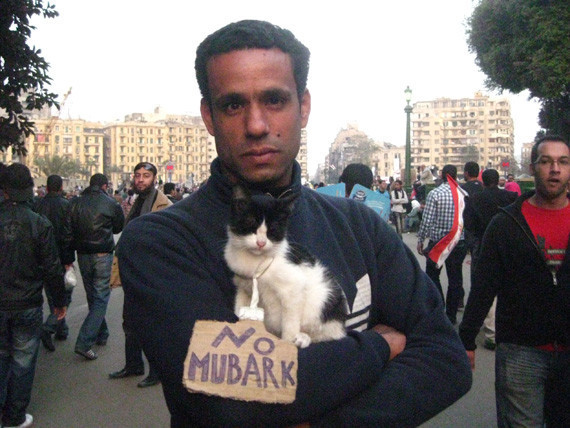

Many were there to just witness history. The hundreds of Egyptian flags--being waved or wrapped around bodies--reflected the nationalist sentiments. Scores of signs I saw read "Down, Down Mubarak," but I didn't see any placards against the U.S. or Israel. I asked a man if I could photograph him holding his cat, which had a little protest sign saying "No Mubark" around his neck. One of the protesters wore a t-shirt with "Lust for Life" written on it. "My generation was stupid," Mohammed reflected, as we left the demonstration. "We sat for 30 years with our mouths shut. My sons are smart. They have the Internet, and know what is happening in the world."

We tried to enter the upscale residential neighborhoods of Zamalek, where I had lived for a total of nine years. A band of armed residents were very aggressively keeping cars out, so we turned around and headed up the Nile again. We encountered numerous checkpoints where army personnel and local residents worked together to inspect vehicles and check papers. Finally, we arrived in Shubra, a massive garbage-strewn sector of the capital whose residents may be equal in number to half the population of Israel. Our car wound its way through crumbled streets partly flooded as usual by water main breaks. At one intersection after the other, we were stopped by tough-looking armed young men who seemed proud to be doing their part to protect Egypt. Surprised to see an American in this part of town, a few times different men told me, in English, "Don't be afraid, you're safe here." We drove by some of the numerous Christian churches in the area; they were untouched in the disturbances.

After night fell, the number of roadblocks increased. On the west bank of the Nile, we stopped at more than a dozen on the way south back to Maadi. At the last checkpoint before crossing the river to the east bank, men warned us not to take the new six-lane Ring Road bridge because bandits were ambushing vehicles there. So we turned around and crossed at another place. When we got to Maadi around 9 p.m., six hours after the start of the daily curfew, the army had completely sealed it off. As one Maadi resident flew into a rage about not being allowed to drive to his home, a local army commander shouted angrily and fired a half dozen shots in the air.

I said goodbye to the friends, got out of the taxi and walked the rest of the way home. A bit later, in my pajamas, I went down to the campfire on the street corner where the men of our neighborhood security detail were watching a TV with President Hosni Mubarak announcing that he would not run for another term of office. Mubarak was already president when I first came to Cairo 28 years ago. "Welcome to the new Egypt," I said to myself.

Scott MacLeod, Time's Middle East correspondent from 1995 to 2010, is managing editor of the Cairo Review of Global Affairs and a professor at the American University in Cairo.

 
Friends following the revolt on the Nile on their television screens in the U.S. are asking: "Are you leaving?" Planeloads of American expats, trapped tourists and other assorted foreigners are being...
 
 
  • Comments
  • 18
  • Pending Comments
  • 0
  • View FAQ
Comments are closed for this entry
View All
Favorites
Recency  | 
Popularity
photo
HUFFPOST SUPER USER
HappyBalance
People BEFORE Profits
09:17 AM on 02/03/2011
Thanks so much Scott, thanks for sharing how things really are and not how the fear mongers (in the US and elsewhere) claim them to be.
HUFFPOST SUPER USER
sherifdxb
06:46 AM on 02/03/2011
Yes Scott, welcome to the New Egypt, where not a single attack on a church or synagogue has been recorded since Jan 25th. A friend of mine, who is admittedly a rich businessman told me by phone on Tuesday : "I've just returned from the march of the one million. I couldn't believe the sense of unity among the people. Someone would offer me water, another some juice, a piece of chocolate. I've never met any of them before. In fact, I've never been to any protest since university (a long time ago), but for once in my life, I am proud to be Egyptian."
HUFFPOST SUPER USER
Marchmont
03:32 AM on 02/03/2011
In Arab countries where “democracy” has been introduced, Islamicists almost always take over and stay put in an African re-run of “one man, one vote, once”. The Muslim Brotherhood is playing it cool in Egypt but it knows its time is coming and when it takes over, the democracy hungry Egyptians can kiss goodbye to elections. These winds of change are likely to bring the West’s worst nightmare - an Islamist crescent spreading from Pakistan in the East to Morocco in the West. However, European and U.S. worries pale into insignificance compared with what politicians and military commanders in Israel are facing. If “democracy” comes to Egypt, the Muslim Brotherhood will immediately rip up the 1979 Egyptian-Israel peace treaty and after that all bets are off.
photo
Halsey
"There is a price to pay for speaking the truth. T
10:43 PM on 02/02/2011
Scott, this was a wonderful post. Do you need (take pity) on a non-Arabic speaking white woman who wants/needs to be part of something monumental? I've no death wish, trust me.
Always a wannabe "involved" person, having recently survived (I assume) cancer, I've experienced a shift in the paradigm of how I want to live the rest of my life. I fear pain, I do not fear death (yet again, want to live). But by gawd I'd be on the first flight that would allow me into Cairo (um..I'd have to stay with you and your family at first). I live in a dream world where I pretend you would hire me.
BTW, HP nailed this by posting the photo of the young man holding a kitten. Tenderness in the middle of chaos.

I am so proud of you.
10:30 PM on 02/02/2011
Scott, thank you so much for the eye witness account. I'm an academic, too, so confess I probably live in a bubble. Nonetheless, all of my colleagues are following the news from Egypt and all of them are solidly behind the protestors and so is most of our media. There are demonstrations here in most big cities; petitions circulating on the progressive blogs... Americans aren't all FOX news tea baggers. They understand people fighting for basic rights. I hope the Egyptians know this. My take so far is that Mubarak is dead meat...the question is how much damage he can do before he realizes it.
09:58 PM on 02/02/2011
Let hope it doesn't become another iran. Iran should become the new egypt.
photo
HUFFPOST SUPER USER
Mara Para
08:23 PM on 02/02/2011
Thank you, Scott MacLeod, for sharing the real Egypt with us. The best and most insightful reporting is coming from the people who know Egypt best - those who actually live there. Big Media politicians, pundits and foreign policy wonks have done very little to convey the real story of the Egyptian people. They may also be taking us in directions we need not go (promoting fear of an unlikely Islamic fundamentalist takeover, for example).

CNN's Ben Wedemann has also offered a citizen's-eye view of the protests in Cairo. An on-line bio says he is fluent in multiple dialects of Arabic. His immediate translation of the chanting I could hear from the street helped me understand what the Egyptian people were asking for. Wedeman talked about his own concerns for his home and family.

Unfortunately, Wedeman's empathetic reporting has been side-lilned by the arrival of CNN star, Anderson Cooper. Cooper and the other television stars who parachuted into Cairo during the last few days cannot offer the same depth of coverage as journalists who are Arabic-speakers and residents of Cairo or Egypt's other great cities. I respect Cooper's abilities as a gad-about reporter, but would rather Wedeman continue to explain what is happening in his Cairo.

I wish main-stream news networks would rely more on the real men and women on the Egyptian beat. Scott MacLeod and Ben Wedeman, as citizen journalists, are doing a superlative job conveying the real human condition in Egypt. Bravo!
HUFFPOST SUPER USER
GV97
Song Bird
07:31 PM on 02/02/2011
Mr.Macleod.....
Thank you for your interesting article.
If Mubarak is fortunate enough to stay until elections is he going to still have control of the ballot
boxes ?
photo
HUFFPOST SUPER USER
macs3rd
07:30 PM on 02/02/2011
My heart aches for the peaceful protesters in Egypt. I believe that they represent the people and that the gangs are just that. Gangs.
07:10 PM on 02/02/2011
Thank you for such a sane view on Egyptian reality.
As an aside, Tahrir Square should probably be renamed Tahrik Square.
Being here myself, I was happy to refresh myself with the local good natured popular approach to a situation which could easily have further degenerated, and still could under such irresponsible provocation from utterly delegitimized authorities.
photo
HUFFPOST SUPER USER
Paperless Tiger
06:07 PM on 02/02/2011
The protesters seem pretty focused on regime change. That random violence thing is scary though, but I guess it's supposed to be.
photo
HUFFPOST SUPER USER
Jehosafats
Body Without Organs
02:37 PM on 02/02/2011
To see the youngster with the sign, in English no less, saying "Dear tourists, don't leave, we will protect you" was a bit surreal, especially since now reporters are being beaten in the streets. And now, what do I see - angry pro-Mubarak b-girls in Adidas jumpsuits! Egypt is sending the world a very mixed message, and it isn't very inviting.
HUFFPOST SUPER USER
William50
11:52 AM on 02/02/2011
Cairo is a huge city with twelve million or more citizens. The gatherings, even when they number hundreds of thousands do not affect the entire city nor the nation. Millions are making sure they are safe, having dinner and watching TV.
The individuals who are demanding change plus the commentators suggest this is a Democratic movement to throw out the bad government. It may have started like this but now it is a rebellion demanding that they take over.
The President after saying he would not run should also state that free open elections will be in four months. Let the people decide. Those in the streets do not want this either because the people may not agree with all of their demands. But that is real democracy, allowing all the people a choice not just those in the streets.
This user has chosen to opt out of the Badges program
01:36 PM on 02/02/2011
Those who are staying at home are providing safe havens for those on the streets, especially when trapped by curfews. There are also children who must be taken care of: 50% of the population is under the age of 30. Notice that there are no kids on the streets. The overwhelming majority of the demonstrators are able-bodied men capable of providing effective rebuttal to the violence of the police and the agents provocateurs. Very smart!

Mubarak had 30 years. He hasn't earned that right to beg for 4 months, 8 months, whatever. He is a Trojan Horse who must leave now.
Teahater
Darjeeling is the greatest evil.
05:39 PM on 02/02/2011
How do you know all this? It really sounds as if you are making it all up.
photo
HUFFPOST SUPER USER
Grendl Jones
11:23 AM on 02/02/2011
Egyptians love their children too.

They will fight to restore order to their country. The only question is what percentage will fight for the old guard and Mubarak's right to remain another eight months, and what percentage want him out now. If the country's split 50/50 or anywhere near it, the bloodshed and violence might be massive.

If, as it seems, theres overwhelming sentiment for him to go now, and the bullying pro Mubarak thugs are a small minority, the process will go smoother. Of course its impossible to get a breakdown of supporters versus dissenters, that's what makes this a crapshoot.
03:09 PM on 02/02/2011
The crapshoot is getting worse. My daughter's friends, who have been protesting at the university, are starting to support Mubarak. His thugs have done so much damage to innocent homes and families that these students are wishing for a return to the status quo. At this point, our American friends are getting it, but our Egyptian friends are starting to give up.