- companies have to report their financial holdings with full disclosure and transparency;
- accountants have to verify those financial assets and statements;
- markets price stocks on the basis of all available information;
- due diligence is conducted on every deal and transaction;
- boards of directors have a fiduciary duty to undertake prudent risk management;
- management want their companies to thrive over the long-term;
- and, most importantly, regulatory bodies and law enforcement agencies are in place to police the system.
- We failed to regulate the derivatives market;
- government-backed agencies like Fannie Mae and Freddie Mac pushed to make housing affordable for greater numbers of people;
- unscrupulous mortgage brokers pushed sub-prime mortgages at every opportunity;
- investment bankers pooled and securitized those sub-prime mortgages by the trillions of dollars and sold them like hot cakes;
- rating agencies - left unmonitored by the SEC - incredibly stamped these pools with Triple A ratings;
- the SEC, which changed the capital-to-leverage ratio for investment banks to 30-and-50-to-1, allowed these banks to buy up huge pools of these soon-to-be-toxic assets; and
- investment banks wrote credit default swaps and then hedged those risks without any central clearinghouse, without any understanding of who was writing how much or what it all meant - all this without any regulation or oversight.
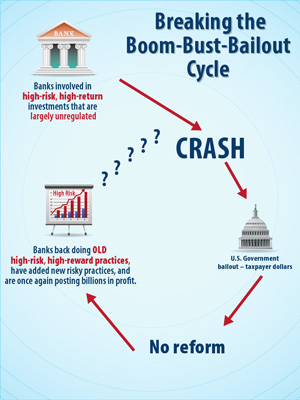
So as the chart so straightforwardly conveys: Banks were involved in high-risk, high-return investments that were unregulated.
Then - crash. The housing bubble burst and a disaster of truly monumental proportions struck.
Americans lost $20 trillion in housing and equity value during the ensuing financial meltdown. The economy lurched into freefall and Gross Domestic Product shrunk by a staggering percentage not seen since the 1950s.
What happened next? The American taxpayer, the deep pocket and lender of last resort, had to ride to the rescue. Mr. President, we can barely even count the trillions of dollars of taxpayer money that have gone into bailing out the banks, bailing out AIG, bailing out a number of financial institutions.
And that's not including the billions of taxpayer dollars we have had to spend to stimulate the economy. Mr. President, we must never let this happen again.
Yet here we are. One year later. With no immediate crisis at hand, we are falling back into complacency. The credit default swap market remains unregulated. The credit rating agencies have not yet been reformed. And the banks are back to their old habits: paying out billions of dollars in bonuses for employees who are still engaged in high-risk, high-reward practices.
What is the great lesson we should have learned from the Financial Debacle of 2008? When markets develop rapidly and change dramatically, when they are not regulated, and when they are not fully transparent - it can lead to financial disaster. That is what happened in the credit default swap market.
Mr. President, we must never let this happen again.
And so I look forward to working with my colleagues to regulate the derivatives markets - to ensure that credit default swaps are traded on an exchange or at least cleared through a central clearinghouse with appropriate safeguards enforced. And to enact meaningful financial regulatory reforms.
Mr. President, at the same time, we need to be looking carefully to see if these three deadly ingredients - rapid technological development, lack of transparency, and a lack of regulation - are appearing again in other markets.
Mr. President, there is no question in my mind that in today's stock markets, those three ingredients do exist. Due to rapid technological advances in computerized trading, the stock markets have changed dramatically in recent years. They have become so highly fragmented that they are opaque - beyond the scope of effective surveillance. And our regulators have failed to keep pace.
The facts speak for themselves. We've gone from an era dominated by a duopoly of the New York Stock Exchange and Nasdaq to a highly fragmented market of more than 60 trading centers. Dark pools, which allow confidential trading away from the public eye, have flourished, growing from 1.5 percent to 12 percent of market trades in under five years.
Competition for orders is intense and increasingly problematic. Flash orders, liquidity rebates, direct access granted to hedge funds by the exchanges, dark pools, indications of interest, and payment for order flow are each a consequence of these 60 centers all competing for market share.
Moreover, in just a few short years, high frequency trading - which feeds everywhere on small price differences in the many fragmented trading venues - has skyrocketed from 30 to 70 percent of the daily volume.
Indeed, the chief executive of one of the country's biggest block trading dark pools was quoted two weeks ago as saying that the amount of money devoted to high-frequency trading could "quintuple between this year and next."
Mr. President, we have no effective regulation in these markets.
Last week, Rick Ketchum, the Chairman & CEO of the Financial Industry Regulatory Authority - the self-regulatory body governing broker-dealers - gave a very thoughtful and candid speech, which I applaud. In it, Mr. Ketchum admitted that we have inadequate regulatory market surveillance.
His candor was refreshing but also ominous: "There is much more to be done in the areas of front-running, manipulation, abusive short selling, and just having a better understanding of who is moving the markets and why."
Mr. Ketchum went on to say:
[T]here are impediments to regulatory effectiveness that are not terribly well understood and potentially damaging to the integrity of the markets...The decline of the primary market concept, where there was a single price discovery market whose on-site regulator saw 90-plus percent of the trading activity, has obviously become a reality. In its place are now two or three or maybe four regulators all looking at an incomplete picture of the market and knowing full well that this fractured approach does not work.
Mr. President, at the same time that we have no effective regulatory surveillance, we have also learned about potential manipulation by high frequency traders.
Last week, the Senate Banking Subcommittee for Securities, Insurance, and Investment held a hearing on a wide range of important market structure issues.
At the hearing, Mr. James Brigagliano, Co-Acting Director of the Division of Trading and Markets, testified that the Commission intends to take a "deep dive" into high frequency trading issues, due to concerns that some high frequency programs may enable possible front-running and manipulation.
Mr. Brigagliano's testimony about his concerns were troubling:
[I]f there are traders taking positions and then generating momentum through high frequency trading that would benefit those positions, that could be manipulation, which would concern us. If there was momentum trading designed - or that actually exacerbated intra-day volatility - that might concern us because it could cause investors to get a worse price. And the other item I mentioned was if there were liquidity detection strategies that enabled high-frequency traders to front-run pension funds and mutual funds that would also concern us.
Reinforcing the case for quick action, several panelists acknowledged that it is a daily occurrence for dark pools to exclude certain possible high frequency manipulators.
For example, Robert Gasser, President and CEO of Investment Technology Group, asserted that surveillance is a "big challenge" and that improving market surveillance must be a regulatory priority:
"I can tell you that there are some frictional trades going on out there that clearly look as if they are testing the boundaries of liquidity provision versus market manipulation."
But none of the panelists, when asked, felt a responsibility to report any of their suspicions of manipulative activity to the SEC. That is up to the regulators and their surveillance to stop, they apparently believe.
Finally, at the end of the hearing, Subcommittee Chairman Reed asked about the reported arrest of a Goldman Sachs employee who had allegedly stolen code from Goldman used for their high frequency trading programs.
A Federal prosecutor, arguing that the judge should set a high bail, said he had been told that with this software there was the danger that a knowledgeable person could manipulate the markets in unfair ways.
The SEC has said it intends to issue a concept release to launch a study of high frequency trading. According to news reports, this will happen next year. Mr. President, I don't believe next year is soon enough. We need the SEC to being its study immediately. Where is the sense of urgency?
Mr. President, our stock markets are also opaque. Again, I refer to Chairman Ketchum's speech: "There are impediments to regulatory effectiveness that are not terribly well understood and potentially damaging to the integrity of the markets."
He went on to say:
We need more information on the entities that move markets - the high frequency traders and hedge funds that are not registered. Right now, we are looking through a translucent veil, and only seeing the registered firms, and that gives us an incomplete - if not inaccurate - picture of the markets.
Senator Schumer echoed this theme at last week's hearing:
Market surveillance should be consolidated across all trading venues to eliminate the information gaps and coordination problems that make surveillance across all the markets virtually impossible today.
Let me repeat: market surveillance across all the markets is "virtually impossible today." And none of the industry witnesses disagreed with Senator Schumer. That is why the SEC must not let months go by without taking meaningful action. We need the Commission to report now on what it should be doing sooner to discover and stop any such high frequency manipulation.
Mr. President, where is the sense of urgency?
Mr. President, we must also act urgently because high frequency trading poses a systemic risk. Both industry experts and SEC Commissioners have recognized this threat.
One industry expert has warned about high-frequency malfunctions:
The next Long Term Capital meltdown would happen in a five-minute time period. ... At 1,000 shares per order and an average price of $20 per share, $2.4 billion of improper trades could be executed in [a] short time frame.
This is a real problem, Mr. President. We have unregulated entities - hedge funds - using high frequency trading programs interacting directly with the exchanges.
As Chairman Reed said at last week's hearing, nothing requires that these people even be located within the United States. Known as "sponsored access," hedge funds use the name of a broker-dealer to gain direct trading access to the exchange - but do not have to comply with any of the broker-dealer rules or risk checks.
SEC Commissioner Elisse Walter has recognized this threat:
[Sponsored access] presents a variety of unique risks and concerns, particularly when trading firms have unfiltered access to the markets. These risks could affect several market participants and potentially threaten the stability of the markets.
Let me repeat that: "These risks could affect several market participants and potentially threaten the stability of the markets."
Even those on Wall Street responsible for overseeing their firms' high frequency programs are not up to speed on the risks involved, according to a recent study conducted by 7city Learning. In a survey of quantitative analysts, who design and implement high frequency trading algorithms, two-thirds asserted their supervisors "do not understand the work they do."
And though quants and risk managers played a central role exacerbating last year's financial crisis, 86% of those surveyed indicated their supervisors' "level of understanding of the job of a quant is the same or worse than it was a year ago," and 70% said the same about their institutions as a whole.
I agree with market expert and 7city Director Paul Wilmott, who said: "These numbers are alarming. They indicate that even with the events of the past year, financial institutions are still not taking the importance of financial education seriously."
Mr. President, where is the sense of urgency?
Time is of the essence.
We must act now.