iPhone app iPad app Android phone app Android tablet app More

Featuring fresh takes and real-time analysis from HuffPost's signature lineup of contributors
Seth Shostak

GET UPDATES FROM Seth Shostak
 

Forsaking the Ivory Tower

Posted: 12/12/2012 1:34 pm

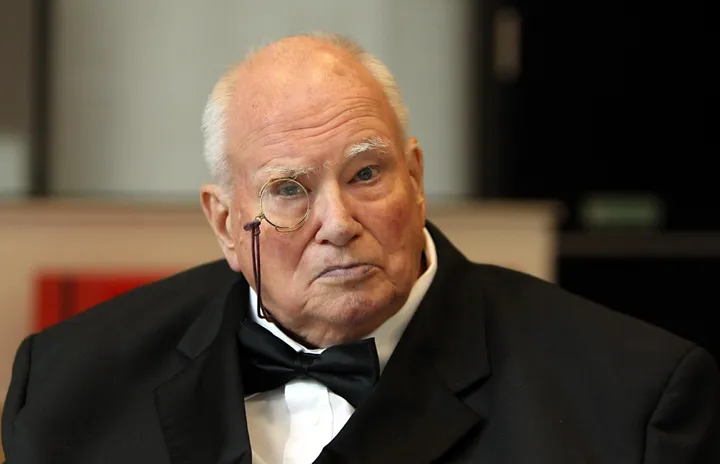
Patrick Moore -- the brooding presence with the gruff voice and monocled eye -- has died. The famous British popularizer of astronomy passed away at the age of 89 this week. He had the distinction of being the author of more than 70 books and the host of the world's longest-running television series featuring a single host: The Sky at Night.

Moore was a popularizer; not a traditional research astronomer with a PhD, tenure, grad students and -- most important -- a stack of academic reprints. Moore chose broadcasting over narrowcasting, and tried to educate the everyman. His work was for the public, not the specialist.

That may sound like a worthy, indeed an admirable, life. But to many scientists, it isn't. All too often they feel that talking at a level that the general populace can grasp is somehow a lesser activity. Taking science beyond the lecture hall borders on the unseemly -- as if NBA stars were to routinely engage in pick-up games with the neighborhood kids.

Popularization, and even more so its less frequently used synonym, vulgarization, have a distinctly low-brow tenor.

This is a relatively new development, however. Towards the end of the 19th century, when science was growing like kudzu and inventors including Nikolai Tesla, Thomas Edison and George Eastman were warping its discoveries into everyday products, there was good reason to connect the public to science. Science was something that any educated person could understand -- and in many cases, turn to use. Lectures and popular magazines were ubiquitous. Top-notch academics went on the road to speak of the latest developments. British scientist John Tyndall traveled to New York to give some physics lectures, and when these were written up by a local newspaper, fifty thousand copies were sold.

Explaining the discoveries of science to the general public was considered worthwhile and exemplary.

But a half-century later, attitudes were distinctly different. Science had become both arcane and specialized. Consider the theories of General Relativity and quantum mechanics, developed near the time of the First World War. Both are subtle and intensely mathematical. Scientists assumed that garage tinkerers wouldn't understand them, and couldn't convert the new ideas into practical devices. They largely abandoned popularization and their work turned cryptic.

At the same time, government funding of research (often channeled through universities) cut the umbilical cord between the practitioners and the public. Many scientists didn't care much whether Mr. and Mrs. Front Porch had the slightest clue about their day jobs.

For the last hundred years, science has become a boutique activity, performed by high priests assumed to possess superior intellects and inferior social skills. But we can no longer afford to seclude science in an ivory tower. As Shawn Lawrence Otto repeatedly demonstrates in his book Fool Me Twice: Fighting the Assault on Science in America, our day-to-day existence is now deeply marinated in science. Even more, our species' future hinges on making the right choices in matters that are shaped by science. What do we do about climate change? About genetic engineering? Future water and energy needs?

We need the next generation of scientists, yes. But a more problematic requirement is ensuring a citizenry that understands enough about research to make the best decisions. And that underscores the critical importance of that seemingly bourgeois occupation, science popularization.

Conveying the excitement, the sheer joy of learning something of everlasting truth and, often, unbounded utility, is not merely a nice thing to do. It's an essential thing to do.

When I was ten years old -- an age at which many people develop the interests that will remain with them for a lifetime -- I was given a book by Patrick Moore about the planets. That was a single, small seed that planted a lifelong flowering in me, yes... but Moore spawned forests around the world.

He was a man of protean accomplishment and noble purpose. We need more like him.

 
FOLLOW SCIENCE
 
 
  • Comments
  • 50
  • Pending Comments
  • 0
  • View FAQ
Comments are closed for this entry
View All
Favorites
Bloggers
Recency  | 
Popularity
Page: 1 2  Next ›  Last »  (2 total)
photo
White Raven
Eyeballs are tasty
12:11 AM on 12/19/2012
So long as scientists are sequestered in universities and not involved in the day to day life of those of us who do most of the living and dying in society they will be little more than erudite pets. They lose their relevance more and more, the more distanced they become from the rest of us, most of whom do not live or work in a university. It also means that come a day when we no longer can afford to keep those pets, the scientists will find themselves among the first to go because they have lost the ability to make the case for their usefulness to people who need to eat.

It would absolutely be in the interests of scientists to remember these facts.
08:01 AM on 12/19/2012
Oh, the French Revolution strikes back! Based on the tone of your post, you may not know all the ramifications that kind of attitude brought to that country. Look it up.

I must say that I do not know whether to be amused or offended by being called an "erudite pet", but at any rate, I take issue with that statement, which is by the way, a reflection of what is going on in our country, sadly, this will most likely make us lose our preeminent world position as a technological country.

I hope you realize that academics are largely responsible for the discoveries and the education of those who invent and build virtually every kind of technology that you may use, including the electronics that you are using to disparage us. Before you point out the successful school dropouts, note that they are the proverbial smallest minority... Anyway, life scientists do the discoveries that your physician uses to treat your disease (most physicians do not do research).

Also, who says that we do not live and die in our society? Reverse elitism much? Any kind of honest job is an honorable one. I just happened to choose this one because of a modicum of mental capacities and VERY hard work, make no mistake about that. I am a scientist and professor because I used my abilities...
photo
White Raven
Eyeballs are tasty
02:54 PM on 12/19/2012
First let me apologize. I don't actually intend to belittle your profession. When I wrote that initial post I was (still am actually) feeling sick and extremely cranky. I'd rather you chose to be amused at being called an erudite pet, because if you chose to be offended by it that wouldn't really speak well for either of us.

As for the elitism charge: That's the problem. There is a strong sense of elitism in too many university professors. If you are one yourself then I hardly have to tell you this, as you surely see it.

I absolutely agree that scientists do a tremendous amount of good for our society. I am if anything extremely pro-science myself, being neither conservative enough to deny climate change or evolution nor liberal enough to deny the utility of space exploration, animal research, or vaccinations.

Anyway please read my statement as the rant of someone whose head has been pounding and is generally angry at everybody.
08:13 AM on 12/19/2012
And by the way, I am also a churchgoer (I do not only drive by it), volunteer in my community and (brace yourself) pay my taxes!!!!!!
10:56 PM on 12/18/2012
Lol, sorry about that; toy have a couple of paraphrased posts form mine that say essentially the same thing. My apologies.....
10:18 PM on 12/18/2012
Again?
10:07 PM on 12/18/2012
I have tried to post this comment 3 times already. Here it goes again. I am all for bringing science to the general public. That is part of what I do myself, as I blog about it. I also happen to be an active scientist and educator. It is great to write about science, but it has to be done right. I have little patience with some "science journalists" who write "fun-size" science and leave it at that. For example, it is great to look at space pictures; they are gorgeous! But, how many times these are accompanied by a description of all the hard work involved? About the Curiosity probe and Mars, that's great, but almost nobody writes about the complex engineering that some people master to make things like this happen.

We NEED the kind of training and know-how that the proverbial Ivory Tower represents. We can do away with the elitism of some, but that is another topic. Finally, it is absolutely possible to be a top-notch scientist and a prolific popularizer, do not forget Carl Sagan...
06:19 PM on 12/18/2012
I think it is very important to bring science to the general public, and I do not only talk the talk. I blog about it. I also happen to be an active prof scientist. It is not enough to bring science to the public, you have to bring the correct information, you absolutely need to know what you are talking about. I have little patience with many "science journalists" who report bite-size science and leave it at that. Take space pictures for example, they are absolutely gorgeous, but in a newspiece about them you rarely hear anything about all the work that took to take them. Curiosity landed on Mars? GREAT! But have you heard about all the complex engineering that so many people had to master in order to make it happen?

We absolutely NEED the knowledge and know-how associated with the proverbial ivory tower. There is no other way for true, well-done science to progress. We can do without the elitism usually associated with it, but that is another story.

Finally, it is entirely possible to be a top-notch scientist and a prolific communicator; let's not forget Carl Sagan!
photo
HUFFPOST SUPER USER
Alex Prior
Abyssum abyssus invocat
08:53 AM on 12/17/2012
Yea gods and little fishes! If I read one more American scientist inserting their head up their tiny little enclosed nationalist posterior I will have to scream aloud and jump up and down in a parody of impotent fury!

Science education works well, science communication works well. It does so everywhere except American and Saudi Arabia. In the US you have some complete whack-jobs in political power. Yip. They banned stem cell research and globally, stem cell research moved elsewhere. Times have changed.

Stop mixing up science and nationalism. Ain't the same thing.
05:01 AM on 12/17/2012
The popularity of science has exploded and everyone seems to agree on the need for it. This has provided the opportunity for many opportunists to bend science to conform to their own philosophies and as a result the definition of science has been stretched to encompass just about everything. I'm not sure it's fair to say that the popularization of science has declined, rather, the popularity of science has been used to fool a scientifically-illiterate public that can't tell what's science and what isn't. There are no dominating personalities out there popularizing science like Stephen Jay Gould and Carl Sagan but they're out there. The problem is that what they have to say is drowned out by the constant drone of junk from cable TV (i.e. the so-called History Channel, the absurd SyFy Channel and the wanna be Science Channel). So I think we need not worry about there not being enough popularizers out there. We need to worry about the fact that others are abusing science and getting away with it. It would be nice if some of the popularizers could step up and show the victims of this 'science piracy' what science is what it isn't. IOW, they should make a special effort to confront the pseudoscience directly. There's amazingly little out there that responds directly to pseudoscience. If we could do that then we might see an appreciation for real science grow and maybe we'll see the number of science popularizers grow, too.
photo
HUFFPOST BLOGGER
rtgmath
There has got to be a better way!
11:02 PM on 12/15/2012
"For the last hundred years, science has become a boutique activity, performed by high priests assumed to possess superior intellects and inferior social skills. But we can no longer afford to seclude science in an ivory tower."

Huh?

And again, I say, Huh?

Where has this author been?

Okay, I know he is an astronomer. With SETI, no less -- the organization that helps us looks for signs of life in the great "out there."

But maybe, just maybe, he ought to pull his head out of whatever dark hole he has pushed it into. Scientists do *lots* and *LOTS* of science in the public view. Perhaps we haven't gotten Fox News to tell about us very much. But science and its efforts get lots of good press.

Ever hear of NASA and the missions we have on Mars? Or the pictures that come from the Hubble telescope as well as others? Or the work being done on battery technology to make electric cars feasible -- with the goal of being able to go 500 miles on a charge and "fill up" on electricity in a few minutes? Or the latest dinosaur fossil finds? Or the new medical treatments? And how about those cell phones?

The problem isn't that science is being done in an ivory tower away from everyone. It isn't, and hasn't been for years. Science is being transformed into usable technology, making our lives more connected and complex.

Science isn't hidden. It is integrated.
photo
Keagan86
Breaking normal thought patterns
02:44 AM on 12/15/2012
That's why we have people like Stephen Hawking, Neil DeGrasse Tyson and Richard Dawkins. There contributions are in the realm of explaining to us normal people their passions and how it relates and ultimately uplifts all of us. I love thinking about the universe and quantum mechanics, but I suck at math so I could never do it. However, I am totally inspired by all of it.
photo
HUFFPOST SUPER USER
bccmeteorites
Don't believe everything NASA says.
03:50 AM on 12/14/2012
Lots of science has gone off the deep end literally, and I'm not just talking about the medical and behavioral sciences. I'm talking about all science at least in the US. It's sad to watch. I read a medical study (and this is typical) someone actually got paid to perform. The headline was "Women become dehydrated and agitated when denied liquids". Oh really? There was another recent study, "Team of scientists use DNA to discover early people transported food across the sea". (They actually had to employ a team of DNA microbiology specialists and a separate team of Archeologists to examine these clay jars and tell us early Europeans transported food in amphorae-clay jars across the Mediterranean something, that has been known since people could build boats).

One of the DoE centers is currently featuring their brilliant work on their front page. A Scientist shown in a lab holding a lithium battery the size of a penny with big plans to increase it's energy output by X% or something like that. How about letting the battery companies or high school kids figure that one out?

If this is the type of stuff scientists want to communicate to the public, please stay in the ivory tower.
HUFFPOST SUPER USER
DakkonA
www.DisentangledReality.com
11:34 AM on 12/14/2012
I just searched for the article you mentioned. The only thing I found is you making the same claim back in May.
photo
HUFFPOST SUPER USER
bccmeteorites
Don't believe everything NASA says.
12:10 PM on 12/15/2012
Good.
HUFFPOST SUPER USER
DakkonA
www.DisentangledReality.com
11:38 AM on 12/14/2012
1) There are always going to be less useful things. You seem to be cherry picking your evidence.

2) "One of the DoE centers is currently featuring their brilliant work on their front page. A Scientist shown in a lab holding a lithium battery the size of a penny with big plans to increase it's energy output by X% or something like that. How about letting the battery companies or high school kids figure that one out?"

Umm... maybe because it relies on a degree of chemical knowledge not available to high school kids? Maybe because, I don' t know, the DoE's job is energy research? And oh, its certainly not possible that such a technology could scale up, could it? /sarcasm
photo
HUFFPOST SUPER USER
bccmeteorites
Don't believe everything NASA says.
09:54 AM on 12/15/2012
Umm... maybe because it relies on a degree of chemical knowledge not available to high school kids?

That's a challenge tailor made for high school kids, but not a challenge for the DoE. I mean seriously.
08:50 AM on 12/13/2012
There is so much to agree with in this essay. The greatest thrill I have experienced always involved a learning experience. Whether through reading or listening, my attention was riveted to the detail or message offered by a person who cared enough to want to communicate.

The "Ivory Tower" allusion is apropos, but the current lack of respect for scholarship has reached an alarming level. The aphorism, "Knowledge is Power", somehow now simply relates to data mining for computer search engines. It is, however, the foundation for everything you do in life. Then, maybe at the end you can "Know Thyself".
08:03 AM on 12/13/2012
I must strongly disagree with the theses of this post for a number of reasons. First, as a practical matter, engaging in popularization takes time that could otherwise be spent doing science, as the careers of Patrick Moore and Paul Sagan amply demonstrated. One simply can't both write popularizations and do research at a cutting edge level.
In the second place, a combination of decreasing general literacy here in the US combined with the author's admitted increase in complexity of the topic has acted to stifle the conversation. I'm a physicist for whom quantum mechanics was my favorite topic in graduate school. I LOVE talking about it, but don't because when I attempt to start a conversation with my non-scientist friends, I see eyes glazing over and sudden urges to find the restroom. In America people are much more comfortable talking about sports or their kids, clothes, houses, cars. (My cynicism derives from having similar responses when I try to talk about art.)
Finally, here in the US especially, the rise of the religious fundamentalists with their absurd positions on practically everything scientific (global warming, the age of the earth, evolution, the response of the female body to rape, you name it) coupled by their complete intolerance to other ideas makes people like me extremely reluctant to engage in a public discourse. Who enjoys being threatened?
09:39 AM on 12/13/2012
To my mind, your post is a perfect validation in response to Seth's argument. The American public needs more scientist's who are gifted in communicating how their professions stimulate and excite their curiosity, which leads them to new discoveries and marvels.

I am sure you are well respected and have a gift for science. The gift of communicating is just as vital in the current dilemma faced by the scientific community. Those who vilify the scientists and their findings have a lot to lose when the theories are shown to be proven fact.

Sagan & Moore must have been so excited about their field that their zeal was catching by the populace.

I would not enjoy being threatened and I am sorry that you are.
photo
VeryGrood
only class worse than micro-bio was molecular-bio
03:15 PM on 12/14/2012
To my mind (I hold an undergrad degree in biochemistry and a graduate degree in physical chemistry), his post is spot on.

I took 4+ years of collegel math (calc 1 + 2, linear algebra, diff. eq., bio based statistics, general stats & prob, graph theory, real analysis).

I can't even come close to understanding the mathematics behind the MAJORITY of the cutting-edge research being published today. You cannot water down / popularize the vast majority of the science being realized today.

And, more to his point... start talking about "Schroedinger's Cat" with any number of science enthusiasts and you will realize exactly how far off the people who are actually intrigued by science are.
lastpost
see biography
07:40 AM on 12/13/2012
 “a relatively new development”
Not really. Questions that experts can’t answer have always been around. The trick has been to prevent such erratum from permeating public consciousness. While the correct response to such paradoxes was Patrick’s very own catchphrase: We just don’t know.

“Nikolai Tesla, Thomas Edison “
A perfect example of propaganda being deployed to pervert the paragon, that true science aspires to become. AC vs. DC. Practicality vs. presentation.

“Scientists assumed that garage tinkerers wouldn't understand them”
Maybe we need a breed of garage/scientists. Which appears to be happening. With ventures giving anyone access to a 3D printer. Or with scientists that question conventional wisdom and, by playing around, access a graphite super material.

“high priests”
tend to make reference to their own bibles. Which, if containing an error, have no mechanism for self correction.

"Fool Me Twice:"
Failing to ask for a second time, what should have automatically been asked the first.

“What do we do about climate change?”
How about, admit that science has provided us with the potential to destroy ourselves? Much as religion did before it. These two forces are powered by the very lifeforce they were devised to protect. Thus those ways in which they create a threat to their own existence, are counter-productive in the extreme.

“everlasting truth”
The holy beaker of unending quest(ioning). Why would any ideology expose itself to testing, if its opponent was not more than eager to submit itself to a similar Promethean baptism?
09:43 AM on 12/13/2012
F&F'd. Brilliant.
photo
HUFFPOST SUPER USER
CharlesCT
02:45 AM on 12/13/2012
There are many that worry about their grandchildren having to pay for our debts incurred now. And, they want austerity with lower wages for the "working' peoples because they say we cannot afford to be the biggest and the best any more. These are the people that shun science.

I was lucky enough to grow up in the '50's and 60's when we BELIEVED in science and knew we could do anything we wanted to. Go to the moon. FANTASTIC. Fly the speed of sound. Achieve and accomplish what we set out to do. Everyone gained as we grew in knowledge and experience. We all got a better life. We respected knowledge and science. We respected the men and women that achieved and taught. We actually were in awe and wonder of these greats. I am so grateful to them all. "Greed is good" was not a value then.
09:46 AM on 12/13/2012
I too, feel lucky to have grown up in that era. What a change faces our grandchildren.
photo
HUFFPOST SUPER USER
jsgaetano
Legum servi sumus ut liberi esse possimus
02:16 AM on 12/13/2012
I've been reading about science for entertainment my entire life. It's hard for me to view science as being in some "ivory tower", since I see all kinds of outlets discussing science which are easily accessible.