
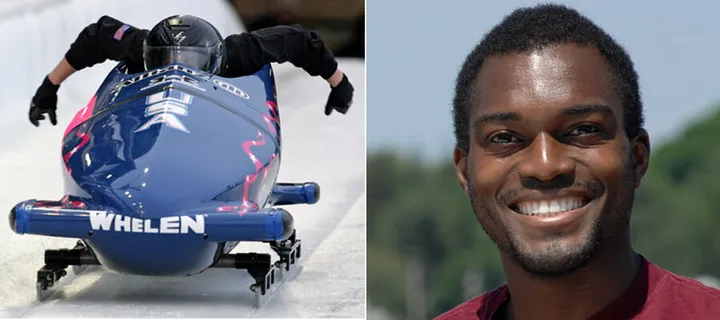
As a 26 year-old African-American, I don't know which is more difficult: trying to make history as the first Nigerian delegate in the Winter Olympics, or finding a donor for a bone marrow transplant.
In June 2009, just days after graduating from Yale Law School, I was diagnosed with two rare and aggressive forms of cancer: lymphoblastic lymphoma and stem-cell leukemia. Instead of a grueling Olympic training regimen for the skeleton -- an 80 mph headfirst plunge down a mile-long ice chute -- I underwent an equally grueling cycle of high dose chemotherapy during a seven-week hospital stay at Memorial Sloan Kettering.
My survival hinges on receiving a bone marrow transplant. The likelihood of a match is highest among persons of similar racial backgrounds, but only about 515,000 potential donors -- 8% of the total registry -- are African-Americans. As a result, 83% of African-American patients like myself do not receive a life-saving transplant.
The emotional toll of searching for a donor can be even more devastating than chemotherapy, as I recently expressed on my blog:
As I padded down the fluorescent-lit linoleum corridors of the leukemia ward this morning, my intravenous bags and pole obediently in tow, I bumped into a tall, lanky white male patient in his early sixties, clad in a blue and white polka-dot hospital gown. We fell into stride together; he talked, I listened.
Like me, my companion was waiting for a bone marrow transplant. Unlike me, he had already found three matches through the national registry. I responded to the good (miraculous, even) news with a hearty exclamation of congratulations, but he had already moved on to a more pressing concern: filling out the mountain of insurance forms that awaited him. I lapsed into a pensive silence as my cheerful companion rattled on about paperwork, reflecting upon the radically different roads to recovery that he and I must tread.
From his casual demeanor, the prospect of a matching donor (let alone three) did not seem to rise to the level of a miracle; if anything, for him, finding a match was a statistical probability. Not for the first time, I felt a deep chasm of inequality yawning beneath my feet -- one that almost every transplant candidate of color must first leap, even before facing the harrowing challenges of the transplant itself.
To combat this tragic situation, I seek to recruit 10,000 new potential donors to the national registry. On January 10, 2010, from 11 - 4 p.m. ET, I will host a donor drive at the Yale Club in New York City with DKMS, the world's largest and fastest-growing donor center. All it takes to register is a cheek swab! If you are fortunate to be a match, you will need to stay committed and available. A DKMS representative will guide you through the entire donation process, which can be done in one of two ways. Both are outpatient procedures.
1. The most common form of donation involves collecting stem cells via the bloodstream. To increase the number of stem cells for the collection, donors receive daily injections of a synthetic protein called filgastim for four days. The donor's blood is removed from one arm, passed through a machine that separates out the stem cells, and then returned through the other arm. The collection takes about 6-8 hours. Side effects of the filgastrim may include headaches, or bone or muscle aches, but the achiness subsides shortly after the collection. The feeling of having just done something incredible lasts much, much longer.
2. A less common donation method involves collecting marrow cells from the backside of the pelvic bone using a special syringe. Donors receive anesthesia so that no pain is felt during the surgical procedure, which lasts one to two hours, and are discharged on the same day. Donors might feel discomfort in their lower back, as well as side effects from the anesthesia, such as nausea, sore throat or light-headedness. Another side effect might be a certain glow that comes from knowing you have just saved someone's life. After donation, the marrow completely regenerates within a few weeks.
You can learn more about becoming a donor or register online at www.dkmsamericas.org, and follow my quest at nigeria2014.com And, in 2014, when I am racing down the Olympic slopes in Sochi, Russia, you can say you helped me make it to the finish line.
If you were inspired by this blog post to register with DKMS Americas, we'd love for you to post a comment below. Impact wants to see Seun Adebiyi exceed his goal of 10,000 new donors. With your help, we can see him at the Olympics in 2014.