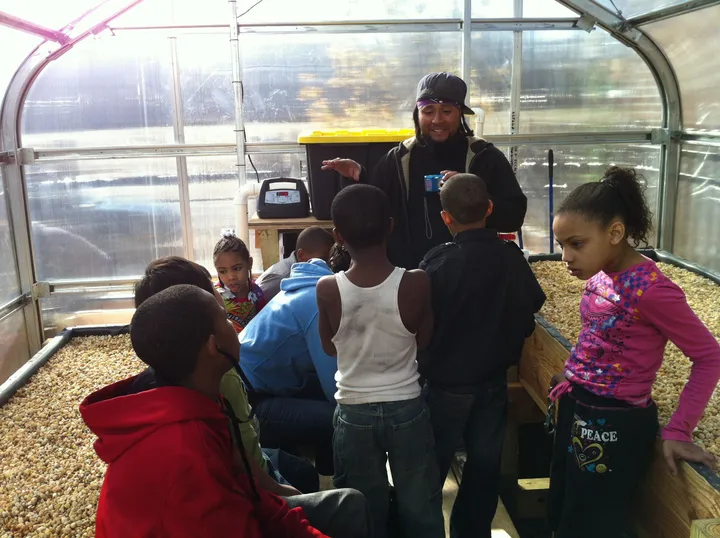
"What's that?" one of the kids asked, with big gleaming eyes.
"That's a firefly" I said, with a smile, realizing it was his first firefly-sighting.
"Why does it glow like that?"
I thought for a minute. "I'm not sure. I think God just felt extra wild one day and said, "I think I'll make a bug that glows in the dark."
"God is cool" the kid said, grinning from ear to ear.
One of the most beautiful things we get to do here at The Simple Way is plant gardens in the concrete jungle of North Philadelphia -- and see kids discover the miracle of life, and fall in love with the Creator of life. Gardens have a special place in the human story. After all God first planted humanity in a garden in Eden. And the most redemptive act in history began in a garden in Gethsemane. And the story ends in Revelation with the image of the garden taking over the City of God, with the river of life flowing through the city center and the tree of life piercing the urban concrete.
Now, as we approach 15 years of community here at The Simple Way, we have half a dozen lots that we are gardening on. And we are seeing a neighborhood come back to life. I will never forget the haunting words of a neighborhood kid who once said years ago, "It's easier to get a gun in our neighborhood than it is to get a salad." His words broke my heart. And they have continued to fan a flame all these years to try and change that reality.
When a kid pulls a carrot out of the ground for the first time it is magical. The more they see things that are alive, the more filled with wonder they become at the God who made all this wild and wonderful stuff like fireflies and butterflies, hummingbirds and earthworms - and you and me. Sometimes it's hard to believe that there is a beautiful God when so much of what you see is ugly. It's hard to believe in a God that is a lover of life when there is so much death and decay and abandonment.
So we talk alot these days about "practicing resurrection" -- by making ugly things beautiful... and turning vacant lots into gardens... and loving people back to life. Not a bad encore after Easter here. After all, resurrection is something we get to do every day. Every day is Easter. We are resurrection people.
Our latest experiment in resurrection has been a new greenhouse which we completed this past week. We built it on the fire-scorched land where our houses burned down almost exactly 5 years ago. Now our park flaunts this solar-powered greenhouse with a 200-gallon fish pond that can hold over 1000 fish that will fertilize the water where plants will grow... an integrated system of fish-farming and hydroponics that mimics what nature does naturally. Building on some of the most creative techniques in urban farming, we are now cultivating life in these post-industrial ruins, where we see the dark side of the global economy every day. Each morning we wake up on the wrong side of capitalism. But we see hope. We are building a new world in the shell of the old one. We see grass piercing concrete. We see a neighborhood coming back to life, rising from the dead. We now have a little oasis in the "food desert" of North Philadelphia.
In the end - it's all about small things with great love. What's important to us is not how much we do, but how much love we put into doing it. We want you to know that we are committed to taking your financial gifts and doing small things with great love.
It is no coincidence that the images Jesus uses for the "Kingdom of God" are very small. The Kingdom of God is like yeast, which you cannot even see. It's like light - and salt... little things that have unprecedented power. And one of those images is mustard.
Mustard was an interesting metaphor. It was an invasive plant. Jews had laws against growing mustard in their gardens, because it would take over the whole garden, leaving them only with mustard. It's like the wild kudzu we have down south that can cover an entire house with greenery, or like the wild weeds that crack the foundations of our houses here in Philly. It's a beautiful and scandalous image. Mustard is a humble plant though - it didn't grow huge like the cedars of Lebanon, or the giant redwoods in California. Mature mustard only stands a few feet high, a modest little bush.
One thing that mustard, light, salt, yeast all have in common is that they take over - they are invasive in the best sense of the word. Everywhere we look we see this dazzling invasion of grace in the world - spreading like wild mustard. It is happening on our block as gardens take over vacant lots. It's happening around the world as new communities sprout like seedlings. And you all are like the hidden heroes of the garden. You are planting seeds that you may never even see the fruit of - so thank you.
Here are some seeds to remind you of the incredible movement that we are all caught up in. Thanks for making it possible. And thanks be to our Lord Jesus - the seed that died so that we all can live. Please remember us in your prayers as we continue to practice resurrection. And know that you are in our prayers as you cultivate life and interrupt death right where you are.
Here is a prayer that we pray every morning, and that we prayed as we dedicated the new greenhouse last week. We invite you to pray it with us. Somedays you can replace "Kensington" with your town name... and other days we hope you will leave "Kensington" in and remember us.
Almighty God,
we praise you for all you have done.
Help us with all that you want us to do.
Come, Holy Creator,
and rebuild the City of Kensington
so that we do not labor in vain without you.
Come, Holy Savior,
and heal all that is broken
in our lives and in our streets.
Come, Holy Spirit,
and inspire us with energy and willingness
to rebuild Kensington to your honor and glory.