iPhone app iPad app Android phone app Android tablet app More

Featuring fresh takes and real-time analysis from HuffPost's signature lineup of contributors
Sharon Salzberg

GET UPDATES FROM Sharon Salzberg
 

Meditation: The Key to Resilience in Caregiving

Posted: 11/19/10 09:21 AM ET

As I look forward to co-leading this retreat, People Who Care for People: Tools for Resiliency at the Garrison Institute, I find myself reflecting on caregivers I know. Some practice caregiving professionally, as nurses, first responders, chaplains, non-profit attorneys; others in their personal lives, as parents, children, siblings, friends. As difficult and pressured as caring for others can be, as tiring and overwhelming as it often becomes, many express a very powerful happiness at being able to serve.

An important element in how we keep going is being able to touch that happiness, broadening our perspective beyond what we see just in front of us, reminding us of our deepest motivation and what we care about most. In a challenging environment, facing our own or others' suffering, we need to draw on inner resources.

Whether you care for a young child, an aging parent, a difficult-to-understand teenager, a client at work with no clear resolution to their problems in sight, any skillful relationship of caregiving relies on balance -- the balance between opening one's heart endlessly and accepting the limits of what one can do. The balance between compassion and equanimity. Compassion is the trembling or the quivering of the heart in response to suffering. Equanimity is a spacious stillness that can accept things as they are. The balance of compassion and equanimity allows us to profoundly care, and yet not get overwhelmed and unable to cope because of that caring.

I have been involved for several years in a program run by the Garrison Institute, bringing the tools of meditation and yoga to domestic violence shelter workers, and then to shelter supervisors and directors. These people are very much on the front lines of suffering, dealing daily with their clients' issues of betrayal, heartbreak, fear, anger, humiliation. They might be survivors of trauma themselves. They might receive very little institutional support. They inevitably rely on inner resiliency to sustain their work over the long term.

Our premise has been that fostering greater balance of heart and mind is a key to that resiliency, and that one valuable avenue to cultivating this balance is meditation practice. Meditation helps us see our own difficult mind states -- such as anger or fear or a sense of helplessness -- with compassion instead of self-judgment. It also provides a refuge during life's storms by helping us connect compassionately with others, no matter the circumstances.

Especially in times of uncertainty or pain, meditation broadens our perspective and deepens our courage. The spaciousness of mind and greater ease of heart that naturally arise through balanced awareness and compassion are fundamental components of a resilient spirit. They bring us an unusual kind of happiness, one not determined by the conditions we find ourselves in, not defined by the amount of "success" or "failure" we saw in our efforts today. Meditation helps us return, again and again, to this unique happiness.


Follow Sharon Salzberg on Twitter: www.twitter.com/sharonsalzberg

As I look forward to co-leading this retreat, People Who Care for People: Tools for Resiliency at the Garrison Institute, I find myself reflecting on caregivers I know. Some practice caregiving profes...
 
 
  • Comments
  • 17
  • Pending Comments
  • 0
  • View FAQ
Comments are closed for this entry
View All
Favorites
Bloggers
Recency  | 
Popularity
photo
Keith DeBoer
Meditation Teacher
12:11 PM on 11/26/2010
Nice article. The ideal, as I think you have described is to care, and to give, but to set limits and also care and give to ourselves and meditation is one good way along with proper diet, proper rest and recreation. Balance is key. Blessed are those that have the desire and ability to care for others who are in need. Peace be with you.
photo
HUFFPOST SUPER USER
khanti
Cultivator
11:09 PM on 11/21/2010
Real caregiving whether to the sick, healing the mind or simply looking after our aged parents do need compassion. Being in the caregiving profession like doctors and nurses mean you get trained to do a proper job but the compassion factor plays an important part. Those who succeed in this profession like Florence Nightingale and Mother Theresa are shining examples of people who have compassion for their job. Compassion is spontaneous, not much of thinking more on the reaction at the sight of sufferings.
08:10 PM on 11/20/2010
Amazingly truthful article, we are in the health care industry and you can tell who is burnt out almost immediately it is to bad the clients have to be exposed, that is why it is so important that management has the experience to spot such patterns. http://soberlivingbythesea.blogspot.com
11:37 AM on 11/20/2010
It is a very interesting article. It is wonderful to have the opportunity to care for others and meditation gives the ability to access the calm, peaceful and happy center of our being. I practice the Art of Living meditation technique along with the Sudarshan Kriya breathing technique everyday.I find it gives me the serenity to deal with the ups and downs of life with poise. It has opened me up so I can see the beauty in everyone and really care for people with my heart without getting too bogged down by problems. best wishes, Maya
http://www.artofliving.org
10:34 AM on 11/20/2010
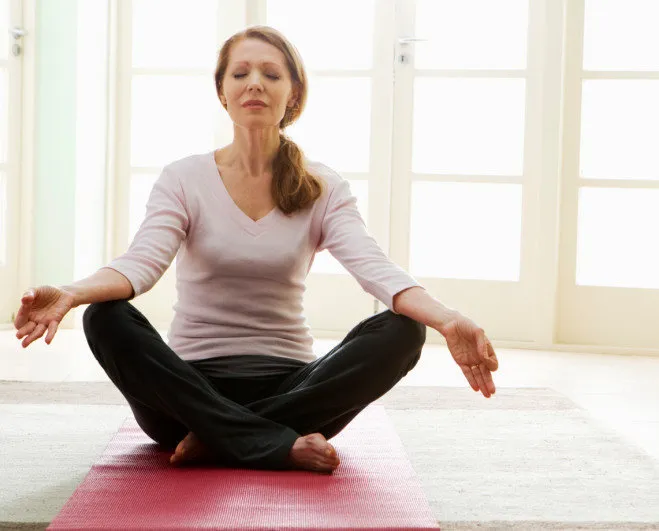
The picture of the meditating woman for this story shows she is not actually meditating at all. Her posture is terrible. In meditation the first rule is a straight spine.
This user has chosen to opt out of the Badges program
photo
SarcasticFringehead
Mute Nostril Agony
06:22 PM on 11/20/2010
Good observation.

I've heard of the Full Lotus position, the Half Lotus position, even the Quarter Lotus position.

The woman in the photo must be doing the Non Lotus position.
photo
HUFFPOST COMMUNITY MODERATOR
Weirdwriter
12:12 AM on 11/20/2010
A great article. I hope people reading it who haven't tried meditation will be more inclined to give it a shot -- it can be learned completely for free, by the way. No need to pay out bucks for some self-styled guru to teach you.
photo
HUFFPOST SUPER USER
Dustin Rudolph
Clinical Pharmacist & Certified Nutritionist
10:06 PM on 11/19/2010
I keep reading more about meditation and the benefits of it and it really makes it easier to do which is not an easy feat in itself with me. My mind is always racing and I have a hard time calming it down for as little as 5 minutes.

When I tried meditation the first time it was a lost cause but as I keep trying I'm able to "get it" at least for a few minutes (5-10 minutes). Hopefully I'll be able to get to a half hour someday. I certainly could use this stress reliever being in high stress job in the medical field.

Dustin Rudolph
www.PursueAHealthyYou.com
07:58 PM on 11/19/2010
Appreciate this reminder so much, Sharon, especially your inclusion of all sorts of people we don't typically think of as caregivers. Recently a former client, Olivia Hoblitzelle, sent me the new edition of her book Ten Thousand Joys & Ten Thousand Sorrows: A Couple's Journey through Alzheimer's (I worked on the first edition; this one was just released by Tarcher/Penguin) and I was reminded how Olivia's story of caring for her husband is permeated by the balance of compassion and equanimity you describe -- all courtesy of her meditation practice. May your teaching work continue to bring benefit to caregivers, and by extension, to those in their care. Hats off!
This user has chosen to opt out of the Badges program
photo
05:27 PM on 11/19/2010
Thanks for bringing attention to the power of meditation and the need. Caregivers should meditate so that they CAN give the care, otherwise one can run out of energy and loose presence of mind, and thereby not be fully available to help others.
03:48 PM on 11/19/2010
Thank you for this, Sharon, it is a timely article. I work as a professional caregiver, and am ordained as a lay monk in the Chan tradition. I am an enthusiastic proponent of meditation not only as a sitting practice, but especially for active caregivers, a way of being with our clients or loved ones. Staying mindful of the principle of staying awake in the moment allows us to turn our attention away from negative inner speech and toward a more contemplative approach. As I get to know a client's wants and needs, I make a point of really listening, both with ears and heart and attending to any judgments that arise, in order to question their reality. In this way I try to remove any obstacle to providing care with an open heart and a present mind. Care giving can be stressful, but it doesn't have to be. By remaining present in each moment, and drawing our attention back to the present when it inevitably strays, one gradually finds staying present easier, and care giving more relaxed, intuitive and stress free. I find that even the most 'difficult' clients respond to loving presence positively.
01:11 PM on 11/19/2010
Being a caregiver can be a very stressful experience, and meditation is a great way to reduce stress. Caregiving can also be a significant source of worry and anxiety, and, if left unchecked, this obsessive worry can start to take over your life and prevent you from being the best possible caregiver. I often recommend meditation, guided imagery, and breathing exercises for patients who are experiencing stressful situations like caring for a sick relative. These simple techniques can go a long way in improving one's health and quality of life. I describe the difference between these methods on my blog: http://bit.ly/dp6rjP
HUFFPOST SUPER USER
ritaray08
Obama Supporter since 2004
12:54 PM on 11/19/2010
Wonderful starting place for resiliency of the spirit. I've been in these situations more than once & it is so hard to keep things in perspective when you watch others suffer. Thanks for the article.
photo
HUFFPOST BLOGGER
Stephen Kent
11:51 AM on 11/19/2010
This points up an important social issue. Trauma is a global epidemic: in the US 7.7 million veterans and civilians with PTSD, 5.3 million reported cases (32 million estimated) of domestic violence annually (half are children), worldwide 26 million displaced persons. Secondary trauma or vicarious trauma, where the human service providers (nurses, therapists, cops, shelter workers, humanitarian relief workers, etc.) are at risk for trauma from working with traumatized people, is also epidemic. But it's more generalizable; eldercare, parenting, teaching, and any form of dealing closely with distressed people (and who of us doesn't?) all require inner resources to cope with stress, avoid burnout, bounce back and be effective. Meditation is the way to access them, and it needs accessible delivery mechanisms to reach the millions who could benefit from it.
This user has chosen to opt out of the Badges program
photo
05:17 PM on 11/19/2010
Very true. Meditation is essential for the care giver, as much as for those who need the care.

Another current Huff Post article addresses just that — how veterans and others suffering from PTSD, and their families, can benefit from meditation. There's an upcoming benefit where Clint Eastwood, Dr. Oz, Russell Simmons and others are getting together with David Lynch to raise money to provide effective meditation training to 10,000 veterans and families: http://www.huffingtonpost.com/jeanne-ball/clint-eastwood-russell-si_b_781840.html
03:14 PM on 01/07/2011
Thank you for connecting meditation practice to caregiving work.

I work as a home tutor in NYC. All of my students come from immigrant families who have many needs apart from the basic tutoring that I specifically provide.

Having boundaries here is difficult because I genuinely do CARE, but have difficulties determining when to decide that it is time to leave. I "feel" like if I take the time to ask a question, I will never leave. So I am currenty torn between my heart which tells me to get involved and to ask more questions about culturally sesntive topics that I encounter or to just leave-- when I simply leave, I preserve myself, but I also don't foster deeper connections.

I ask myself: How deep do I expect my connection to be with my students' families? What is a balanced relationship built on prefessionalism, trust and friendliness look like?

Two of my students are Afghan, here for the last 2.5 years after the Taliban's influnece bacame worse in that country. They come from the upper class. Anyway, I now see that the parents may be in need of therapy for their memories, trauma, but if I suggest it, I get more deeply involved and I have found that when I do this, I compromise the specific tutoring work that I do and I become distracted.

I am in the process of finding support for my work, I haven't found it yet.
11:15 AM on 11/19/2010
Thank you, Sharon. This is truly helpful. I'm sending this to several of my friends, most of whom are caring for ailing parents, and need all the support they can get. These simple but powerful reminders are rippling out, and I am grateful to you!