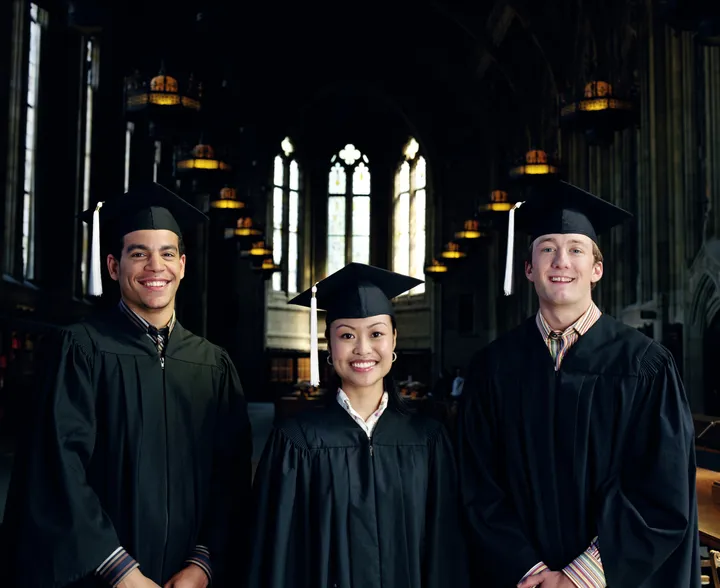
It has become a truism that the United States is one of the most religiously pluralistic countries in the world. Increasingly, in order to articulate the nature of current events, we find ourselves having to learn the cultural and theological distinctions among different religious traditions. Yet discussions about the current religious landscape often ignore one salient fact: the Abrahamic religions and cultures have been deeply intertwined and intricately related from their inception. At the same time, other religions, such as those with origins in Asia, are steadily growing in their number of adherents in the United States. Within a five-mile radius of Claremont School of Theology, there are places of worship for Jewish, Muslim, Christian, Hindu, and Buddhist communities. In states like California there is no majority race, ethnicity, or religion. Similar demographic shifts, while uneven across the United States, will occur often in the next 50 years.
The idea of people from different faith traditions living in close proximity to each other is an increasing reality. Looking at the demographics, it appears unrealistic to talk about Christianity -- or any other religious group -- in isolation from the other faith communities that surround it, either in this country or abroad, and yet many religious institutions continue to do so until the point of crisis. This reality poses the challenge: Where in our troubled world do interreligious learning, dialogue, and relationships most need to take place? How can religious institutions, in particular those interested in training local religious leaders and the next generation of scholars, build relationships across religious differences that enhance dialogue and learning, better equip current and future religious leaders to live into religious pluralism, and provide people with skills to promote the common good in their communities?
Today we at Claremont School of Theology have made a commitment to live into these questions. At a press conference this morning, we announced our agreement to co-create the first graduate consortium in the world that will provide theological education for Christians, Jews, Muslims, as well as students from other faith groups. Each group will maintain its own curriculum and have the opportunity to contribute to a unique shared interreligious curriculum designed to provide students with the experience of interreligious dialogue and study alongside students from other religious traditions.
In addition to the diverse schools of religion, the "University Project" will include programs in key academic areas including ethics, politics and society. Claremont has already received $10 million to begin funding this co-creation and will offer some of the Project's first classes this fall.
The two Los Angeles-area institutions that have joined us in this idealistic vision are the Academy for Jewish Religion, California, a transdenominational rabbinical, cantorial, and chaplaincy school, and the Islamic Center of Southern California, the oldest and largest mosque in Los Angeles, which plans to help us establish the Center for Advanced Islamic Scholarship to be one of the first accredited programs for imams in the United States.
Another truism is that interreligious dialogue is more about deepening the existing religious identity of an individual than it is about conversion to another religion. Furthermore, research shows that individuals who learn in religiously diverse environments usually do not convert to another tradition. As a Christian, I can attest from first-hand experience that interreligious dialogue expanded my spirit and vision. I have a deeper sense of what it means to be a Christian because of my encounter with people from other faith traditions. Interreligious dialogue has helped me to articulate and to live on a deeper level what it means to be a follower of Jesus than if I restricted my religious encounters to people who shared the same religious assumptions and worldview that I do. Interreligious living has also challenged me to learn more about my own religious tradition, its strengths, as well as its challenges for those who adhere to other truths.
The University Project is not about watering down religious traditions or reducing them to an amalgam of platitudes and positive thinking. We have no intention of being a "food court of religions." Rather, we are interested in creating an environment that challenges each of us to become educated in our own traditions, as well as those of others, to promote mutual respect, and to work together on common issues and concerns. As Claremont's board member, Rabbi Gary Greenebaum, has said, "By knowing more about what I believe and how I express that belief, your own faith can be strengthened. Meanwhile my understanding of my own belief system grows stronger as I better comprehend your beliefs. Less smoke. More heat. Real fire. No mirrors."
We believe that if we can educate religious leaders and scholars across religious boundaries on our campus, we will better prepare them for today's multifaith realities and improve our local communities and our world in the process. As the University Project progresses, we will improve our religious understanding, our spiritual lives, and our ability to work across boundaries to repair the world. May God be with us.
Dr. Larry Dossey: Do We Live in a Meaningful Universe?
Of course we can simply quote the Buddhist monks, some of the more sensible folks in our religious cluster, no doubt, to the effect that "All religions meet on the horizon." Sure, like railroad tracks. Except that, of course, they don't, any more than railroad tracks do, but only appear to; it's called parallax. Wow; talk about much ado about nothing...
IF IGNORANCE OF NATURE GAVE BIRTH TO GODS, KNOWLEDGE OF NATURE IS MADE FOR THEIR DESTRUCTION.
-- Percy Bysshe Shelley, The Necessity of Atheism
-------------------
Ninety five percent of our best biologists reject the Delusion - but not 100%.
OUR LATEST SURVEY FINDS THAT, AMONG THE TOP NATURAL SCIENTISTS, DISBELIEF IS GREATER THAN EVER — ALMOST TOTAL.
We found the highest percentage of belief among NAS mathematicians (14.3% in God, 15.0% in immortality).
Biological scientists had the lowest rate of belief (5.5% in God, 7.1% in immortality), with physicists and astronomers slightly higher (7.5% in God, 7.5% in immortality).
http://www.stephenjaygould.org/ctrl/news/file002.html
http://www.nature.com/nature/journal/v394/n6691/full/394313a0_fs.html
http://ncseweb.org/rncse/18/2/do-scientists-really-reject-god
http://www.lhup.edu/~dsimanek/sci_relig.htm
-
My blasphemous blog
--------------------------
Holyheretic.com
Why is it that I don smiles of contentment whenever I read your blasphemous comments, my friend?
Unfortunately I never know when it is the sacrilegious husband or the sexy, exotic wife who addresses me:-)
Why the constant insistence on displaying stats showing who believes and who doesn't? Why the continued argument "science is based on fact, but religion is based on nothing whatsoever that can be proven..."?
We as believers know this already. Faith is, by its very definition, the belief in thigs not empirically proven, not seen or touched. If it were not so... if we lived in a world where God proved his existence scientifically to each and every person each day... there wold be no need for faith.
As for you... hypohetically, what would be sufficient to make you believe?
Again, hope you are well. I look forward o your views, as always
-- Percy Bysshe Shelley quote, modified.
The Necessity of Atheism
You just got yourself a new fan, mighty midget. I also marked your comment as favorite.
You asked me: "Why the constant insistence on displaying stats"?
As a person of reason, I simply love facts, contrary to full-of-faith people.
The full-of-faith hate facts.
You write: "Faith is, by its very definition, the belief in thigs not empirically proven, not seen or touched".
“THE WAY TO SEE BY FAITH IS TO SHUT THE EYE OF REASONâ€.
Benjamin Franklin
You asked: "As for you... hypohetically, what would be sufficient to make you believe?"
One thing: fairy tales must make sense for me to believe in them.
By the way, dear TheMightyMidget, I assume you are not addicted to the Muslim voodoo. Are you? If not, why not? Voodoo is all the same.
Sorry man, but as long as you guys keep preaching that "anyone who doesn't believe what we believe or question what we're taught will burn in hell forever and ever" or that "Science, Logic, and Reason are the enemy" religion will be nothing but a destructive force.
Regarding "religious pluralism" - do you believe religions are anything but “sectarian dogmas�
THOMAS JEFFERSON'S REPLY TO JOHN ADAMS
"If by religion we are to understand sectarian dogmas, in which no two of them agree, then your exclamation on that hypothesis is just, "that this would be the best of worlds if there were no religion in it."
— Thomas Jefferson
Thanks to great "Rabbis" like Spinoza, Freud, and Einstein, many Post-Holocaust Jews are blessed with being liberated from their sacred dogma.
MY BLASPHEMOUS BLOGS
Holy Heretics - Jesus, Maimonides, Spinoza, the Founding Fathers, Herzl, Einstein.
http://holyheretics.com/
LEARN AND TEACH THE TRUTH IN ORDER TO SAVE THE EARTH.
Hmmm you might try in the science class THAT might be the first place. It's not that science can answer ALL questions, but as long as theology is disconnected from science it's self serving. I might say it's nonsensical regardless but i have a degree in theology and it and it's not completely without merit or value.
God is already with you and working through you. Many thanks.
If more people actually did study the origins of their religion, they would be much more inclined to leave its, um, "revelations" in the timeframe in which they were originally written instead of insisting upon a modern interpretation of ancient documents written in primarily dead languages.
I am working toward a Masters in Christian History myself and understand the importance of this. After all, the largest majority in the Republican party wants to legislate the New Testament. It might be helpful if they actually knew something about it . . .
That's great your studying Christian history. Now you can fight these new legislation's with what you learned in school!
I come from German-Jewish + German-Lutheran stock on one side of the family and Irish-Catholic on the other. It's a rather hodge-podge ethnic, cultural and theological background for sure. These rich, complicated and interesting experiences fed my youth and - even in my 50s - still shape who I am becoming.
I took an MA in Biblical Languages and Literatures at a Jesuit University. One of the main reasons I did so was to be able to couple a technical understanding of the Bible with theology to defend LGBT people against arguments used by faith communities to marginalize us. My education has served me well in that regard. I have found that some people are very open to dialogue, while others are not. Perhaps you may find yourself in a similar boat one day. It's all good!
Beyond that, the very education, itself, and its fruits are their own rewards. I am fortunate to teach and serve as the classical and modern language chair at my school (the $55K tuition bill was not in vain, after all).
That said, my studies and experiences in grad school led me first to become an agnostic and later, an atheist. I have no regrets for my education or decisions.
I wish you all the best as you pursue your heart and your dreams!
BTW I really like you post from Jan 10, 2010 at 14:34:49. Please allow me the first to "Fan" you!
My daughter will enter a Methodist-affiliated school of theology in two years. Two and counting, as far as she is concerned - she is wishing to hurry her undergraduate studies along so that she can be on her way.
Perhaps, with your University Project, she will want to join your community. I believe she has much to bring to that table since she is a child who grew up in a multi-ethnic family. Therefore, although firm in her Methodist roots, she places great value on diversity.
I will share with her this information. Thanks.
If this were a correct interpretation of scripture the Babel story is important. While civilization was building a tower that leads to a confusion of languages, Abraham was building a nation that is to lead to the end of the confusion of languages. While the tower of Babel was being introduced "to build up a name for "themselves", Abraham was building up a name for God through his lineage that would provide a key to the puzzle that involves all the other nations and their stories. In the future all will come together and focus on building a name for ourselves or building up a name for God. It is our choice. We are entering in to this time now.
Every culture at every time has been dealing with universal themes. Our languages have separated us. This is beginning to change.
The Bible speaks of multiple creations/recreations. The theme is that of redemption when possible and recreation when necessary. There isn't much that one must be frightened about.
The story of Babel suggest we all have a common origin and that we are separated by language. These ideas are true, as is the fact that as we progress this barrier seem to be decreasing.
When the Bible speaks about everyone doing what is right in his own eyes it includes Israel; the religious people. I did not suggest anything different. Everyone does that which is right in their own eyes including me.
I understand that you think my post is nutty and I understand why. It doesn't necessarily mean everyone will think it is nutty. I am hoping that someone will appreciate it.