When the streets fall silent in the next days and the dissidents once again head underground, the Islamic Republic of Iran will still be standing, buoyed by the last vestiges of a revolutionary platform: anti-Americanism.
In 1979, when the Islamists overtook the popular revolution and established an irreversible Islamic Republic, they made all range of promises - women's rights, freedom of religion, freedom of the press, open government, freedom, freedom, freedom. They also promised to keep the West, and particularly the United States, out.
Today, the freedoms have vanished without possibility and all that is left is anti-Americanism and the irony that America has inadvertently contributed so much to keeping the Republic intact.
Think back to the eight years of war with Iraq that fueled the martyrdom theme that sustained a fledgling and flailing young Islamic Republic who by the estimation of most Iranians had veered considerably from the path of the peoples' revolution. The United States support of that war is public knowledge now - whether it was backing Saddam Hussein in his early efforts to take advantage of an Iran overcoming revolutionary chaos, or helping supply Iran with the weapons it needed to steal the lives of millions.
Think of the past and current sanctions which have so damaged the Iranian public. They have played no small part in the economic problems faced by Iranians today, preventing ordinary people from conducting independent business, directly creating price increases for foreign imported products, preventing important international scholarly exchanges, and further isolating the Iranian people from the world . The sanctions have allowed the establishment total control over revenues, income, imports and exports - they've been a blessing beyond recognition for the clerics and their colleagues.
And what of the wars in Iraq, Afghanistan, Israel and Palestine? They have strengthened Islamist fervor throughout the region, labeled the United States as evil-doers, and created exactly the type of instability and division that the Republic thrives on.
Crisis mode is the Republic's autopilot and having an enemy which for many years has somehow justified retaliatory Iranian rhetoric in the eyes of millions of people worldwide who suffer US-backed dictatorships and wars has been the icing on the cake.
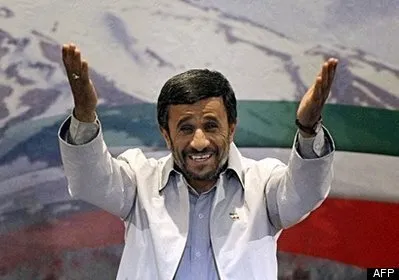
The decision to declare Ahmadinejad President is based largely on the fact that the Republic does not want to negotiate with America - that it quite likes being denounced by the United States.
But it is undeniable that continuing to isolate Iran is the best thing the Obama administration can do to ensure the Republic's continued survival.
Ahmadinejad's divisive rhetoric thrives on the notion that it would look terribly embarrassing for Obama to negotiate with him. But if the Obama administration is on a path toward improved relations with the Muslim world, it must improve its relationship with Iran. Publicly, not behind closed doors.
First off, America must distance itself from discussions of sham elections - the American government's legitimacy to condemn stolen votes has not yet recovered from its own sham presidential elections of recent. It is actually not the place of the United States government to question the domestic elections of any nation - this is internal interference and it doesn't look good on the diplomatic or impartiality scales. It also further validates Ahmadinejad's insistent claims of US plans for regime change.
It must cease talk of new sanctions and gradually see out current sanctions.
It must not underestimate the shrewd capability and organizational strength of the clerical system - a network that is centuries in the making and has successfully guided Iranian leaders of all stripes long before the ulema first established themselves as purveyors of the state religion of Iran some 500 years ago.
It must cease talk of war against Iran and condemn fanatic rhetoric of that kind from any nation. This talk is aggressive posturing which only elevates Iran's credibility amongst the millions upon millions of Islamists, Muslims, and non-Muslim third-worlders who have turned to Iran as the strongest voice of opposition to American hegemony.
It must engage in face-to-face dialogue with Iran. Distant criticism and transoceanic discourse make both sides lose credibility, fashioning a wild west stand-off out of what should be diplomatic talks.
Overall, the United States must give the Republic less excuse for legitimacy in anyone's eyes.
The Republic requires American antagonism to uphold its regional influence and its stranglehold on the Iranian people - the United States should deprive it of this gift. Both the United States and Iran need each other, but only one is a superpower. While the clerical dictatorship in Iran is stronger than ever, what is even stronger today is the public's will to be rid of it.
Don't think for a minute that Iranians actually believed that Mousavi is a reformer - they were so desperate for a chance at peace of mind - however little and temporary it might have been with a Mousavi win - that they were willing to go along with the charade. The landslide win was just a slap in the face to anyone who actually thought that even a miniscule window of opportunity would be possible.
The public isn't stupid - it is at its wit's end.
In Iran today, daily life is a complex psychological battle for dignity. What you wear, who you associate with, what you say and do either inside or outside your own home - all of these things are under government control and take a daily toll on the public's livelihood and serenity.
The people are so hopeless that they were willing to show support for Mousavi - a man known for upholding the values of a Republic that has systematically deprived Iranians of basic civil rights; a man who, as senior adviser to President Khatami stood by as the second "cultural revolution" of the late 1990's and early 2000's swept students off the streets, shut down semi-free newspapers, terrorized dissidents, and paved the way for the so called "hardliners".
If the Obama administration is truly supportive of the Iranian people and their real desire for change, at the very least it will stop providing the Republic with anti-American fodder. Instead, it will engage in dialogue with Iran toward the one goal it actually can achieve, eliminating the last bastion of the Republic's revolutionary zeal: the American threat.