Life Cycle is a series of posts on the extraordinary lives of everyday things.
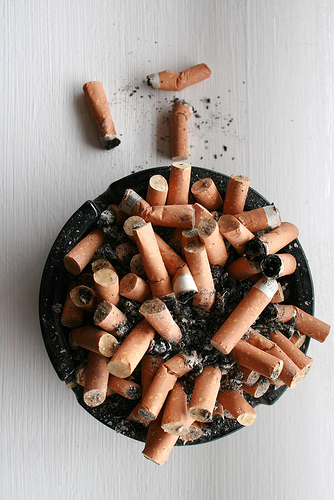
Growing up, the first thing co-blogger Sarah smelled every morning was smoke from her grandmother's menthol cigarette. (She ranks this odor somewhere between paper mill and trash in a hot alley, and as a teenager rebelled by NOT smoking.) She would come downstairs to find Grandma smoking over a skillet of bacon, buzzing happily with her first fix of the day--as were the millions of other Americans who rely on cigs to get through the day.
Our little tobacco friends begin, as do so many things, in a field within a warm climate, where tobacco plants are doused with chemical fertilizers and pesticides. Once harvested by many hands--sometimes those of a child--the leaves are dried and cured for upwards of three years and finally shipped from the company farm to the company producer. That's when the fun stuff gets added. The same ammonia that cleans your toilet helps your brain absorb nicotine more quickly. A chemical similar to rocket fuel keeps the tip of the cigarette burning efficiently. A little formaldehyde here, a little fungicide there. By the time leaves are cut down to size, adorned with filters, nestled in foil and wrapped in cellophane, one carton of cigarettes has wreaked a lot of havoc.
Deforestation is the most direct environmental repercussion of the approximately ten gazillion cigarettes smoked in the world daily. Wood is used just about every step in production--to cure tobacco, to wrap the leaves with paper, to box them up with cardboard. A cigarette manufacturing machine produces up to 14,000 smokes a minute, blowing through four miles of paper every hour. For every 300 cigarettes, one tree is consumed.
Other real drags, if you will: Tobacco production in developing countries utilizes child labor and causes food shortages by diverting farmland usage.
Once the cigarette has met its fate and burned down to a stub, it's headed for the landfill (or ditch or parking lot or river), where it takes anywhere from one to 25 years to decompose. In California's annual statewide cleanup, about half the collected items are cigarette butts.
The question of whether to light up most often revolves around the sanctity of one's own lungs; the legality of it revolves around personal rights of smokers and nonsmokers alike. But maybe that inner and social debate should involve not just personal health and freedom but the health of the planet.
If you agree, and are among those given to an occasional or habitual nicotine fix, consider rolling your own cigarettes. Or look into additive-free cigarettes on the market (referenced in our last post). Definitely check out the innovation of a couple brilliant young Brits, who have crafted a cigarette filter of vegetable starch and recycled hemp.
Join us next time for a most delicious morning consumable: newspapers!
This post was written by Sarah Smarsh and Simran Sethi. Thanks to the University of Kansas School of Journalism & Lacey Johnston for research assistance. Cig picture courtesy of Dani Connor on flikr.