Life Cycle examines the birth, life and death of the products in our lives.
How can a mahogany desk, made of slow-growing hard wood plundered from the Amazon, be eco-friendly?
When it's re-used.
Often, the greenest consumer route is not buying new products made with Earth-friendly methods but rather scoring used products made with traditional, possibly heinous methods. Reduce, reuse, then recycle.
This rule of thumb certainly applies to office furniture. Unlike energy-consuming products such as appliances, furniture is somewhat innocuous to the environment during that period between factory and landfill known as "in use." The impacts on indoor air quality, however, are like Britney: Not that innocent. Your cubicle accoutrements off-gas volatile organic compounds from glues, varnishes and sealants. That new furniture smell is a source of ear, nose and throat irritation, nausea and dizziness. But once your desks and chairs have been brought into the world, they should be encouraged to live long lives.
Scoring a desk via Craigslist, FreeCycle or good old-fashioned dumpster diving has several positive outcomes:
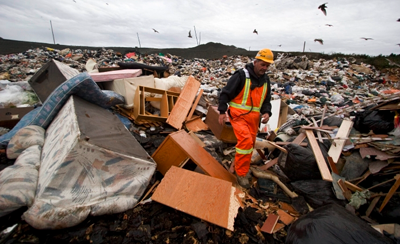
1. The used desk doesn't end up in a landfill. The EPA reported that furniture accounted for 8.8 million tons, or 3.6 percent, of our trash stream in 2005 (quadruple the tonnage in 1960).
2. Your need for a desk doesn't contribute to consumer demand for furniture production. Every year, U.S. companies purchase 16.5 million chairs, 4.5 million tables and 11 million file cabinets and 3 million desks. That mahogany beauty we mentioned may have resulted from illegal logging, a booming industry that meets demand for increasingly regulated, unsustainable hard woods and destroys native cultures and forests in places like Peru. Beyond wood, today's furniture is heavy on plastic, glass and metal--all involving finite natural resources, all creating air and water pollution throughout the refining and manufacturing process.
3. You save a little cash. Cheap, even free, used furniture gems are easy to find for the home. As for business owners who need large, streamlined quantities, furnishings can be a ginormous cost. Several companies now cater to them with affordable, refurbished products. The Virginia company Open Plan Systems cleans and repaints metal with low-VOC coatings, and replaces worn-out upholstery with fabrics made from recycled plastics. Michigan-based Kentwood claims that remanufacturing a single workstation saves 1,000 pounds of waste from landfills.
4. You feel great. It sounds silly, but it's true. Every time we reclaim something that would have ended up in a landfill, we're making things better. And fewer pieces of wooden furniture means less deforestation, which is a major contributor to climate change. It's been said that the mighty oak is just a little nut that stood its ground.
This post was written by Sarah Smarsh and Simran Sethi. Thanks to the University of Kansas School of Journalism and Lacey Johnston for research assistance and to Media.Canada for the image. You can catch previews of this and future posts on Green Options.
