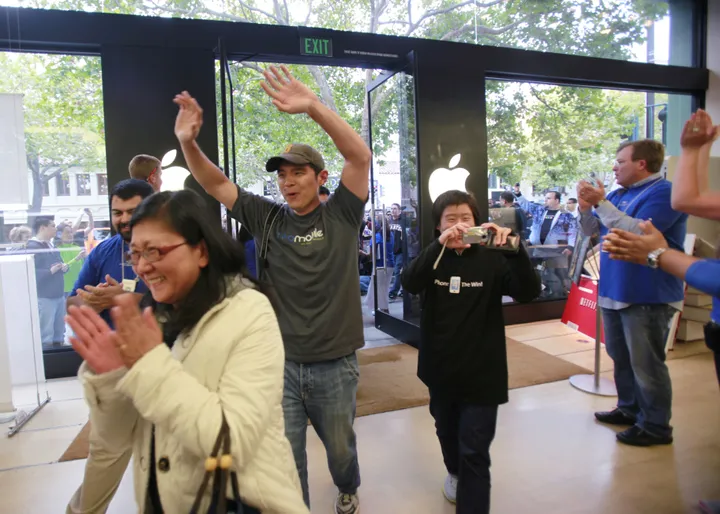
This week crowds of worshipers outside Apple Stores around the globe will finally be able to lay their hands on the latest object of their devotion: the iPhone 4. The public was given its first official look at the device a few weeks ago when Steve Jobs descended from his holy digital mountain with the updated phone in his hands. Reports have already circulated about spontaneous rallies of Apple fans, and we've seen the video footage of consumers reacting with fits of ecstasy as they hold their new purchase.
The frenzy created every time Apple releases a new product highlights a growing but under-reported phenomenon: the power of consumer brands to supplant traditional religions in peoples' lives. Many Christians believe the greatest threat to the church today is postmodernity. Others zero in on relativism. Some believe the enemy is secular humanism. Others think it's Islam. I disagree with all of these. In my view, the greatest challenge facing the contemporary church is consumerism. By that I do not mean consumption. It's not wrong to consume things. In fact, as contingent beings we've been designed to consume for survival. The only human that doesn't consume is one that has reached room temperature, in which case they are now being consumed. (Do I hear "The Circle of Life" in the background?)
The consumerism I'm concerned with is the kind that functions as a worldview. It forms the uncontested assumptions of our lives, and when it intersects with faith our perceptions of worship, mission, community, belief, and even God are fundamentally altered. These are all subject I tackle in my book, The Divine Commodity (Zondervan, 2009).
One aspect of consumerism that is particularly powerful is branding. (Add to it commoditization and alienation and you've got the unholy trinity of consumerism.)
Douglas Atkins, author of The Culting of Brands: Turn Your Customers Into True Believers, says, "Brands are the new religion ... They supply our modern metaphysics, imbuing the world with significance ... Brands function as complete meaning systems."
Without question one of the most potent brands in America today is Apple, and new research has shown that Apple has achieved the same impact on the human brain as religion.
Martin Lindstrom is the author of Buyology. He says:
Apple is (as we've proven using neuroscience) ... a religion. Not only that -- it is a religion based on its communities. Without its core communities, Apple would die -- it is already facing strong pressure as the brand simply is becoming too broad (losing) its magic. What's holding it all together is the hundreds if not thousands of communities across the world spreading the passion and creating the myths.
Adding to the evidence that Apple is actually a religion, psychologist David Levine, a self-identified Mac nut, says:
For many Mac people, I think [the Mac community] has a religious feeling to it. For a lot of people who are not comfortable with religion, it provides a community and a common heritage. I think Mac users have a certain common way of thinking, a way of doing things, a certain mindset. People say they are a Buddhist or a Catholic. We say we're Mac users, and that means we have similar values.
For more about the religious (even cultic) power of Apple, I suggest reading this article in "Wired" that details the messianic characteristics of Steve Jobs. There is also a documentary on the subject called "Macheads." In the trailer the film declares, "It's more than a computer, it's a way of life."
The identity-forming power of brands like Apple means the act of shopping has immense significance in a consumer culture. As Benjamin Barber writes, "If brand name can shape or even stand in for identity, then to figure out 'who you are' you must decide where (and for what) you shop." This may explain why shopping is now the number one leisure activity for Americans. As we peruse the shopping mall or stand in line at the Apple Store, we are not simply looking for an MP3 player, a computer, or a phone -- we are looking for ourselves. Shopping occupies a role in society that once belonged only to religion: the power to give meaning and construct identity. "To shop," Pete Ward observes, "is to seek for something beyond ourselves," and this desire "indicates a spiritual inclination in many of the everyday activities of shopping."
One question I pose in The Divine Commodity is this: If brands have become religions, is the opposite also true? Have religions been reduced to brands? I believe the evidence suggests they have. Researchers like Barna, Gallop, and others are finding it increasingly difficult to differentiate the behaviors and values of self-identified Christians from non-Christians with one exception: what they buy. Total sales of religious goods in America is nearly $7 billion annually. That is a whole lot of "Tommy Hellfighter" t-shirts, "Jesus Is My Homeboy" underwear, and "Fruit of the Spirit" energy drinks. One church leader has linked the merchandising with our new understanding of conversion: "Conversion in the U.S. seems to mean we've exchanged some of our shopping at Wal-Mart, Blockbuster, and Borders for the Christian Bookstore down the street. We've taken our lack of purchasing control to God's store, where we buy our office supplies in Jesus' name."
What does this mean for the future of the church in America? I hear a lot on Christian radio and see a lot of Christian books fighting against postmodernism, relativism, and secularism. But if people, including Christians, are constructing their identities and lives around consumer brands like Apple, is the church fighting the wrong battle? And perhaps more disturbing, are we unknowingly contributing to the problem by encouraging Christians to construct and express their identities via Christ-branded merchandise rather than through characters transformed to reflect the values of Christ himself?