
In the first event of its kind, over 200 of the world's leading experts on child protection on the Internet came together in Washington, D.C. last week for the inaugural Family Online Safety Institute (FOSI) Conference and Exhibition. Held at the Ronald Reagan Building a block from the White House, the FOSI conference was both a gathering of the faithful in the, at times, contentious world of online safety, and a celebration of the maturing of this issue in the minds of government, industry and the NGO sector.
The program was headlined by FTC Chairman Majoras, FCC Commissioner Tate, Internet co-founder Vint Cerf and a host of leading lights from the UK, Australia, Mexico and the European Union. In addition, over a dozen companies and organizations showed off their latest technology, educational materials and approaches in the adjoining exhibition hall. (Full disclosure: I am the CEO of the Family Online Safety Institute and was responsible for much of the program.)
The online safety community, which has been around since the mid-1990s, has reached a critical point of maturation - some would say an awkward adolescent stage - where the stakes are higher and the need to "get it right" has caused many to look more critically at what currently exists and where we, as a movement, need to go.
Commissioner Tate, in a session run by Charlie Firestone of the Aspen Institute, proposed that the e-rate be used to fund local media literacy programs across the country. Derek Wyatt, MP, upped the ante by saying that online safety should be taken to the next G8 gathering for consideration by the heads of states of the leading industrial countries. In a conversation with Ambassador David Gross, Vint Cerf talked up the powerful filtering tool, SafeSearch, within Google and the flagging system within YouTube used by the community of users to report porn or other noxious content.
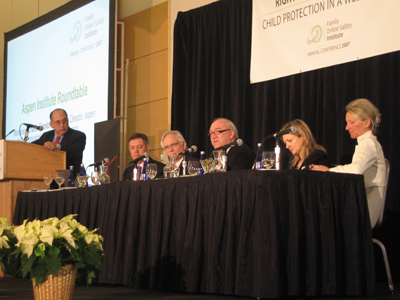
From L to R: Charlie Firestone (Aspen Institute), Chris Chea (ACMA), Bob Corn-Revere (Davis Wright Tremaine),
Derek Wyatt MP, Helen Normoyle (Ofcom), FCC Commissioner Deborah Tate
As head of FOSI, I criticized the current Administration for its lack of leadership and called for an annual White House Summit, bringing together the CEOs of the leading Internet companies, the heads of the many government departments involved in this issue and the top NGOs to review the lay of the land and for the President to use his or her bully pulpit to urge everyone to do more to protect kids from the worst of the Web.
At a time when the U.S. Congress is moving ahead with various measures to fund online safety education in much more meaningful ways, attention is being brought to bear on the nature of these programs - their methods and messages. As this is such a new field, very well intentioned folks and organizations have been creating training sessions for kids, parents and the teachers, themselves, with vastly different approaches and with little evaluation or independent review of effectiveness and worth. With bills on the Hill promising $50M of funding over the coming five years, with competitive tendering and, some, FTC oversight, the online safety world has got what it has been wishing for: Recognition, potential funding and much greater awareness of the problems and potential solutions to the various dangers of a Web 2.0 world.
It is now up to us, the many and varied actors in the family online safety space, to take the momentum, excitement and high level support, demonstrated at last week's conference, and turn these into cohesive, relevant and timely educational and awareness raising programs that increase the safety, decrease the fear and expand the benefits of our online world, particularly for children. It's time for us to grow up and show up for our kids and our families.