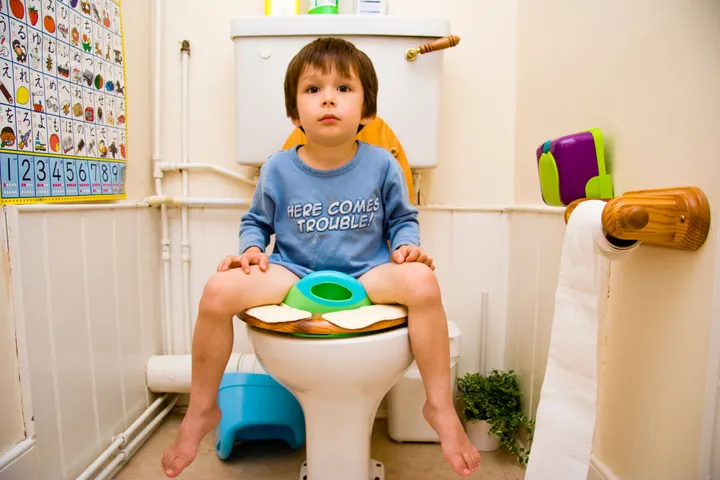
At the playground you don't hear, "Payton peed in her pants at school yesterday." No one posts on Facebook: "My second grader wet the bed again."
Toileting troubles may not be topic number one at your annual block party, but trust me: Based on the clients I see, probably one-third of the potty-trained kids on your street are constipated, and a huge number of them are having accidents and bedwetting episodes because of it.
Potty problems are often dismissed as a normal, if bothersome, part of childhood. You hear, "Kids are kids -- they get busy and forget to go potty" or "He's a deep sleeper -- he'll outgrow the bedwetting."
Accidents and bedwetting are common, affecting 20 percent of 5-year-olds, but they are not normal. They signal that a child's bladder has gone haywire, and in most cases the cause is chronic holding -- of pee, poop or both.
Holding pee thickens and irritates the bladder, causing spontaneous, forceful contractions like hiccups. Holding poop stretches the colon, which presses against the bladder and irritates the nerves feeding it. All this has been demonstrated in published studies, including my own and several dating back to the 1980s. It's clear: When you treat constipation aggressively, wetting episodes almost always cease.
Nonetheless, constipation in children often goes unrecognized, even in children with grapefruit-sized poop masses lodged in their rectums. That's just what happened with Zoe Rosso, the 3 1/2-year-old who was suspended from her Arlington, Virginia, preschool for "excessive" potty accidents; her doctor had missed a giant mass of stool in her rectum that made it impossible for her to stay dry. Zoe later became my patient, and I found her mass on a garden-variety X-ray.
Most kids with masses like Zoe's poop daily (softer poop oozes around the hard mass), so no one is the wiser. Many doctors don't look for clogged rectums when patients present with accidents and bedwetting.
Meanwhile, parents wait and wait for their children to outgrow their potty problems, and this delay often makes the troubles worse. I just treated a 9-year-old whose parents had been told not to worry about the kid's bedwetting; they finally brought him in when he started having daytime pee and poop accidents as well. His colon was one of the most stuffed I've encountered, which is saying a lot. Untreated, these severely kids may develop chronic medical problems, including damaged colons and, eventually (with girls), pain with sex.
Constipation Nation
Our country's potty problems are becoming more common. A 2011 study tracking data over a decade found that constipation diagnoses more than doubled at outpatient clinics and quadrupled at hospitals. Johns Hopkins Children's Center reported a 30 percent rise in the number of serious and chronic constipation cases in a short period in the late 2000s. And these are just the recognized cases.
As with our country's childhood obesity epidemic, the worst cases are getting worse. Some children's colons have been so stretched by giant poop masses
for so long -- think of a python with a goat in its belly -- that in addition to having severe urinary problems, they need surgery to remove the segments of their colons that won't shrink back to size.
So we know what causes toileting troubles: holding poop and pee. But what's behind the holding?
Let's start with diet. As long as children subsist on breast milk or formula, their poop tends to stay mushy. Life is good! But when kids start on real food, pooping problems often develop.
The Western diet, of course, is seriously lacking in fiber, especially the foods marketed to kids -- chicken tenders, hamburgers on white buns, mac and cheese. Everyone knows our kids' eating habits are contributing to skyrocketing childhood obesity rates. But this diet also is a major cause of constipation, even in lean kids.
When kids lack fiber, their poop gets firm and painful. So even before toilet training, many children withhold large hard stools. Almost all kids who have difficulty toilet training are constipated before their little bottoms ever hit the potty chair.
If your child manages to avoid constipation before toilet training, either because she's genetically lucky or has stellar eating habits, don't worry -- toilet training will fix that! Kids hold their pee and poop because they simply don't understand how essential it is to get themselves to the bathroom when nature calls. Kids think you only go to the bathroom only when you desperately need to, or when your mom threatens to withhold treats if you don't.
The most seriously constipated kids I treat are those who trained earliest and with ease. In other words, they've been deciding for the longest period of time when they should pee or poop. But even kids who train later can develop problems, especially if Mom and Dad aren't keeping tabs on them. Parents cringe when I say this, but getting your child out of diapers is the easy part!
So once you've got your toilet-trained child who lives on chicken nuggets and holds her pee and poop until the last minute, what's the one thing that could make the situation even worse? Sending her to an unfamiliar, structured environment with unreasonable toileting demands and possibly frightening and/or filthy toilets. You know: school.
For starters, you have preschools and summer camps that won't accept 3-year-olds in pull-ups, forcing many parents to train their children too early. At school these newly trained kids are expected to interrupt their teachers during story circle and announce they need to pee or to climb out of their just-built fort and venture over to the toilet. What happens: These kids don't go, because they feel too shy or excited or nervous that some other kid will steal their special train, and they develop a clogged rectum, thickened bladder or both.
Then it's on to grade school, where kids are offered chocolate milk at lunchtime and virtually no opportunity to engage in the kind physical activity that keeps their insides humming along. But those problems pale compared to school bathroom restrictions and conditions.
One of my favorite studies had this title: "Do public schools teach voiding dysfunction?" Yes! In this survey of Iowa elementary school teachers, one-third of the teachers admitted asking a child requesting a bathroom pass to wait. A paltry 15 percent suspected an underlying health problem in children who peed or pooped in their pants. Forty-two percent noticed bullying in the boys' bathrooms.
And this was in elementary school! You generally don't find seven-year-olds ripping off stall doors, spray painting erotic graffiti on the mirrors, or hurling wet paper towels at their peers for going number two. And that's the least of what goes on at many middle schools and high schools.
At one Georgia school students were messing with the toilet paper, so the principal removed toilet tissue from the stalls and had teachers stand outside the bathrooms handing out piles of TP to students who asked. Though I sympathize with desperate administrators, I can tell you my patients aren't about to discuss with their teachers how much toilet paper they need. They're going to bypass the bathroom altogether.
As you may or may not recall, the fine film American Pie featured a character nicknamed "Sh*t-break" because he refused to poop at school. One his called friends solved this problem in a prank involving a bottle of laxative and a mochaccino, and the scene is pretty darned funny. But from where I sit during my day job, it's not funny at all.
It turns out we have a nation of "Sh*t-breaks," kids who are either too scared, grossed out, or embarrassed to poop or even pee at school. One of my patients avoided using her school bathrooms for years because of the "mystery smells -- like sewage" emanating from them, not to mention the hair-clogged sinks and missing toilet paper, soap and paper towels. None of this shocked her mom, an elementary school teacher who is not allowed to let give her students more than four bathroom passes per quarter.
These policies, combined with our processed-food eating, video-game-playing culture, have created a serious problem.
Some kids, because of their temperaments or genetic makeups, are less affected than their peers by these factors and manage to avoid potty problems. However, enough forces in our culture conspire against healthy toileting behaviors that more kids than you can imagine end up with whacked-out bladders.
This article is adapted from "It's No Accident: Breakthrough Solutions to Your Child's Wetting, Constipation, UTIs, and Other Potty Problems." Published by Lyons Press. Learn more at itsnoaccident.net.