Here's just one example of how bad things are for the Detroit Three: GM announced Wednesday that they have more than 14,000 orders for the new 2010 Chevrolet Camaro. That's a nice, round number for an eagerly-awaited car which has just gone into production.
But at the SEMA automotive aftermarket trade show in Las Vegas during the first week of November, 2008, GM officials told me then the company had 8,000 orders for the new car. This means Chevy has received just 6,000 orders for the new Camaro in the past five months. Not a good number.
Now that we've seen AIG CEO Edward Liddy "in action," so to speak, it's appropriate for an update to our most recent post about the differences in how Washington has treated Detroit and Wall Street. Edward Liddy was formerly the CEO of Allstate -- so I guess we're all in "good hands" (he wrote sarcastically).
Many Americans have a "let them die" mentality when it comes to the Detroit Three, and you really can't fault them, at least when they're talking about these companies' products.
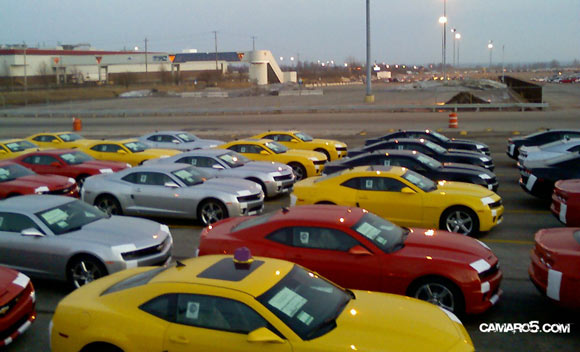
New 2010 Camaros readied for shipment to dealers
Someone, though, has to stick up for those companies, and it might as well be me -- at least for now. Those of you who follow this blog know that my support of Detroit is very complex, and mostly based on my fervent desire to not add another three to four million Americans to our nation's vast assembly of the unemployed; nor the many more millions worldwide whose jobs can easily disappear overnight.
Wednesday, Liddy told the congressional committee AIG "retention bonus" contracts are inviolate, permanent and unbreakable.
A congressperson told Liddy, "Contracts are changed every day in America."
Liddy responded with, "Yes, a contract can always be changed as long as the all parties' involved agree to it."
But in this case, we can bet that one of the parties involved -- i.e., those who got some of the more than $160 million in recent AIG bonuses -- will probably not agree to any change. It's a pretty safe bet.
Heck, would you? A few mil can get you that house on the golf course in Palm Springs or Bal Harbour.
And Liddy's explanation of the differences between "retention bonus" and "incentive bonus" held little, if any, water with us.
If a company wants someone to stick around, then what is the difference between the two? In fact, we found out today, many of the folks who got these retention bonuses have already left AIG for greener (and probably, they hope, more virgin) financial pastures.
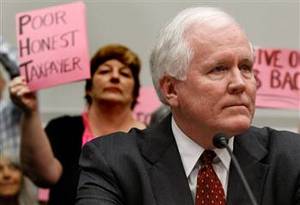
AIG CEO Edward Liddy testifies at a congressional hearing, with a little inspirational help from Code Pink
It was this kind of back-and-forth between Liddy and the committee members which led me to think about the people who work in the AIG "Financial Products" division and those who labor on the assembly lines of Detroit.
Washington ordered GM and Chrysler (and essentially, Ford, too) to cut costs and present corporate viability plans to congress. It looks now as if all three are may be "cutting themselves to death." They're making huge cuts in the number of their employees -- but only those who task on the lines, not those in executive suites.
And, Ron Gettelfinger, head of the UAW, immediately agreed to work with the Detroit Three and make major contract concessions; yes, to make changes to existing contracts.
Both GM and Chrysler have said this week that they don't need anymore TARP money, GM saying they're on their way to viability and Chrysler's Bob Nardelli said Wednesday that Chrysler could soon be, once again, "a stand-alone company" (the Fiat/Chrysler "merger" is on hold until congress looks at it). I think those positive comments from the companies are good sound bites and nothing more. When it comes to Washington, Detroit is laying low.
But also Wednesday, GM CEO Rick Wagoner used the "b" word -- bankruptcy -- perhaps signaling what he sees as the inevitable.
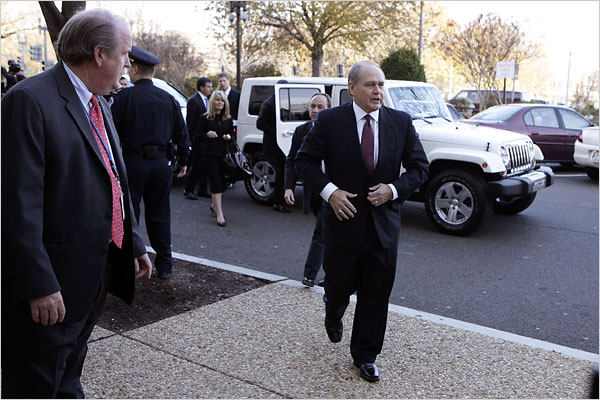
Chrysler CEO Robert Nardelli exits an "electric Jeep" concept vehicle at the US Capitol
Incidentally, Wagoner made $26 million last year; we don't know what Nardelli earned in 2008 because Chrysler is now a private company and not obligated to give the public that information. In Dearborn, at Ford, Alan Mulally, then head of Boeing, demanded and got a $20 million "signing bonus' deposited in his bank account before agreeing to run the company.
The elimination of the "jobs banks" program, which kept UAW members who had been laid-off able to keep receiving some of their salary, and the union taking over, from the car makers, the financing and operation of their own health care plans are just two examples of the unprecedented level of cooperation Washington wanted between Detroit and the UAW.
Rep. Elijah Cummings (D-Maryland) made some of the most powerful statements at Wednesday's AIG hearing, questioning the loyalty and patriotism of AIG employees. Another panel member said, to paraphrase, "AIG employees put their country last, and themselves first."
We posted yesterday about Detroit having received just 10% of TARP money loaned to just one Wall Street firm, AIG. And Wednesday, sources in congress said that the $18.5 billion in loans requested for the crucial auto industry's supplier companies, might not happen at all, and if it does, certainly not in that asked-for amount.
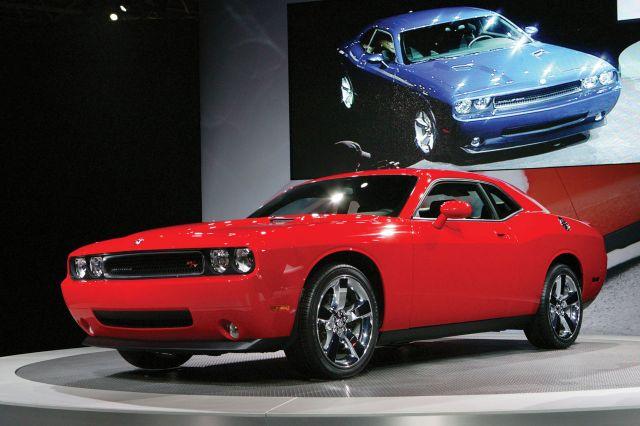
Chrysler's Challenger modern-day musclecar is another example, along with Camaro, of the wrong car at the wrong time; Ford doesn't get off easy, either -- their 2010 Mustang is just hitting showrooms
Which brings up another point: Recently, we've all become perhaps more aware of "deferred payments" in sports contracts. Why are these Wall Street firms and banks not operating in that mode? Deferring bonus payments to employees to a future date when, as we all fervently hope, the US and world economies begin a full recovery, is not the worst of ideas.
My plan for Detroit is complex, but involves the firing of senior and many members of mid-level management. Sure, keep the "car gals and guys" who actually know something about building cars and trucks.
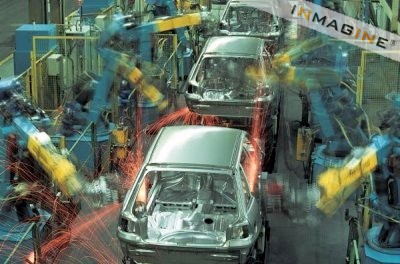
UAW members have made gigantic concessions to the Detroit Three and are rewriting contracts
But those top managers, the bean-counters, as they're called in the industry, most graduates of Wharton, Harvard, Yale and other top-notch business schools, have got to go. Unless and until that happens, congress could throw hundreds of billions at GM, Ford and Chrysler -- but how could the results be any different from what we see now?'
As many, if not most members of the congressional committee grilling AIG's Liddy said yesterday: How can the people who got us into this mess possibly get us out of it?
(Please be sure to "tune-in" to www.TalkRadioOne.com every Saturday and Sunday at 5pm Pacific / 8pm in the east, for my live WebRadio shows)
Want to reply to a comment? Hint: Click "Reply" at the bottom of the comment; after being approved your comment will appear directly underneath the comment you replied to
Great post. It is really hard to decide how harsh to be on the people who got us in this mess.
This is the double standard that has been around for a long time, hasn't it? We are told that breaking contracts with the UAW is absolutely necessary, but contracts with Wall Street executives are sacrosanct. Dumping money from the treasury into failed banks is necessary for our economic future, dumping the same money into auto companies is socialism (Never mind that we've been bailing out the rail and airline industries for decades.) We won't even go into the rash of bungled no bid contracts that has gone on for years. At what point are we going to realize that we can throw all the money in the world at failed business models, and it won't help one damn bit. If we really want to call ourselves capitalist, why can we not let these companies fail and force them to rebuild? Trust me, if there's a market there and money to be made, another, likely better run, company will spring up, faster than you can turn your head, to replace it.
And don't forget that the money spent on the ENTIRE auto industry, in both rounds, is less than 10 percent of what went to the wall streeters. AIG ALONE got almost 6 times what GM, Ford, and Chrysler ALL got!!!
See Steve Parker's Profile
Great comments from all of you! Thank you so much ... I think we all learn a lot here (well, I know I do).
But the comment below about the Huff Post being "censored" is not correct - at least not on this automotive blog. I've never "flagged" one comment for being abusive or offensive, but the truth is, I haven't really seen anything like that posted here, either.
Steve
It's clear to me that the American buying public is mostly to blame for the Big 3 automakers problems.
I mean, what happened to the concept of trading in your car every 3 years whether you needed to or not? That's what kept the auto makers solvent for so long. In this day and age of trying to keep cars longer, or even buying more economical cars or caring about gas mileage, carbon emissions, green house gases, and the planet--well of course there's a problem. The automakers are completely undeterred, really, or they wouldn't even be building things like Camaro, Corvette, Lincoln Navigator, Challenger. And have you noticed that every car add mentions more horsepower, more luxury, more of everything we don't really need in basic transportation. Mostly because those features are what makes money for the car makers. Truly, stop buying their crap!!!!
Guess I need to keep in mind that HP is censored more strictly than the Disney Channel. Anyway... while what you say has merit, the general public has been willing to buy the worst SUVs and cars that could possibly be put to market, but remember... you're also talking about an industry that has fought tooth and nail against every possible advancement, from emissions standards, to fuel efficiency standards, to safety standards... anything they could do to cut their bottom line operating cost and construction cost, short of lowering executive pay, was done. Every corner that could be cut was cut. Every possible standard they could barely eke through was eked through. The public can be blamed as far as they were willing to buy such junk, but when that's all that is offered, what choice did we really have? We can't all love Toyota Priuses. In the end though, Detroit knew it couldn't possibly have kept going like it was. There's no reason this should have come as such a big surprise to them, and the only way out is to completely restructure from the top down, not the bottom up.
See Steve Parker's Profile
President Obama had it right when he said, yesterday, at an EV facility in So Cal, that the Model T Ford got better mileage than most cars and trucks sold today.
Yes, Americans bought the biggest, baddest trucks they (we) could for the past 20 years. But think about this: If the car companies. domestic and foreign, hadn't known they were able to make the biggest profit margins for the most number of years on big trucks and big, thirsty, dirty truck engines, do you think they'd have made so many of them and marketed them as aggressively as they did? I mean, come on - the HUMMER!? It's kind of like that old saying, "God must love poor people because he made so many of them (us)."
It was an amazing marketing story - car makers knowing about the "cocooning" and "nesting" generations, that many Americans wanted to either stay home, or take home with them when they got on the freeways. They don't mess around with this stuff; they pay a lot of people a lot of money to find out and develop this kind of information. It doesn't just happen on its own.
In a future post, I'll write about how Arnold Schwarzenegger was personally responsible for AM General making the Hummer. And the story was told to me by the man who ran AM General when all of that happened. Fascinating marketing story, actually, and a fascinating profile of Our Own Guvernator, too.
Steve
GASP!!!!! You can't expect them to fire WHITE COLLAR WORKERS now can you!?!?!?!?!?!?!?!?!?!? I mean, c'mon, those are the productive ones!!!! Except for the whole thing about not producing anything, whereas the blue collar workers are actually producing something....
Are you kidding? Non-union workers are the ONLY ones who have been fired at GM. I strongly suggest doing a quick google search before commenting.
Uh huh.... You go on believing whatever it is that rushbo the great tells you, and I will enjoy living here where the sky is actually BLUE!!
This is incorrect. I work at GM as a contractor and white collar employees are also making sacrifices. GM shed white collar jobs last year through buyouts, and will cut thousands of additional jobs in the coming weeks.
White collar employees, including executives, are taking pay cuts starting May 1, will receive no bonuses and have had their benefits reduced, as well.
The top executives have already taken significant pay cuts, and will receive no bonuses.
This has been well covered by major news outlets, and in GM's viability plan. Many of these actions took place BEFORE the company requested government loans.
See Steve Parker's Profile
What do you call it when assembly lines shut down? When engine plants and tooling plants are closed? Where do those blue collar workers go? The Job Banks are gone, a HUGE concession on the part of the UAW to try and save these workplaces, the last line of "job security". the UAW was able to offer.
Maybe there's a difference between "laid off" and "fired?" Am I missing something?
Huge numbers of UAW men and women were canned by Ford, GM and Chrysler over the past several years - and Detroit didn't dare ask for taxpayer money until it became clear the entire world economy was being wiped-out by all those genius bean-counters in Wall Street, most of whom graduated from the same prestigious universities where the top management in Detroit has come from for the past 100 years.
Some white collar cuts have been made - especially at Ford, interestingly, which still (on paper) seems to be the most successful (or is that the least near death?) in Detroit.
Forgive me if I'm a little bitter - I scan all the newswires every day, worldwide, and the number of white collar men and women leaving the car makers is really minuscule to the number of actual line workers. Those are just the facts.
Steve
I would have to agree with this post. For the most part the new Camero and Challenger were pushed into design long before the meltdown, however they are still wrong. Neither car is expected to make money for the company on their own, they are nothing more than sizzle. They are a "get them into the showroom" cars. I hope that both GM, and Chrysler can get a more balanced lineup. Chrysler is the worst of the bunch with their cars. They offer almost nothing interesting or bankable. The management at both companies needs to be trimmed back (there have been white collar jobs eliminated at both companies) There are solutions out there, and they can be back to profitability if they are sensible and pragmatic. I think both companies need better sales pitches especially the television commercials. Their is such a lack of imagination when presenting these cars.
The Camaro and Challenger were designed in ~2005, and shown as concepts back in 2006. Now if those cars had come out a year later, like they probably should have, they might have had a chance. Now, it's way too late for them to cancel it, the manufacturing money has been spent, but it's also way too late for them to be a success because the entire market has changed. They're damned if they do, damned if they don't.
See Steve Parker's Profile
The Ford Flex is another "right car, wrong time" thing. Different looks, lots of room but just one thirsty V6 as the sole engine choice.
Still, how did NO ONE in top management see all this coming, starting three decades ago?
Steve
See Steve Parker's Profile
Lots of people thought the "retro" design craze in Detroit was over when that last-generation T-Bird sold so poorly.
Mustang makes money for Ford, and they still sell about 60,000 of them a year, every year. Build a decent mpg version of Camaro and Challenger, and GM and Chrysler would at least stand a chance of paying-off the tooling for those new cars in less than five or six years.
Steve
You must be logged in to comment. Log in or connect with