By now we've all heard the news from GM -- the claim that the Chevrolet Volt extended-range hybrid will get as many as 230 miles per gallon in city use.
It's an exciting and bold claim, but the question is: What do you think will be the reality for Volt?
It's due for-sale at the end of 2010 and most analysts are saying the price will be near $40,000 (and no one at GM is denying that).
Volt's mpg ratings are a bit backwards from what we're used to; in-town mileage is much better than highway, because the first 40 miles in-town can be run on the lithium ion battery alone, no gasoline necessary. On the highway, Volt will make use of its gasoline engine to keep the battery charged, so mileage will be worse than in-town, but still impressively in the triple-digits, says GM.
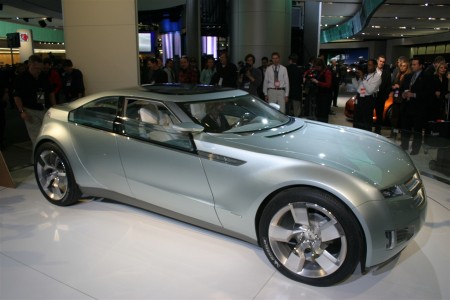
Chevy's Volt as seen today at 230mpg announcement in near-production trim
Using EPA numbers, Nissan's Leaf EV (profiled in an earlier blog post), also due out late 2010, will achieve the equivalent of over 350 mpg, all the time. But of course it has to be stopped and recharged, while Volt, which can also be plugged-in for recharging, will use its gasoline engine to keep the battery 'up' while on the road.
One other thing I found a bit 'backwards' -- GM making the Volt announcement today, the same day some 250 GM dealers in California started selling cars on eBay. I thought the two stories should have had more space between them to get the most public attention. Maybe Bob Lutz should have had a little marketing input to GM's announcement plans today.
Volt at the 2008 Los Angeles Auto Show --- this prototype looked a lot different from what we saw today
But let's get right to it: What about the Volt? Will you be in the market for one? If so, why, and if not, why not?
Believe me -- top people from GM will be reading your comments.
Follow Steve Parker on Twitter: www.twitter.com/autojourno
Want to reply to a comment? Hint: Click "Reply" at the bottom of the comment; after being approved your comment will appear directly underneath the comment you replied to
We're just beginning to see a whole new range of options in automotive technology. So I wouldn't be among the first to jump on the bandwagon.
But I do have two questions: Has GM or Nissan specified what type of power outlet that will be required and how expensive it might be to add? How soon will a manufacturer develop an electric vehicle with four-wheel drive for those of us in the north?
What kind of fools does GM think we are? $40K for this simple electric car? No Way! Not ever!
The Volt ignores a fact that every potential plug-in carmaker ignores: many if not most people do not live or work in a place that allows access to an outlet to plug in the car. And very few landlords or employers are going to pay the heavy cost of retrofitting their properties for electric cars.
The Progressive Ansari X-Prize has strict mpg accounting procedures.
Electricity from the grid is computed for it's carbon footprint and converted to equivalent gasoline carbon footprint. It's not just how much does it cost for electricity, in dollars, to drive 230 miles compared to how much does one gallon of gasoline cost, in dollars.
The test is "energy consumed required to move the vehicle" and "pollution created to get that motion".
On average, well designed ICE cars and EV cars show that the EV gets three times the energy efficiency of the ICE. That alone translates into three times the distance traveled on one GGE (Gallon of Gasoline Equivalent).
"Driving style" counts for more than engineering efficiency, with energy-conservative driving styles already have produced over 100 mpg from out-of-the-showroom stock models of Toyoto Prius, Ford Festiva, and Mercedes Smartcar.
If carbon-free energy powers an EV than the mpg figure is virtually infinite, say PV-electrolyzed hydrogen gas fuelcell EV, no matter how sloppy one drives.
I say wait until cars are sold out of the showroom and driven in the real world before getting excited by mileage claims. As it stands today you would need an electrician to install a new commercial grade welding power-line circuit with 440 volts and enough juice to fast-melt metal to get the fast charges claimed by some of the sleazoids in the EV vaporware racket.
This is a good start, and something that can be built upon with better battery technology. The initial Prius wasn't that spectacular, but they built on the technology and now have something that is relevant. GM has a lot of options with this platform, and things such as regenerative braking (which already exists on GM models) and the possibility of mating to a diesel engine that can generate power more efficiently can someday be employed to further bolster efficiency. I'd have to think about it long and hard if I'd buy at $40k, though. Not that I don't think it's worth it, it's just a lot of cash to deal out for a car. I think if GM could sell the first year or two of production at a loss to garner in customers that would buy them some time to come up with a better battery that customers would be more willing to pay for.
Steve, I of course welcome a great improvement in any car's mileage, but it's GM here. I still don't trust that they can put something out like this that won't be recalled (probably several times) or have to end up in the shop on a regular basis. After all, a car gets zero miles to the gallon on the mechanic's rack.
Also, if the Volt proves popular, just what kind of rigamarole is GM going to subject buyers to? A DailyKos diarist recently wrote of the outlandish weeks long hassle he had trying to buy a Ford Focus, including Ford coming back and trying to jack up the price on him after they had agreed to a lower one previously. So the guy just gave up on the Focus and went to a Toyota dealership and drove out of their parking lot with a brand new Prius that day.
In other words, it doesn't matter what new promising technology auto makers come up with if the firms are ill managed and makes consumers feel like they got screwed.
GM can call it a concept, prototype, or whatever but don't call it a 230 mpg car until the customer can test drive it, buy it, and feel GM's legendary reliability reputation. To get 230 mpg, do I have pull over every 40 miles and spend hours to re-charge the battery? $40,000 is almost twice as expensive as the ACTUAL, best selling hybrid on the market today.
The thing could run on water and I still couldn't afford to buy one priced at 40K. I know production costs in Detroit are trade secrets, but why can't the automakers price these things affordably and sell a higher volume? It worked for Henry Ford's Model T. It worked for the VW beetle. It's working for the Prius.
See Steve Parker's Profile
It takes time to make money on a car. I've been reading 'J-management,' a new book about Japanese corporate culture right now, and apparently the costs involved with the Prius are just huge. The company says they're making money on each one now, but I wouldn't bet on it. The R&D costs were worldwide and outrageous. It's probable that only Toyota could have afforded it at the time.
And that's WITH all the government help they got, which was a lot.
That's why trucks and SUVs were so popular with the car-makers. They didn't have to make big changes to them for as long as ten years, sometimes more. They started making big money on them after just a couple of years. Cars need a major refreshing or need to be completely new about every four years, inside and out.
Volt is known to be costing GM a fortune, more than anyone planned on. But if it works ... and if they can use the drivetrain in other, less-expensive cars, they might really have something good on their hands. I frankly hope they do.
Best thing GM could do? Surprise us ... cut the Volt price to under $30K and eat the loss for another few years. If all else is going well, if the new GM becomes a going concern, they'd be able to afford it. And they'd make a LOT of new friends around the world.
Steve
This car was basically like all concept vehicles, it was never meant to see the streets. The only reason it is going into production is because of pressure from greenies, politicians trying to score points, and GM's desperation to look like it can do more than build overweight, overvalued trucks and SUV's.
No way is this thing worth 40K and I can imagine that it will have all sorts of problems. It's also ugly. The concept at least had a little style, the production model is yet another boring GM sedan. The folks that buy this thing will be making a statement, like Prius owners, and never considering the dirty materials that go into hybrids and electrics such as copper, nickel, coal from the power plants they plug in to.
I'll buy a VW diesel long before I buy a hybrid or electric.
Generating electricity from a large generator is much more efficient than converting the chemical energy of oil into mechanical energy in a relatively tiny engine. SO2 pollution would certainly be higher from burning more coal, though, as cars burning fuel do not produce it. A diesel is a good route to go, but as the power grid in the US slowly moves towards renewables, plugging in becomes even less dirty.
As for the materials that go into making a battery, this is still a pretty contentious subject. I think it's disingenuous to claim that buyers of hybrids "never consider" the impacts of increasing demands of these materials. As with all things the technology evolves (based on demand). Recycling these materials has become a market in itself. The materials needed becomes reduced as efficiencies are gained. The types of materials used have evolved in the relatively short time hybrids have been around.
See Steve Parker's Profile
Thanks for the comment.
Can't agree about the Volt's history -- it was always going to make it into production, in one form or another ... at least the drivetrain was.
But DO agree any of the clean diesels are interesting and exciting cars ... the VW Jetta TDI Sportwagen I drove with the transmission paddle-shifters was a surprising ton of fun to drive and of course they all have HUGE torque, what you feel off the line and coming out of corners. We Americans LOVE torque!
Steve
Detroit has been over exaggerating its mileage claims for years, as it had been doing with horsepower claims years ago in the musclecar heyday. Believe what you will. But, are you willing to shell out $40k+ to find out?
Your mileage MAY vary.
Take public transportation in the city.
Good points about the carbon footprint for manufacturing.
See Steve Parker's Profile
I got an email today from someone complaining that they're getting 6mpg less than the sticker said they'd get with their new Hyundai something-or-other. So in addition to telling them the mpg figures are determined by EPA computer model, and are almost ALWAYS higher than reality, there are a million other factors affecting mileage,too, from tire pressure to road conditions to driving style ... to driving with the windows open.
I encouraged them to feel good about the good mpg they're probably getting. But what happens when production Volts come up short of 230 mpg, if it indeed does? GM is making a very big deal out of that number...and the EPA is already backing away from it, saying they have NOT tested a Volt so can't verify ANY numbers...
I think the specific mpg announcement was a mistake.
Steve
Hard to believe the 230. Ever heard of "Under Promise-Over Deliver"? I won't be buying one because I never buy new anyway and I'm for sure not an early adopter.
If they had stuck with the EV1 we wouldn't be having this conversation. And maybe GM could have avoided bankruptcy.
I say good luck with it. In 10 years we'll all own electric cars for our short haul miles. They might be Chinese made, but we'll have them.
And what is the carbon footprint for making one of these?
I'm not sure of the carbon footprint of this specific model, but for the average car about 10% of its footprint is during manufacturing, 85% during use and 5% during disposal. This holds true for mybrids like the Prius, so I assume it would be very similar for the Volt.
*hybrids
I will give this car consideration when it comes out, for sure. The 230mpg claims are ludicrous for the average driver and completely irrelevant, as we won't ever achieve that in any realistic scenario. Also, the attitude of Bob Lutz towards vehicle efficiency and consumers interested in hybrid style vehicles will make me very leary of any GM products. His disdain for the customers the Volt will be geared towards is not at all helpful for the marketing. In the end, though, the car will speak for itself. If the manufacturer makes impossible claims about mileage and the first few customers get 40mpg (which is good, but disappointing against the claims), the results for GM will be disappointing. If the will be honest up-front and people get what they are expecting, things will go a lot smoother.
See Steve Parker's Profile
Thanks for the comment.
About Lutz's apparent disdain for the customers ... I think he's angry that people are buying cars based in large part on their mpg rating. He told CNBC that mileage and gas prices are the "prime determining factors" when people buy a car. He then called for increased federal gas taxes to encourage people to buy smaller cars --- becoming the first top exec from a car-maker to do so.
So I think he kind of resents the way the public is throwing around their buying power and he's frustrated, too --- he's not used to it. He knows about building and selling big, fast expensive cars --- and expects people to buy them. This is a new world for him.
Steve
I agree. Thanks for your insight. It does seem that he is stuck in a world view which isn't evolving with demand. I also remember an interview he gave some months ago when the Volt was first making its rounds in the media. He made comments about hairy, hippie girls being attracted to hybrid owners. It was a comedy show and his comments were in jest, but the disdain in his voice was tough to mask.
Hopefully he'll continue to come around and get fully behind where the market is versus where he wants it to be. I would love to have as many options as possible when I look for a new car in a year or two. When I went shopping for my current car in 2004, I wanted something fuel-efficient (at least 40mpg), with at least 4 cylinders and room for a growing family. I've been pleased with my current car, but it would be nice to have a few reliable GM models to fit that criteria next time around.
You must be logged in to comment. Log in or connect with