General Motors and Chrysler have received a total of around $17 billion in loans from the government; Ford wants to be able to draw on a $10 billion government credit line if and when they need it.
As of right now, AIG has taken-in $170 billion from taxpayers.
Why does Detroit get 10% of what the banks and Wall Street have been loaned, and without doubt more cash headed their way?
Why were Detroit and UAW leaders grilled sternly and publicly in testimony before congress, while executives from Wall Street and the banks have been able to avoid that spectacle?
Why does Washington think a 100-year old manufacturing industry, which employs between three and four million American workers, and arguably was the single-greatest creator of our middle class, isn't as important or critical as industries which produce, essentially, nothing but numbers on paper?
(At last year's Consumer Electronics Show in Las Vegas, GM's Rick Wagoner presented a Chevrolet Volt protoype along with CES chief Gary Shapiro; GM's received about $14 billion in loans - so far)
And why do many members of congress (and the other usual suspects, including the US Chamber of Commerce) say that the wages fought for and won by the UAW should be tied to the lower wages paid to non-union workers by the "captive imports, foreign-owned car- and car parts-makers located mostly in the nation's southeast?
Here are other ways we've seen Washington cower under Wall Street, while Detroit has been told go to hell.
- GM and Chrysler were told by Washington that in order to get any money from government, they had to prepare, and turn-in this month, "viability reports," detailing renegotiated union contracts and agreements with bond holders, the state of future products and specifying how and when they will pay back the loans.
- No such demand was made of any of the financial institutions, and in fact the first $350 billion in TARP funds is "missing in action."
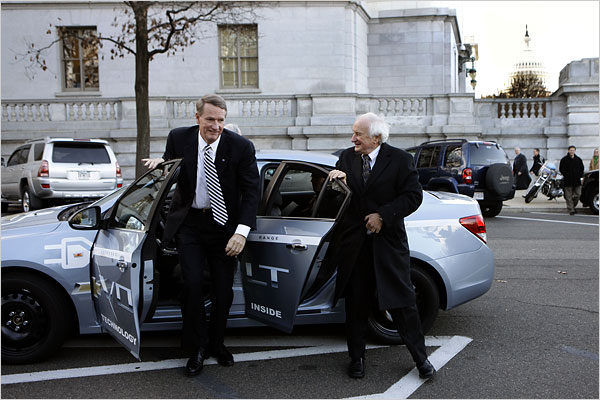
(In front of the US Capitol, GM's Wagoner steps out a Chevrolet Volt mule," what they call vehicles used to hide new powertrains under the sheetmetal of an existing car or truck. Getting out of the back seat is Detroit-area Cong, Sandy Levin, brother of Michigan Sen. Carl Levin. GM and Chrysler must have said some dumb things in DC when one company gets almost 100% more in TARP funds than Detroit)
- Another part of Washington's loan conditions for the Detroit Three and the UAW was renegotiating existing union work, health and retirement contracts covering current and future employees. No such demand has been made of the banks or Wall Street getting TARP money, and AIG, for example, says that bonuses "must" be paid because of existing contracts. So far, the Obama Administration hasn't said they can force AIG to renegotiate the bonus contracts. But if they forced Detroit, why not AIG?
- Most all of the house and senate members who oppose help for America's domestic car-making industry are republicans (with a blue dog democrat or two) with the car- and auto parts-making operations of foreign-owned captive imports in their states and districts.
- Hearing President Obama voice our collective anger and frustration towards AIG certainly allowed some venting by all of us, but the bottom line has to be: some kind of fairness when handing-out TARP money.
- Financial services companies and banks can, if necessary, be run by government, and there's no lack of business graduates pouring out of Wharton, Harvard and Yale who could hit the ground running. Maybe a little inexperience is just the thing for those outfits. FDR made Joe Kennedy the first head of the SEC because Kennedy was the shrewdest, most crooked and most experienced trader on Wall Street; FDR figured not only did Founding Father Kennedy know all the tricks, he invented a bunch of them. The choice was akin to FDR appointing Charles Ponzi his Treasury Secretary.

(Charles Ponzi, once a hero to Wall Street in a booking photo circa 1910; remind you of anyone else?)
Running a car company requires an entirely different set of skills, which may explain why the bean-counters who have run GM, Chrysler and Ford the past 30 years haven't done a good job; in fact, they've beached their own industry and endangered the world economy and the jobs of millions of Americans and more worldwide.
The adversarial relationship between Detroit and Washington has been ingrained so strongly on both sides that too many of our people view our domestic industry not with pride, as you're likely to find among people in Asia and Europe who respect their own car industry and support it at all costs, but as populated by a bunch of greedy big shots, the car versions of Tom Wolfe's Masters of the Universe, our own modern-day robber barons, making lousy products with safety and the environment mere afterthoughts and with "shoving metal down the throats" of buyers their most important cause. Not that Detroit doesn't deserve much of this reputation.

This is what we mean by the UAW fighting hard for decades to get their members fair pay: There was blood in the streets during the legendary Battle of the Overpass in May, 1937, outside a Ford plant. UAW leader Walter Reuther led unarmed auto workers against a phalanx of well-armed Ford security people and other mercenaries hired by Henry Ford and his evil, violent henchman, Harry Bennett, infamous for keeping a loaded pistol in the top drawer of his desk.
Want to reply to a comment? Hint: Click "Reply" at the bottom of the comment; after being approved your comment will appear directly underneath the comment you replied to
Very good argument from Steve ---
For all its failings, Detroit produces real things. Our financial and paper shuffling sectors don´t.
Manufacturing is strategically important for the future of the U.S., and legislation should be passed to this effect. On the contrary, the speculative and parsitic activity of the financial sector should be reduced to a minimum.
What is a nightmare is the existing for-profit health care and retirement systems. Until there is a national system of some kind there will be an unequal playing field and a severe competitive disadvantage for our manufacturing
It is simple.
The auto companies need to go into bankruptcy so that they can get their affairs in order. It is their only way out.
Bush didn't want it to actually occur on his watch, so he kicked that can down the road.
See Steve Parker's Profile
GM's Rick Wagoner used the "B" word publicly this week - it may be that even he thinks it inevitable at this point.
But the public is speaking loudly about not wanting to buy a vehicle from a company which might go bankrupt - of course no one can get credit to lease or buy a new car or truck, either.
It's a damn scary spiral.
Steve
Its a simple answer.
Wall Street has both Democratic and Republican Loudmouth Hypocrites on their side, and Detroit only has a few meak and mild democrats on their side.
In the past the big 3 Corporate and Execs had some republicans and only a few dems on their side, while the UAW workers and suppliers had dems on their side.
Since this credit crunch the Execs have been forced through public scrutiny and a need to work together, to acknowledge that the UAW is not at fault for high priced cars, or bad corporate decisions, or direction of the company, or that they make ungodly wages.
Counter in fact, its been shown that execs like Waggoner make too much, and are out of touch.
Not deserving of such high pay for poor decisions in the past, and now realizing that the Republican party as a whole doesnt really care about them now that they have so many foreign car manufacturers in their backyards they need to lie for.
For the first time in big 3 history, the execs have been forced to concede and defend their UAW counterparts to get some popular and political support to help their companies move forward.
Interesting how disaster makes enemies into allies.
I understand Toyota has applied to the Japanese government for a bailout.
Steve's right; this is a tough one. A year ago, GM was the planets second auto maker and had a 50/50 chance of being displaced as the top seller in the United States by Toyota. Now, they are talking about liquidation and vanishing the way of Studebaker or Nash. The sudden and sharp fall of auto sales has had a lot to do with that. If these were different times, we could watch them go with merely a personal sense of sadness.
In these harsh times, the disappearance of GM means more hopeless workers, the loss of their taxes and purchasing power. It may be cheaper to tide them over than pay them unemployment for not working. There is a lingering hope that GM might recover and be a substantial citizen into the indefinite future. Little things mean a lot to such public companies in the marketplace. The auto companies have been profitable in a fairly recent past after a lesser slip.
Why? Because men and women who do their jobs well their entire lives deserve to have both their pensions and their health care and old age pulled out from under them, while 73 nitwits on Wall Street whose incompetence, scheming and greed brought the whole world's economy to its knees deserve to get their multimillion dollar bonuses. That's why. You see, those tool and die workers, those spot welders, those assembly line workers -- did was their jobs, correctly, and for decades. That's why they're going to get the plug pulled on their life support systems when they can't afford their hospital bills.
See Steve Parker's Profile
Any worker can build a product only as good as it plans. Blue collar worker in Detroit don't design and engineer the cars; they just build what they're told to build. And all those plans come from the executive suites, not the shop floor.
Steve
The problem with the GM and Chrysler is that they're failed business models. Their costs are way too high relative to what they take in because of huge pension and retiree health care liabilities. GM couldn't even make money when they sold a lot of cars in 2005, and only made money in 2004 because of their financing unit, which is now failing too. Everybody knows that until GM and Chrysler take an ax to the pensions and health care benefits, there is no point in giving them more money because they'll never be able to pay it back. Both are bankrupt. AIG is a bit different because their core businesses make a lot of money - they are good businesses. The money they have lost is from the credit default swaps they wrote. But if the US govt doesn't backstop those CDS derivatives, the entire global financial system will implode and bring the global economy down with it (down more than it is already, which is scary).
You're asking me to feel bad for an industry that refuses to improve? The same industry that used taxpayer money to fight against improving mileage?
These companies do more to pollute the earth than just about anyone.
I believe in unions, but the union hasn't talked one bit about how the auto industry has destroyed the earth. They just want their money. Not one union member went on strike to save the planet. They helped destroy it.
Let it all fail. Auto workers, choose better jobs next time.
See Steve Parker's Profile
My own feelings about the car industry aren't that far from yous.
But if they fail, we'll see unemployment multiply by millions in just a few months. So which is more costly to the country? I'm not Tim Geithner, so I can't answer that.
My old thought (old by now) is that throwing money at Detroit will prove as useful as throwing it at Wall Street; if the same people are in charge, how can we expect different results?
And I'll never blame the unions for having a hand in this. All the Detroit Three have renegotiated their current UAW contracts with the support of the union. That's more than I can say Wall Street and the banks... And the only place union worker have power in Detroit is on the assembly line; blue collar workers have had essentially no say on how the company, or even their own assembly lines, were being run. It's very different in Europe and Asia.
Steve
Steve.
You'll never blame the unions?!!?
There is plenty of blame to go around, but the unions had to see this coming. They pay people to sit around and do nothing. Do you think that maybe that was a recipe for failure?
You must be logged in to comment. Log in or connect with