What would you say to Barack Obama about changing our economy's base from oil to hydrogen? Maybe he or someone on his staff, while wandering around the Huffington Post, will find our little part of it ... And read what you have to say about moving from oil to hydrogen ... or not, if you don't believe hydrogen to be a viable alternative, share with us what you think makes more sense.
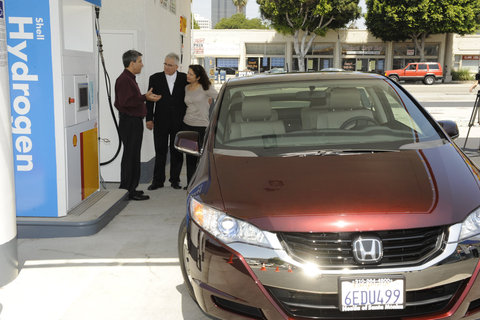
History usually isn't made at car dealerships, but last Saturday that's exactly what happened at Honda of Santa Monica, CA, when it delivered a new car, unlike any other, and about which few people could complain. (A Honda engineer, rear left, shows the first customers of the FCX Clarity how to fuel their new EV at a gas station in West Los Angeles outfitted just last month for storing and pumping, in a sense, hydrogen; that's the car itself in the foreground).
![]()
Local Southern California residents Ron Yerxa and Annette Ballester got the keys to the first FCX Clarity hydrogen fuel cell EV sedan in America. About 200 of the vehicles will be leased over the next three years around the country.
Southern California will have three Honda stores with personnel factory-trained to sell, deliver, service and maintain these truly groundbreaking family sedans.
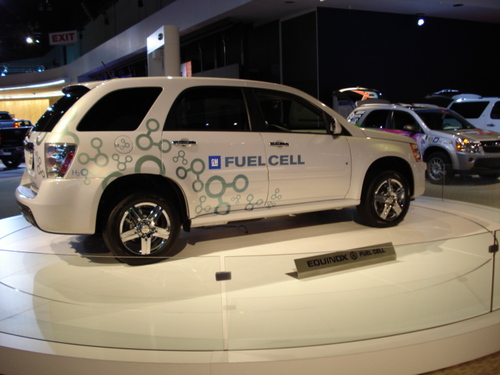
The timing of Honda getting their FCX cars on the roads of America couldn't have been better. Just a month ago, a Shell gas station in West Los Angeles, just a few miles from the Honda of Santa Monica store, was outfitted with the equipment to store and sell hydrogen, one of about 45 places in the country where hydrogen is available to the public. Honda, at their US headquarters in Gardena, CA, also has hydrogen fuel "pumps" for filling-up hydrogen fuel cell-powered vehicles. (GM says many of their green vehicles will first hit the road badged as Chevrolets; this Equinox hydrogen fuel cell-powered CUV was displayed at last year's Los Angeles Auto Show).
![]()
FCX Clarity is, according to Honda, "a next-generation, hydrogen fuel cell-powered vehicle. Propelled by an electric motor that runs on electricity generated in the fuel cell, the vehicle's only emission is water, and its fuel efficiency is three times that of a modern gasoline-powered car."
The company says this latest-generation FCX will travel about 280 miles, or 74-mpg GGE (miles per gasoline gallon equivalent). "GGE?" Great, yet another abbreviation to remember.
General Motors will also lease about 200 Chevrolet Equinox hydrogen fuel cell EVs over the next two to three years, finding their way into government, university and industry test fleets, as well as some lucky private citizens. The monthly lease for Equinox and FCX Clarity is about $600. (FCX Clarity made news as the pace car for the IndyCar race held earlier this year at Twin Ring Motegi in Japan, north of Tokyo (Honda owns the track, by the way); Danica Patrick won that race, the first woman to ever win an open-wheel car race at that high level).

![]()
There's an old joke in the car business about the public doing the last million miles of road-testing for new GM products, but in this case, it's more true than not. Visit GM's and Honda's websites, www.honda.com, www.gm.com, to find out how to qualify for a test drive.
Ever wonder how astronauts get electricity and drinking water in space? Fuel cells.
First described as theory in 1839, the first working model was built in 1845. Fuel cells' first commercial use was in the US' Mercury manned space program. Today, large industrial fuel cell installations supply back-up power for hospitals, factories, office buildings and government installations worldwide. And there are tests being run to see how fuel cells might power private homes, much to the chagrin of power companies around the world.
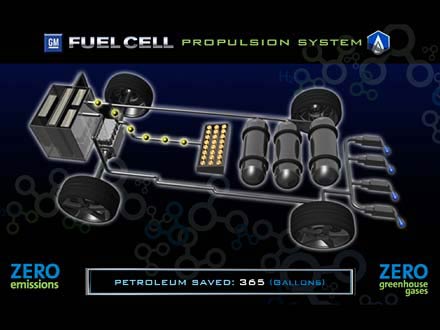
How do they work? Pressurized hydrogen passes through a fuel cell "stack," really a series of chemical membranes, producing electricity and H2O. Which is how astronauts get their water and electricity, and how fuel cell cars, like Equinox and FCX Clarity, work. (BMW was awarded Green Car of the Year at the New York Auto Show earlier this year for this 118d model; it's powered by one of the new clean diesel engines headed to the US over the next few years).
![]()
BMW and Mazda have begun loaning and leasing a small number of 7-series "Hydrogen 7" and RX-8 "Hydrogen RE" models, outfitted with existing piston and rotary engines modified to run on both gasoline and hydrogen (but not at the same time).
No greenhouse gases are produced when hydrogen is used in ICE engines, because there's no carbon in the fuel (find out more at: www.bmw.com, www.mazda.com).
Mazda and BMW have gone this dual-fuel route because there is no wide-spread hydrogen infrastructure -- as yet. But existing oil and natural gas pipelines and pumps could be retro-fitted for hydrogen and, voila, there's the start of our hydrogen economy. (Like most gas/electric hybrids, GM's Equinox has a nifty screen on its instrument panel informing all who care to know how much gas ... or hydrogen ... is being used. Anyway, it's a new form of in-car entertainment).
![]()
America is now fighting wars on several fronts, from the Horn of Africa throughout the Mideast and on to Turkey, in Mexico and throughout many Central and South American nations, almost anywhere there are oil fields or might be in the future, all for the sake of filling our gas tanks.
Like any addict, the first thing we have to do is admit we have a problem. Nationally, we haven't come close to doing that, with the two old men running the country keeping the oil companies close to their hearts and their bank accounts.
If John McCain is elected, then America, and the world, can expect little in the way of this necessary change-over from oil to hydrogen; but if Barack Obama is sworn in, how can he best get us on the road to using hydrogen, along with wind and sea power, as a critical element in producing electricity for this country ... and for our cars?
Want to reply to a comment? Hint: Click "Reply" at the bottom of the comment; after being approved your comment will appear directly underneath the comment you replied to
5000 to 10,000 PSI hydrogen makes me uncomfortable. What happens in a collision where fire engulfs the cars? Those high pressure hydrogen tanks have two choices: fail slowly and create a huge jet of burning hydrogen, or fail explosively worse than a propane tank going.
I have questions about Hydrogen. Let's say there are 2 million Hydrogen cars driving around the freeways in Phoenix, Arizona. Each is giving off harmless water vapor. Now it is a day in the first week of July so the temperature could be 120 degrees in the shade. The cars will add some humidity. How much? What will happen to the comfort index when the humidity goes up? Water vapor is a very strong greenhouse gas so the temperature will increase too. How much will the temperature increase? Finally, hotter air holds more water, therefore the humidity will have to become greater before water precipitates and falls to the ground. How much extra water (this stronger greenhouse gas) will the air hold before it drops to the ground?
Mr Parker: A gas doesn't have to have carbon in order to be a greenhouse gas. In fact, water is a very effective greenhouse gas -- moreso than CO2. The good thing is that under normal conditions, it doesn't stay in the atmosphere anywhere near as long as CO2 or a host of other gasses.
Do we REALLY believe that millions of cars spewing water vapor will have no climate effect?!?
Hi Steve, while I agree with you that hydrogen is the fuel of the future, I don't believe that an extensive distribution system will be necessary for most of our transportation needs.
My dream is a home that is completely "off the grid" and working with solar cells. All of the electrical energy from the cells is dedicated to the electrolysis of water into oxygen and hydrogen. My electrical needs are served from a motor-generator or a fuel cell burning the hydrogen. I also use it in my auto to commute. Mike Strizki is already doing this in his home in New Jersey. Follow this link to see for yourself.
http://www.sciam.com/article.cfm?id=hydrogen-house&sc=WR_20080624
While Mike"s system works, it"s more than just a little expensive. The whole thing cost $500,000 and he does things differently than I would. I would not use the batteries for starters, they"re expensive to begin with and when cycled a few hundred times wear out and need to be replaced. Then there"s the storage of uncompressed hydrogen. The cost of compressing the hydrogen, from free sunlight, by the way, is worth it.
Deriving hydrogen from water is easily done, the process happens with fewer than 2 volts.
Neither the government nor our industries are going to do this for us. If we are going to get there, we are going to have to take the bull by the horns and just do it ourselves.
Agreed. We have all the infrastructure necessary for hydrogen fueling. Pipes and lines pumping hydrogen and the means to extract it are run to nearly every home in the country. We should take advantage of that and focus on better extraction and storage methods, as well as encourage at-home rainwater collection and power generation.
This article did not indicate what method of producing hydrogen will be favored and I don't think the efficiency figures took the inefficiencies in the production of hydrogen into account.
I can't help thinking that plug-in EVs are the best bet because we don't have to develop a whole new infrastructure just so that we remain beholden to big bidness for the fuel for our transportation. With plug-ins you can charge the batteries yourself from the grid, solar, wind ...
Burning hydrogen with air at high temperatures and pressures as in the BMW and Mazda reported in the article will produce oxides of nitrogen which dissolve in water to produce acids. I thought we wanted to get away from this - although fixed nitrogen is a fertilizer.
Ther best may very well be a plug in hybrid with a fuel cell on board that uses hydrogen.
Carping about oxides of nitrogen ( Nox) from burning hydrogen in an IC engine makes no sense. Every IC engine, no matter what fuel it uses, produces Nox. A hydrogen IC engine produces the smallest amount of Nox of all fuels, and it is not caused at all by the hydrogen. It comes from the combusiton process altering the nitrogen in the air. If you get your power from a fuel cell, there is no Nox, no nothing except water vapor
"Every IC engine, no matter what fuel it uses, produces Nox." ... that's why I referred directly to the ICEs mentioned in the article and I didn't suggest it had anything to do with the hydrogen - just temperature and pressure. We're better off without Nox.
I make no judgement on the battery developments mentioned in this link, but I suspect there are still significant improvements that remain to be discovered and developed ...
http://www.huffingtonpost.com/users/profile/research
(AP) TEGUCIGALPA, Honduras — Ousted President Manuel...
The nation's largest insurers, hospitals and medical groups...
HAPPY FOURTH OF JULY! The American flag has been painted on bathing...
***SCROLL DOWN FOR VIDEO OF PALIN'S RESIGNATION SPEECH...
I wish Hunter S. Thompson had lived to see this. As Hunter said, "When the going gets weird, the...
Anyone who is in any way surprised by Sarah Palin's announcement today that she will...
Sarah Palin has announced her abdication of the Governorship of...
Reporters are beginning to piece together an explanation for Sarah Palin's...
The first lady's garb is a great way to gauge what's hot for summer style. Michelle...
I'm liveblogging the latest Iran election fallout. Email me with any news or thoughts, or follow me...
Alaska Governor Sarah Palin has...
During his interview with ABC's This Week on Sunday, Vice President Joe Biden made...
The Cruise family is down under at the moment, and Sunday Tom, Katie and Suri went to the stage production...
A long weekend, parties, crazy hats, fireworks, and fun...
ANCHORAGE (The Borowitz Report) -- Moments after Alaska Gov. Sarah Palin announced...
DENVER — Casket makers catering to natural burials have offered biodegradable coffins made of...
Posted July 28, 2008 | 04:24 PM (EST)