Yesterday we caught a glimpse of transportation's future. And you can bet that today the oil companies are somewhat nervous.
Nissan introduced their close-to-production Leaf electric vehicle at their new headquarters in Yokohama, Japan, just south of Tokyo, It is the fulfillment of company CEO Carlos Ghosn's dream of bypassing the hybrid craze and being the first major car-maker to go directly to EVs. The company says it will go on sale worldwide in late 2010 (Renault-badged EVs should follow soon after).
Ghosn's (pro: Go-on) determination to move directly to EVs, whether successful or not, is unique among the major car-makers, and he must be respected for that. I like a car company which takes chances, especially in this economic climate. It's exactly what Detroit should be doing -- something bold.
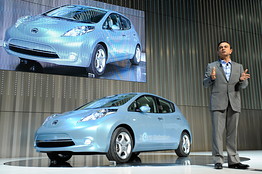
Company CEO Carlos Ghosn introduces the Nissan Leaf EV at the company's new headquarters in Yokohama, Japan
At each of the past few Tokyo Motor Shows, Nissan has displayed their latest lithium-ion (LION) battery technology; the batteries were smaller and lighter at each successive show. This year's show should see the Leaf in production trim.
On my radio show recently, my guest was an original GM EV1 lessor, an NBC-TV network technician who has been an EV enthusiast for years. In line for a Mini E, he found out the day before he was to receive the car that apparently BMW, Mini's maker, took exception with some things he'd said and written on the Web; he didn't get the car, but he's driven several and loves it.
During the interview, I asked him if battery technology was still the biggest obstacle to mass-produced EVs. I was somewhat surprised when he said no; that the latest LION batteries are dropping in price for the car makers and when EVs finally get on the road, prices will naturally drop even more. That's good news, especially for Nissan, given yesterday's announcement.
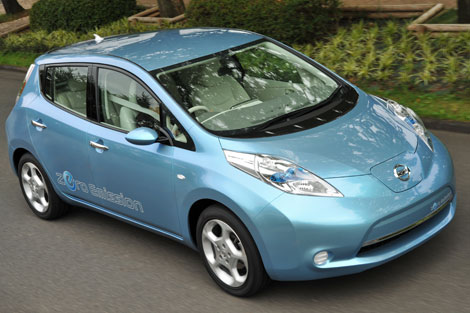
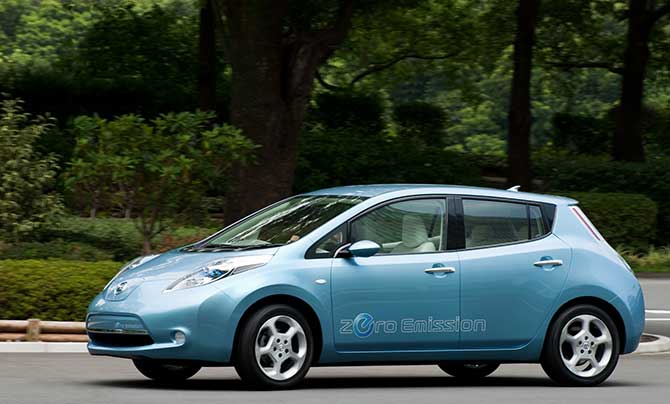
Leaf looking much as it will when it goes into production next year
GM, which has seen costs skyrocket on their planned-for-late-2010 Volt "extended-range hybrid," should also be cheered that battery prices are at least starting on a downward trend.
A five-passenger medium-sized hatchback, Leaf is built on a lithium ion battery-powered chassis with regenerative braking. The battery is placed under the seats and floor, increasing room for passengers and cargo.
No pricing and little performance information was released, but Nissan promises the Leaf will be competitively priced in its segment, which is what we'd expect them to say.
It's estimated the battery pack now costs some $10,000; Nissan may initially sell the car but lease the battery pack to Leaf owners, with new packs installed when necessary at no extra charge (pun intended).
Nissan claims a top speed of more than 80mph and a range of over 100 miles-per-charge. The company says the electric motor will develop 80 kilowatts, which is the equivalent of about 107 horsepower.
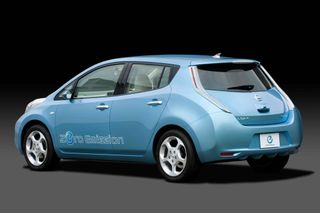
Styling? Aerodynamics control the design, which is why most hybrids look alike; Leaf doesn't do much better in the styling department
The hatchback has no internal combustion engine, and thus no tailpipe, which means no CO2 or other greenhouse gas emissions.
Nissan says Leaf can be fully recharged via a 220-volt household outlet in under eight hours. Leaf can be charged to 80% of its capacity in just less than half an hour if a to-be-available quick charger is used, the company says.
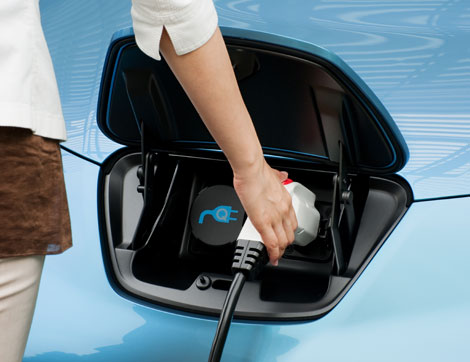
Nissan says Leaf will recharge in under 8 hours from a 220-volt outlet
In spite of the economy, Ghosn says Nissan will immediately begin investing billions building Leaf assembly lines in Japan, Europe (probably at Sunderland in the U.K.) and Smyrna, T.N., Nissan's manufacturing base in the U.S.
Nissan has been working with cities worldwide to help make them ready for Leaf; some have agreed to improve their power grids and electric infrastructures to prepare for what should be the first mass-produced EV since the GM EV1. Nissan says they'll be able to make 200,000 a year by 2012.
Renault/Nissan chief Carlos Ghosn, one of the few foreign CEOs in Japan, has been adamant, some say arrogant, in his desire to move directly to EVs and not invest in and build hybrids. He has a point; the industry is moving in that direction anyway. He's letting others spend billons on hybrids.
In fact, the Nissan Altima gas/electric hybrid uses Toyota-licensed technology; so Nissan sells a hybrid but invested little in its development, something Ghosn demanded.
Ghosn came to Nissan through Renault's investment in the number 2 Japanese car-maker. Nissan was then in serious trouble; rumors that Chrysler was going to buy Nissan were quashed when a top Chrysler executive said, "You might as well put $5 billion on a ship, paint 'Nissan' on the side and sink it."
Ghosn drastically cut the Japan workforce, something of a shock to the nation, and moved the company's American headquarters from Los Angeles to Nashville, to save money and be near their plants in Smyrna, TN, a move still questioned by many in the industry.
After all, Nissan, then Datsun, got its start in the US when "Mr. K," Yutaka Katayama, focused on the southern California lifestyle in developing cars for this market, a move which resulted in the original Z-car. What might Nashville offer in the way of inspiration? We shall see; Nissan Design International, though, is still located in La Jolla, CA, just north of San Diego.
Leaf's dashboard seems as modern as they come
Ghosn, along with Sony CEO Howard Stringer, another "gaijin" (foreigner; literally "barbarian") have become major celebrities in Japan, almost on a par with Japan's major gods of industry, Akio Morita (Sony founder) and Soichiro Honda. This move into EVs will further cement Ghosn's reputation for radical moves within Japan Inc, so conservative it makes General Motors look absolutely wild.
While writing this, I'm also half-watching Carson Daly (is there any other way?) on his NBC show. He's spending his time between music and interview segments showing and promoting the new Tesla EV Roadster. David Letterman famously drives a Tesla every day, but Tesla pricing is still beyond what most can afford.
Maybe Daly should have just hung-out at some Nissan dealer --- that's where the big EV news is today ... thanks to Carlos Ghosn.
![]()
Follow Steve Parker on Twitter: www.twitter.com/autojourno
Want to reply to a comment? Hint: Click "Reply" at the bottom of the comment; after being approved your comment will appear directly underneath the comment you replied to
...And Steve, I think your opening statement defining the oil companies as being "nervous" is somewhat of an understatement. I belive Chevron, Exxon and Shell are as terrified as a cat in a room full of rocking chairs.....!
An affordable, normal-looking, 100% electric car? This is a dream come true. Electric cars are safe, clean, efficient. This is a really big step towards reducing greenhouse gases, lessening the impact of peak oil, and saving money in the process. American auto companies need to learn from Nissan on this one! I just finished reading "Two Cents Per Mile” by Nevres Cefo, which is the most informative book I’ve read on the topic, and I suggest it to anyone interested in electric cars. http://www.twocentspermile.com
I don't understand the "no greenhouse gas emissions" statement. Of course there are greenhouse gas emissions. They are emitted at the smokestack of the coal-fired generating plant.
See Steve Parker's Profile
Thanks for the comment!
Well, of course you're right ... the same way bicycles are polluters. ANYTHING manufactured is inherently polluting the atmosphere somewhere in its lifetime. But you have to start the world's clean-up somewhere ... and I definitely like what Nissan is doing.
In Japan, though, I think almost 50% of their power comes from nuclear plants, so coal may not be the issue it is elsewhere (like here in the US). I've become a tacit supporter of nuclear; I do believe the plants can be built and run safely. If and when the US government finally decides to 'harden' the facilities against attack, I'd feel a lot better ...
Steve
Big base load coal fired plants "ramp down" from nameplate capacity usually after 7 PM . Why? most business load drops off, a lot of industrial load drops off, the 5 PM residential air conditioning compressor "hit" of 4 KV drops off , peak goes down.
What happens then? Due to economic dispatch, heat rate curve conversion of coal btu to Kw and kw-hour, Big coal fired units are "maintained" at " stable fire ball" so as to be on line 24/7. Stable fire ball is usually at maybe 20 to 25% of Name plate rating. At stable fire ball the big coal fired is at a poor point on its inherent "heat rate curve" . Charging up your electric car in evening will allow all this unused Big Coal fired capacity to "ramp up" over evening hours to a better place on "heat rate curve". Nuke plant will cost $30 billion to build , $20 to $30 billion to decommission and long term storage for lethal radioactive used fuel rod waste isotopes is 100,000+ years. Plus there is no insurance for a nuke accident that would make , say the State of Missouri, uninhabitable for 1000's of years. Nuke is not the answer.
90% of drivers have a total commute of less than 50 miles/day.
The speed limit is 55, 65 in rural areas, so 80 is just fine for commuting.
Also, remember, when this is stuck in the inevitable traffic jams, it is using almost NO power.
It will cost pennies a day to run, with almost NO maintenance.
This is not intended for someone who lives in rural Nevada, or northern Idaho. It is a metro-area vehicle intended for the 80% who live in metro areas.
The reason most car companies have shied away from EV's; no maintenance to speak of.
Most dealers and car companies make most of their money on maintenance; oil changes, air filters, lubrication, engine maintenance, etc. NONE of which exist in an EV.
Don't believe me? When was the last time you performed any "maintenance" on the blower motor in your furnace? Same technology, been around for 120 years (some of the first automobiles were electric, but battery tech was not sufficient so they faded away.)
Most bearings are now sealed and need no lubrication, most chassis need no lubrication, and if something is wrong with the battery or electronics, you swap them out completely.
No oil changes alone will cost the Oil Companies dearly, not to say anything about no gasoline needed.
>> Also, remember, when this is stuck in the inevitable traffic jams, it is using almost NO power.
It will cost pennies a day to run, with almost NO maintenance
So I suppose the wipers, radio, A/C and Heat will run themselves at no cost during those traffic jams. Riiiight.
When these vehicles can go 300-500mi on one charge, and you can charge it in 5 minutes then it will be pratical.
When the battery pack cost $200 or less not $10,000 then it will be pratical.
You don't aim for the avg. person's daily commute, because when they get home, they may need to go on a 10 hour drive. Then what? Wait for 8 hours every 100mi to re-charge or get partio 80% charges every 100mi?
Ludicrous. Nice car. Looks great. Moving in the right direction.
Not ready for primetime yet, however.
And don't give me the "you have to start somewhere".
Start by doing the right thing, doing it well, and meeting the end game first.
Any of you who work in the corporate environment know that if you start with the goal being Z, and implement A-C with "plans to release future releases" you never get passed C and it stays that way for 8 years because everyone is used to how it works.
Let's not be impressed with these kinds of accomplishments.
Let's force the auto industry to develop REAL solutions..
You must be joking (or toking.)
"when they get home, they may need to go on a 10 hour drive."
Really.
And that happens how often? Not many people drive for 10 hours, EVER not even on Independence Day and Labor Day, and even then most won't use the smaller "metro" car to do it, they take the "Land Yacht" and load'er'up for the trip.
This is the same old "It won't do EVERYTHING so don't build it." BS.
You think everything should be "perfect" and "all things to all people" right from the get-go huh?
What about off-road? What about towing 1-ton boats? What about having power take-offs? What about hauling 3-ton loads in the back?
Does your car do all of that too? If so, it is a Ford F-250 Hemi and you are not the target market for this car.
This is a canard. If people thought like you we wouln't have the modern computer because at one time it was pretty useless and was projected never to be used in the home. You sir think like a dinasour.
Battery cost will drop as more are manufactured and generic brands compete for their share of the market. Then there are the recyclers who will find cost-effective ways to rebuild battery packs. I look foreward to owning one some day and helping to drive a spike into the chest cavity (no heart in evidence) of the oil pigs.
I suppose it is a move forward, but in reality for the vast majority of car owners it is still impractical. A range of 100 miles and a top speed of 80mph. Forget about using it for anything more than grocery getting, or to and from work. This will be the extra car, not the main stay. Untill the car companies can truely compete with electric cars they will be not be worth the cost.
How on earth is a range of 100 miles (the article actually reports 'a range of over 100 miles') and a top speed of over 80mph in any way impractical for the vast majority of Americans?
I have a roundtrip daily commute of ~110miles (by most people's standards a darned long commute), almost all 4-lane+ highways, and rarely top 70mph. If they can get another 50% range (at least 150 miles rt), or I could figure out a way to partially recharge while parked at work, this car would be exactly what I need. The range limitation (if 100+ miles is a limitation) is the only thing that would keep me away from this car.
My wife's current car is a Toyota Matrix. She probably puts less than 100 miles / week on it. This would completely replace that car from day one with even less than half the current range.
Get real.
Sorry to hear about your commute... I hope you can make it shorter one day.
well for most people, around 90%, 100 miles would be more then enough. If your interested in a longer range ev then go to telsa 's website they have one coming out that get 300 miles to a charge.
You must be logged in to comment. Log in or connect with