- BIG NEWS:
- Bill O'Reilly
- |
- Keith Olbermann
- |
- NBC
- |
- Fox News
- |
There are some moments when you can feel the conversation change -- and the world tilt from right to left.
Today was one of those days.
It began early at the Personal Democracy Forum in New York City. The PdF as it's known, is now in it's 6th year -- and attracts the top talent in politics, consulting, and technology.
Predictably, the conversation this year revolved around Twitter, Iran and the transformational power of social media to change the political landscape. The days agenda featured a list of Obama campaign and administration superstars -- and it perhaps is somewhat ironic that Julius Genakowski, the newly appointed FCC chairman wasn't able to attend, as he was
being confirmed in DC just as the afternoon sessions began.
But the elephant in the room wasn't about software, or technology -- it was about Broadband. The issues around Universal Access emerged as the most powerful metaphor for freedom, democracy, and free speech.
So the conversation came to a head as PdF Founder Andrew Rasiejr moderated a panel about access with two of the industrys best know spokesman -- Hank Hultquist from ATT and James Assey from the National Cable Television Association. Also on the panel, activist Josh Silver from Free Press.
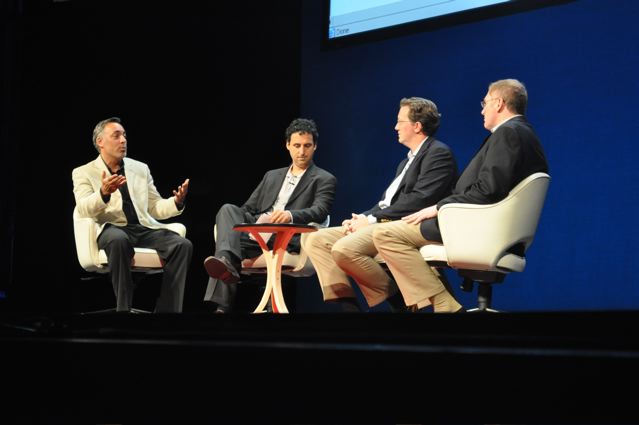
For the bulk of the panel, Josh was the pitbull -- taking on big cable and telcos for being a "duopoly" and that they had the interests of their shareholders and profits above the public good. Surprisingly, neither of the industry spokesman denied the charge, rather pointing out that it was because of the free market that they'd been able to 'invest' in the infrastructure that today was bringing Broadband to the nation. The fact that our access is woefully behind most developed nations, and priced high and going higher, was left an open question.
Then, as the panel was drawing to a close -- a woman got up to ask a question from the audience. She introduced herself as an Argentinean journalist, and said -- simply -- isn't' broadband access what is making the Iran Protests happen? Wasn't broadband and essential component of freedom and democracy. In short - should broadband access be a civil right?
It was a question that was stunning in its simplicity.
If the internet is the backbone of free speech and participation, how can it be owned by corporate interests whose primary concern isn't freedom or self expression or political dissent? Doesn't it have to be free?
You could feel the room go silent.
Hmm... freedom = broadband.
Broadband as a right, not a privilege.
Wow. That's the moment you could feel the conversation change.
Follow Steve Rosenbaum on Twitter: www.twitter.com/magnify
Want to reply to a comment? Hint: Click "Reply" at the bottom of the comment; after being approved your comment will appear directly underneath the comment you replied to
Actually I think that the best solution to this emerging problem of media company oligopoly (control by the few) is what made the internet a success to begin with: direct citizen action.
Neighborhood mesh networks can work as well in urban environments as in rural environments (where they are often used to provide "cheap" broadband access to citizens without the high trenching costs).
If neighborhoods would band together and purchase one fat pipe to the backbone, and then provide the details on how to purchase and run a mesh node, they could band together and bypass the big media oligarchs altogether.
It's not simple, but it's not prohibitively expensive or technologically impossible. Of course, the cableco and telco would fight it tooth and nail -- likely they'd have some politicians in their pockets to rule that neighborhood-run ISP's were somehow illegal (drawing, to be sure, on some old Ma Bell regulations that are no longer relevant...). That's how things have played out in the past...
But the point is, if we wanted to, we COULD overcome this oligopoly.
Free speech is a civil right but broadband is a business model antithetical to the idea of free speech – http://frankston.com/?name=BroadbandInternet.
High speed Internet service is not a "duopoly" at all. There are more than 4,000 competitive, independent Internet service providers which are giving the cable and telephone companies a run for their money. I happen to be one of them.
Josh Silver and his organization are claiming, falsely, that there is a "duopoly" in an attempt to justify government regulation of the Internet. Ironically, such regulation would create a duopoly by driving smaller competitors, which could not cope with the cost of the regulation, out of business. In fact, the very threat of that regulation is discouraging investors from investing in high speed Internet providers like mine, harming thousands of small businesses all across America.
If we want to see lots of competition, lower prices, and plenty of civil participation on the Internet, the way not to do it is to impose the stifling regulation advocated by Mr. Silver. Instead, encourage competition. Lots of it. The only intervention which the government should do is to step in when anticompetitive business practices threaten that competition.
What can the government do to encourage competition ? Because in my neighborhood you either get Comcast or you tie two sticks to an iguana and duct tape his ass to the roof ?!!! You get the picture do you need another hooked on phonics version of an example ?
I call that a fkn MONOPOLY, it's NOT like I can lift up my house and move it to another county.
Someone in the state government is green lighting a one company county area. Thats not just a monopoly thats corruption.
So as a result, if I have an internet problem I can talk to the iguana or I can do without because they dont know what customer service is and they dont care........why ? BECAUSE THEY DONT HAVE TOO.
It most assuredly IS a duopoly. Broadband service in almost every area (except for a few test WiMax areas and so forth) means either high speed cable, or some form of DSL (in other words, the telcos).
True, there are ISP's that ride on the back of those two -- for instance, in my area, Speakeasy is an "independent" ISP, but even so, they get their service from Qwest (or maybe it's Verizon, can't remember).
In fact, it gets worse. DSL isn't available in my area, and the Verizon FIOS is prevented from being offered in Seattle by contract, from what I understand. So my neighborhood, at least, is a Comcast *monopoly*.
Competition in the broadband arena is dismal, and getting worse. Until the government treats network access as a requirement the same way that access to water and power are, and forces the playing field to be level, we'll see more and more exclusionary policies, continuously jacked up rates, and more and more lag behind the rest of the developed world.
The internet is increasingly becoming *THE* backbone for real democracy. We cannot let the greedy cablecos and telcos swallow it up.
A government that represents its people will make sure everybody has free broadband because it is so good for the main street economy. A government that does not represent its people, like ours, will likely protect the telco, cable duopoly. Calling it a "right" just complicates things. What good is a right to broad band if I don't have broad band.
The magnitude of money flowing from cable companies to Senators coffers is so profound that unless the American people rose up with pitch forks and torches and marched on Washington DC NOTHING is going to change other than you and I will be paying more and More and MOre and MORE for Broadband until it is so essential that unless you have $300.00 a month you wont be getting any.
Why ? Because THEY CAN. Because we graze like sheep instead of demand from our elected officials. Because the vast majority of Americans are ignorant and uneducated and passive.
Absolutely. This is why it is critical for us to organize BEFORE we get to the "pitchfork moment" (as Rachel Maddow appropriately termed it).
Interesting question! As the politicans in Washington don't seem to be able to agree that all Americans deserve healthcare, I doubt they would agree that everyone needs Internet access. Once the physical health of all Americans is assured, then the intellectual health should be addressed.
Imagine the implications, if every American had access to affordable Internet (and a computer) would a more informed populous demand the legislators in DC and State Capitals become actual extensions of the people and not the lobbyists?
For many legislators, I am guessing that this would be a truly frightening thought!
Broadband is not superabundant, but scarce.
Broadband is provided by human labor.
If you have a "right" to the product of another person's labor, then the other person has become your slave.
You cannot have a "right" to the production of another person.
You do, however, have the right to *trade* for the product of another person's labor.
That is the peaceful way to go about things.
The ISPs have stated that "bandwidth is basically free."
And how would you describe the post office ?
You cannot decide what the people do or do not have a right to receive.
Emergency medical training is not superabundant, but scarce.
Emergency medical service is provided by human labor.
Therefore, by your reasoning, all paramedics are slaves.
Think before you post, and until then, go back to reading the Fountainhead or whatever crazy source of "all goverment intervention is evil" propaganda you prefer.
Broadband may or may not be a civil right. However, to compete in the World Economy now we must make it a priority. Per Free Press, we are 14th in national access to broadband & increase our broadband speed - currently 22nd in the world. For a robust, recovery we need to update & MAINTAIN an up-to-date infrastructure - ocean & river shipping, high speed passenger rail, improved inter-intra city rail & bus improvements, etc.
We're approx. 20 years behind in energy conservation, wind & solar energy. We haven't even started on decentralized wind & solar generation on a smart grid. Once we get to that point + clean, protected water supplies we're almost at the EUs current state. It's time to play catch-up & we're nowhere to be seen.
We own the airwaves. Each and every one of us has a stake in how our airwaves are used. They belong to us, not the government, not private corporations. Broadband is simply a term to represent how the airwaves can be made available to everyone who owns them. Seems to me, as owners, we need to exercise our right to what we own. If corporations block access to our airwaves, we need to end their licenses, and return ownership to the Public.
I canceled my landline phone. I have Asterisk (a software pbx or switchboard) that does everything a phone company does. I have an antenna that receives digital signals from 100 miles away. It is called, Gray-Hoverman. It cost less than $10, and is patent-free. I have a videophone, software as well. I can see who I call, and they can see me. I have to pay an ISP to gain access to the Internet, and I have to pay a telco monopolist to provide backhaul for that Internet, each month. Between them, they limit my service, depending on how much I pay them. I pay them to access my airwaves that I own. I have the technology to replace them. All I need is a national broadband policy that calls for decentralized broadband infrastructure, which costs but $50 per house.
There should be no discussion, and certainly, there should be no corporation speaking on any panel that won't acknowledge who owns the airwaves they're controlling.
"Broadband is simply a term to represent how the airwaves can be made available to everyone who owns them."
That is in no way what broadband is.
broadband is not necessary for you to exercise your right to free speech or protest...your voice will do nicely...unless you are saying that rights should advance along with the technology...maybe we can apply that logic to the 2nd amendment as well....
15 years ago, if we decided that dial-up internet was a civil right and the government took action to make it happen, I'm pretty sure we'd ALL be using dial-up internet today - but there would be no such thing as broadband.
Let the greedy companies fight it out... 10 years from now, we'll all have broadband for free, and we'll be asking if the next big thing is a "civil right".
Just like we get free cable tv, right? Right?
Yeah, the "just ignore it and the problem will go away" tactic has worked so well for monopolies/oligopolies in cell phone access, computer operating systems, cable TV access, the music industry, the movie industry, etc...
Methinks we have our history to learn a lesson from: do nothing, and no good will come of it.
"She introduced herself as an Argentinean journalist..."
...who was quick to deny knowing anyone in South Carolina politics. :-)
You must be logged in to comment. Log in or connect with