iPhone app iPad app Android phone app Android tablet app More

Featuring fresh takes and real-time analysis from HuffPost's signature lineup of contributors
Steven Cohen

Steven Cohen

Posted: January 28, 2010 01:48 PM

The State of the Union: Jobs, Energy and Climate

What's Your Reaction:

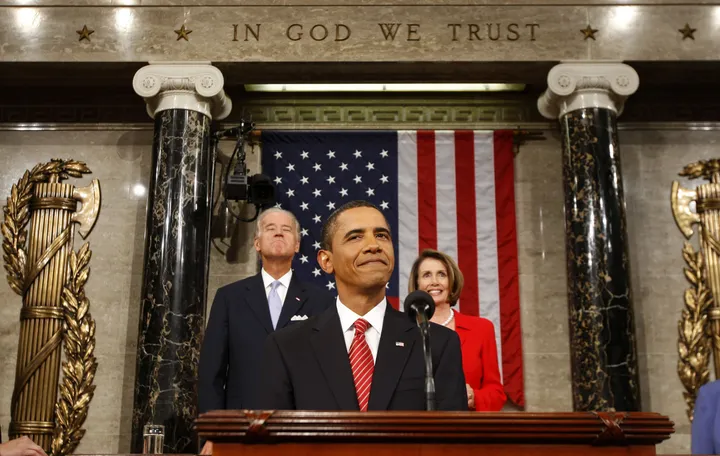
I continue to root for Barack Obama. Blunt and tough was just the right tone for his first State of the Union. While I expected him to submerge climate policy within the veneer of energy and employment policy, I was impressed that he addressed it so directly:

I know that there are those who disagree with the overwhelming scientific evidence on climate change. But here's the thing -- even if you doubt the evidence, providing incentives for energy-efficiency and clean energy are the right thing to do for our future -- because the nation that leads the clean energy economy will be the nation that leads the global economy. And America must be that nation.

I agree with his strategy of brushing off the climate change deniers, but at the same time we need to think hard about a political system that is so reluctant to deal with scientific fact. To put it simply, the world is getting more complicated, and scientific analysis is needed to truly understand and effectively manage this complexity. The idea that a global population of nearly seven billion people does not have any impact on the environment defies common sense. Stand behind a car for an hour and breathe the exhaust and see if you think it has no impact on human biology. Multiply that impact by 260 million, the number of cars on the road in this country alone, and tell me that you really believe that we are not damaging this planet.

Here at Columbia University, we have over 100 doctoral level scholars researching every element of the climate problem at the Earth Institute alone. They are studying and teaching about the causes and impacts of climate change and how to adapt to the change that we all see coming. It is true that we cannot predict the future, and that we do not know the precise impacts that will come from rising global temperatures. But it's also true that we don't know the precise place from which the next terrorist attack will come. Our lack of clairvoyance is no reason to deny facts or avoid formulating public policy.

On January 26th, my colleague and boss, Professor Jeffrey Sachs, convened a meeting of over 100 diplomats, scientists and leaders of non-governmental organizations to discuss post-Copenhagen climate policy. One of the recurring themes of those discussions was the need to do a better job of communicating climate science to the public. Those who are not scientists need to do a better job of translating scientific jargon and analysis for decision-makers and the general public, and those who are scientists need to focus communication efforts on the facts that can truly be demonstrated and understood. The language used by some climate scientists to predict impacts is more certain and less conditional than it needs to be; we simply do not understand the full environmental impact of the high-throughput global economy that we live in. We need not pretend to fully understand it to mitigate the most obvious problems we are creating. Climate change is one of those problems. Biodiversity loss is another. A shortage of fresh drinking water is still another. The degradation of the planet's biosphere is a fact that we do not necessarily have to fully understand, but one we unquestionably need to learn to manage.

President Obama demonstrated during his State of the Union address that he understands these fundamentals. He also understands that, politically, he needs to turn his focus to growing the American economy and creating more job opportunities. It makes good strategic sense for him to link environmental protection to the development of a sustainable, and successful, green economy. Given the EPA's move to regulate greenhouse gases as air pollutants under the Clean Air Act, I expect that in the short run a key element of American climate policy will be good old fashioned command-and-control regulation. Political realities suggest that we may have to give up on the idea of linking that policy to the sort of comprehensive attack on the climate problem we saw in the Waxman-Markey and Boxer-Kerry bills, at least for now.

If that is the case, and we defer a comprehensive climate law, we will clear the deck for a renewable energy and energy efficiency bill: a bill that funds research on renewable energy and provides financing and subsidies for renewable energy and energy efficiency projects. A program focused on green energy would create employment while simultaneously reducing greenhouse gases. With EPA regulating emissions and a jobs program focused on energy infrastructure, we could empower local governments and the private sector to move forward on the transition to a green energy economy. This would undoubtedly contribute to our global competitiveness by reducing the proportion of our gross domestic product spent on energy.


Follow Steven Cohen on Twitter: www.twitter.com/earthinstitute

I continue to root for Barack Obama. Blunt and tough was just the right tone for his first State of the Union. While I expected him to submerge climate policy within the veneer of energy and employmen...
 
 
  • Comments
  • 5
  • Pending Comments
  • 0
  • View FAQ
Comments are closed for this entry
View All
Recency  | 
Popularity
05:44 AM on 02/06/2010
Aerospace Jobs from Every Online and Printed Source they Can Find. The only job-opening research institution in the world whose mission is to track down every aerospace job opening through research. Airlines Jobs locates jobs inside your niche, conducting a more Aerodynamic Engineer Jobs search. There are tens of thousands of employer and job sites out there.AerspaceCrossing goal is nothing less than to show you every job from every source.
03:57 PM on 02/01/2010
Communicating about climate change has seemingly become the number 1 identified issue whether it's a panel of leading NGO's, private sector leaders and thought leaders at a carbon conference or now at the global level. The hurdle however, isn't just communicating clearly and finding a way to resonate. The reality is that no one is taking responsibility for communicating to the public and ensuring that they get the information to begin with.

The average citizen that doesn't have a general interest in climate change receives the occasional headline from the media, the tone of which can change depending on which party is leading the conversation that day. But what the public needs is a national campaign that involves leaders from all sectors, dissemination of information and a stabilized position on the facts. With such a partisan Congress, the latter part could prove challenging, but at least putting the facts in the hands of Americans will give them the foundation they need to make a reasonable decision.

People are interested, curious and care, but we have to make it easy and accessible for them. We've seen it in general elections, the same kind of thinking is needed to communicate climate change.

NicoleS
(PR professional and grassroots organizer)
www.zerotosixtycommunications.com
photo
HUFFPOST SUPER USER
TomDegan
Author of "The Rant": http://www.tomdegan.blogspot
05:27 AM on 01/31/2010
The entire country was focused on President Obama's State of the Union address this week. I have nothing original to add to the discussion other than my view that it seems the prez is trying to jump start his faltering administration. A lot of "the experts" are at the moment dismissing this White House as dead in the water. If they had any concept of history they would know better. Many presidents in the past got off to a bad start. If George W. Bush were judged only on his first year in office, he would today be remembered as one of the worst Chiefs Executive in American history....

[Long, awkward pause]

Okay, maybe that's not a good example. Let me try again....

Jack Kennedy had a fairly shaky start in his first year (Remember the Bay of Pigs?) and yet he turned out to be pretty good at the job. A year from now will find us at the half way point of Obama's first (I hope) term. Let's see what happens between now and then.

NOTE TO THE LIBERALS: To abandon all faith in this president now would not only be foolish, it would be a half-step away from insanity. Chill!

http://www.tomdegan.blogspot.com

Tom Degan
08:42 PM on 01/29/2010
Strong commitments from Obama in his State of the Union address: firm support for green jobs and nuclear power and a push for the Senate Climate Bill. It will be interesting to see what solutions the panel finds for the hazardous waste generated by the $54-billion-nuclear reactors and how quickly tax incentives generate green jobs and whether Congress passes their Climate Bill.

Researching how to make your company, product, or next project more Green? Go to http://www.greencollareconomy.com for sustainability white papers and the largest b2b green directory on the web.
photo
HUFFPOST SUPER USER
joshuak2077
05:24 AM on 01/29/2010
President Obama's noble effort to accent on the importance of Environmental technologies and the real implementation of such is compelling and deserves highest grates and agree with your acute observation. But, overall the implementation of Environmental technologies is not cost effective and might never be in an very competitive Globalizing market when simultaneously many parts of this market are so poor that such expensive preposition seems quite inadequate as well. To expect Environmental technologies to become part of the market competition is more-like building infrastructure and public transportation to become such too.
Hence, if Environmental technologies are to be implemented into the real economy the (the Environmental technologies) projects should be either financed on a very low interest rates and totally exempted of taxes but even further these projects aught to be subsidized: these kind of financing would well be expanded Globally, because if these policies are applied only nationally the pollution will be working out its ways in China and Russia as an example, so what is the wisdom of loading US businesses with cost ineffective projects and where the money is to come from for such enhancements anyway?;