The first phase of the Obama administration's efforts at progress on the Arab-Israeli dispute is over, and let's be honest: it's not what the administration hoped would happen when it embarked on its campaign to bring the parties to the table. In a prelude to negotiations, the Israelis were supposed to freeze settlements, but the Netanyahu government only talked privately about going part of the way. The Palestinians were to increase security measures to prevent violence against Israel and decrease incitement. Although there was some progress on security, largely because of General Keith Dayton's efforts at training Palestinian police which would have happened anyway, nothing was done on stemming incitement. By toughening their stands on preconditions for talks, just showing up for the summit in New York became a concession.
To build momentum for re-engaging, the broader Arab side was supposed to provide confidence building measures like overflight rights and offers of Israeli liaison offices in their capitals. Only Oman, Qatar, Barhrain, and Morocco took positive steps. The state that could really have helped, Saudi Arabia, stood steadfast on claiming it would do nothing until Israel agreed to withdraw from the Golan and the West Bank.
The Obama team was smart to declare that the first phase was over and it was time for the parties to enter into negotiations. Otherwise, it was clear that they would not budge from established positions. After chiding them for not taking the steps he had requested, President Obama declared before the summit "Simply put it is past time to talk about starting negotiations--it is time to move forward". Inside the room, apparently, his impatience and frustration showed even more clearly.
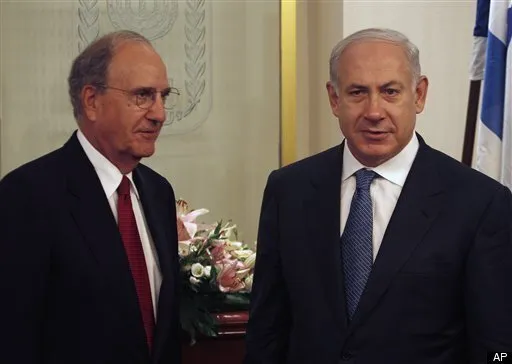
Now Mideast envoy George Mitchell has the tough task of actually initiating negotiations. The problem is that he has to do make that challenging effort in an atmosphere in which all parties feel that the other side hasn't taken the necessary confidence building steps that would have improved the context for talks. President Obama himself has validated that disappointment.
In his speech to the UN General Assembly, President Obama provided the direction for a new approach, when he said that in pursuit of his goal of peace between Israel and "its many neighbors", "we will develop regional initiatives with multilateral participation, alongside bilateral negotiations," to use the President's words.
We have an idea for just such an initiative. Why not revive the regional "multilateral" approach that provided breathtaking examples of what could happen in the Middle East in the 1990's. It's hard to believe now, but after the Madrid Conference in 1991, Israelis, Palestinians, and nearly all Arab states met regularly in five international groups to redress such common problems as water scarcity, environmental degradation, refugees, economic development, and regional security.
Among their achievements, they agreed to establish a regional desalination research center for producing fresh water, a program to reunite refugee families, an environmental code of conduct, a regional development bank, and pacts to avoid dangerous incidents at sea and require early notification of certain military activities in order to augur greater transparency and comfort. Equally important, seeing their diplomats on television engaging each other for the first time in various Middle East capitals on these issues gave Israelis and Arabs confidence in the overall peace process.
Sponsored by America and Russia, and facilitated by Japan, Canada, the European Union, Turkey, China, India, and other "extra-regional" states, the multilaterals demonstrated the potential fruits of regional peace, while Israel and its immediate neighbors engaged in direct bilateral negotiations. Progress was pegged tightly to the outcomes from the bilaterals. When those negotiations deteriorated, so did the multilaterals' five working groups. It didn't help that a heated dispute developed in the Arms Control and Regional Security group, largely on Israel's purported nuclear force, and poisoned the rest of the multilaterals as a consequence.
We think that a 2009 version of the multilaterals would help jumpstart the Obama administration's new efforts, because it would immediately change the atmosphere from a sense that the parties are just going along with President Obama because they have no choice, to one in which all parties could have buy-in that would build Israeli and Arab confidence that this process will indeed lead to a lasting, comprehensive peace.
But based on experiences in the 1990's, we suggest reconfiguring the process to make it better. First, leave the water and environment groups as they were because they worked well. The economic development group should continue in its old dramatic way, holding large economic summits like those conducted in Casablanca, Amman, Cairo, and Doha, and attracting as many as 4,600 participants.
The refugee group in the 1990s focused primarily on Palestinian refugees and demonstrated that these meetings weren't just designed to make Israel feel as if it belonged in the region. Indeed, this group accomplished important steps on designing a system for addressing refugee needs. Since then, illegal immigration has escalated throughout the region, creating new refugees, along with huge numbers in Jordan and Syria escaping the Iraq war. As such, the group should enlarge its focus and include immigration problems.
We recommend not reviving the arms control and regional security program, as important as it is, at this time, because this group had such a negative impact on the entire multilateral process in the 1990's. Hard security talks should continue, but in a second track format. As witnessed in the Asia Pacific context, an officially sanctioned Track Two program can serve successfully as a venue where issues not ready for formal negotiations can be incubated.
We would also add four other groups. The first is on education, a topic of regional significance because of the negative manner in which Arabs and Israelis describe each other in textbooks and classrooms, and because the issue of education is so critical to future regional development as suggested by several United Nations reports.
We would add a tourism, group because of the shared ancient experience of many countries of the region. Coordination between neighboring countries could enhance tourism and the economies of many countries in the region.
We would also look at energy. Despite an abundance of oil and gas in the region, these commodities are not uniformly distributed and will become scarcer in the next three decades. Regional parties are beginning to search for alternatives to fossil fuels, including nuclear and solar. Only regional electrical grids and power production partnerships can provide a stable foundation for meeting growing energy demands in the Middle East, and potentially in neighboring Europe.
Finally, in an era of pandemics and potential man-made and natural disasters, a multilateral on health security would be a logical step. Pandemics do not recognize borders and can easily overwhelm individual countries, and realistically can only be addressed through regional coordination at the functional level.
With strong American support, the eight multilateral working groups could serve to accelerate the momentum for peace agreements in a genuinely altered Middle East environment as negotiations begin and the tough process of making concessions is initiated. They would alter the role of President Obama from a stern teacher lecturing the parties on their failings to a lofty visionary showing the way for a better future. The Obama administration's policies are the right way to go, and the administration is right to proceed. As the President told the UN, "even though there will be setbacks and false starts and tough days, I will not waver in my pursuit of peace". We think that the revival of the multilaterals would ease the way in the negotiations themselves and enhance the prospects for his success.
Steven Spiegel is Director of the Center for Middle East Development and Professor of Political Science at UCLA; and Michael Yaffe is Professor of International Relations at the Near East South Asia Center for Strategic Studies and former member of the U.S. delegation to the Madrid multilateral talks.