iPhone app iPad app Android phone app Android tablet app More

Featuring fresh takes and real-time analysis from HuffPost's signature lineup of contributors
Steven Strauss

GET UPDATES FROM Steven Strauss
 

Actually Tax Cuts Don't Seem to Have Much Impact on Economic Growth...

Posted: 10/25/11 05:56 PM ET

It has been something of an article of faith among conservatives that the solution to America's problems is in smaller government and lower tax rates. The argument on taxes goes something like: 'We need to unleash the wealth creators, who stimulated by the prospect of more income (due to lower tax rates), will create wealth for all of us.' And, that any tax increase -- for even the wealthiest taxpayers -- would have catastrophic consequences.

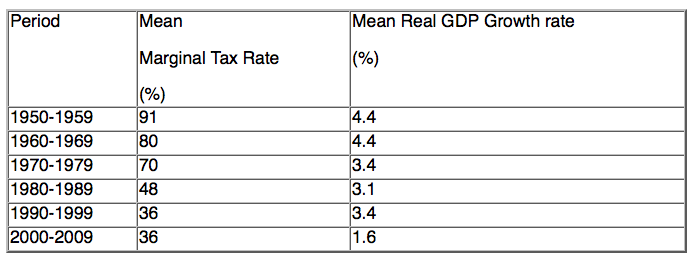
Actually the post World War II American economy provides a nice empirical test of this hypothesis -- the maximum marginal income tax rate gradually declined from about 90% to about 35%. Shouldn't this decline have lead to an explosion of economic growth as our wealth creators were unleashed? Sorry, Sarah Palin... it didn't.

During the ultra high tax 1950s (top marginal income tax rate of 90%), the United States had some of its best real economic growth (over 4%/year). And, for the decade where we had our lowest marginal income tax rates -- we had our worst real economic growth (about 1.5%/year). (See Table 1 below.)

So what happened? Well, first of all (Spoiler Alert! The following will upset ideologues!), the real world is complicated. Taxes are one part of the American economy, but by no means the only driver of our decision making process. People are motivated by lots of things -- not just money. In all the recent discussions about Steve Jobs, I can't recall a single quote, anecdote or story that suggested income tax rates had any influence on Steve Jobs' behavior. Does anyone really believe that if US income tax rates had been slightly higher Bill Gates would have founded Microsoft in Singapore (or some other low tax center)? As another example -- Warren Buffet, who has been an active investor from the 1950s to today, certainly could have moved offshore when tax rates were higher. He didn't.

Also, keep in mind that economic growth is not driven just by entrepreneurs and their hard work (okay, I've now simultaneously infuriated both the left and the right). In the 1950s, the global economy was emerging from World War II and the United States was the only industrial economy relatively unscathed. With better policies (arguably, the then current 90% tax rate was too high), we might have had even higher economic growth rates in the 1950s. But, our strong economic growth throughout the 1950s was helped by a strong tail wind (from outside the US).

In the early 21st century, we suffered relatively anemic economic growth (despite much lower tax rates), but we also faced a far more competitive world and a disastrous real estate bubble. It is not clear that lower income tax rates would have had much impact. But higher income tax rates and other policy adjustments might have avoided the real estate bubble from which we are now recovering.

Finally and most importantly, it is not just how the money is raised, but how it is spent. Tax revenues that improve infrastructure, and pay for basic research and education are investments in our future, and will foster economic growth. Tax cuts that primarily favor high end consumers might stimulate the purchase of luxury goods (McMansion anyone?), but may not contribute much to overall economic growth.

My point, and I do have one -- is that ideology is a poor substitute for pragmatic approaches to complicated problems. In fact the evidence that tax rates influence economic growth in any way is equivocal at best. A myriad of other factors are involved. Simply reducing tax rates, and primarily for the wealthy, may hinder -- rather than enhance our economic recovery.

Table 1: Comparison of mean marginal tax rates and mean real GDP growth rate
2011-10-25-Screenshot20111025at4.50.07PM.png


Steven Strauss was the founding Managing Director of the Center for Economic Transformation at the New York City Economic Development Corporation. He will be an Advanced Leadership Fellow at Harvard University for 2011-2012. He has also worked as a management consultant for McKinsey and has a Ph.D. in Management from Yale University. You can follow him on Twitter @steven_strauss.

Sources: The real GDP growth rates are from www.wolframalpha.com; the income tax rates are from the National Taxpayers Union.


Follow Steven Strauss on Twitter: www.twitter.com/steven_strauss


  • Comments
  • 462
  • Pending Comments
  • 0
  • View FAQ
Comments are closed for this entry
View All
Favorites
Highlights
Recency  | 
Popularity
Page: 1 2 3 4 5  Next ›  Last »  (8 total)
HUFFPOST SUPER USER
Jim NLN
Hillary-Frank 2016
09:39 AM on 10/27/2011
Tax cut boost the economy and lead to more jobs!
--REPUBLICANS (Making up facts since 1854!” )
jimbo57
ni dieu ni maitre
06:15 AM on 10/27/2011
Does this mean we can finally throw away the Laffer curve and the cocktail napkin it was originally drawn on? Not a minute too soon
09:32 PM on 10/26/2011
"ideology is a poor substitute for pragmatic approaches to complicated problems." Ideology is essentially a projection of psychological needs. So a good question is: why do 'conservatives' need to project these particular beliefs about the economy? Is it simply rationalized greed? Which without the support of a socially accepted ideology would produce moral guilt?
This user has chosen to opt out of the Badges program
08:48 PM on 10/26/2011
undefined
photo
HUFFPOST SUPER USER
onlinesavant
02:35 PM on 10/26/2011
As reagan said, "facts are stupid things." Obviously, he was a right wing icon.
photo
HUFFPOST SUPER USER
marco01
02:09 PM on 10/26/2011
"Articles of Faith" are how the RW operates. Facts and credible sources need not apply.
HUFFPOST SUPER USER
rjlwis
12:55 PM on 10/26/2011
You'd think conservatives would realize that the super wealthy would want to make more money since they are being taxed at a higher rate. How else will they afford all of their excesses...
12:00 PM on 10/26/2011
One has to wonder if the folks in Congress who tout trickle down really believe in it or recognize it for the BIG LIE that it is. After all, they don't need to believe in it to profit by it. Certainly the likes of ALEC don't need to believe in it to profit by it. They just need to convince the poor fools in the 99% because they need their votes to keep the BIG LIE alive.
11:50 AM on 10/26/2011
Great article; but I must say that the dismal graph does not show that growth slows with falling tax rates as much as it shows that the end of all mature capitalist systems is stagnation. And if we take bubbles and huge government stimulus of the economy through massive military spending, the building of the interstate highway system, the space race, rural electrification etc, the graph would be more dismal still. The present trend toward austerity, ie, the cutting of government expenditures, will only slow growth even more. Our entire economic system needs to be restructured to take the stagnation of capitalist systems into account. The Group of 1 has already come to terms with this fact, which is why they are putting all their marbles into emerging nations that can deliver profits from rapid growth until they themselves become mature capitalist systems that will then experience the same stagnation of growth that we are. In the end there will be no where for capitalism to go in order to gain the profits that it desires; unless, of course, they resort to the time honored tradition of nation destruction through war or economic catastrophe.
photo
HUFFPOST SUPER USER
Kristopher Leang
training to take down the elite
11:36 AM on 10/26/2011
AHAHHAHAhaA owned you conservative liars. i knew it was always a lie because there was no facts to fact it up..

but for a conservative facts, logic and reasoning are all side notes to supporting ideology. simply BELIEVING in it is the only criteria for good vs bad policy
photo
DXM
An extreme moderate
11:32 AM on 10/26/2011
"...ideology is a poor substitute for pragmatic approaches to complicated problems"

Unfortunately the demonstratably anti-intellectual Right only has ideology to address our problems even when objective reality says they are wrong. Compound this with an intellectually lazy electorate and a corporate-run media more interested in preserving access and profits than in the spreading the truth (even if it's uncomfortable), and we have a genuine recipe for disaster. Until something very drastic happens, none of this is going to change and America will continue its decline.
HUFFPOST SUPER USER
lolablev
Bring Peace into your Life
11:24 AM on 10/26/2011
"My point, and I do have one -- is that ideology is a poor substitute for pragmatic approaches to complicated problems." Agree or not agree with Mr. Strauss, this point is unequivocally, unarguably, valid.
hroark314
The handle says it all, doesn't it?
11:17 AM on 10/26/2011
The author has a valid point, but his data is misleading. More importantly, his valid point that low taxes are not an economic panacea is presented in a way that confuses the more important debate over the government's on the economy.

Regarding his data, the author looks at GDP growth rates, not GDP per capita. Population grew much faster during the 50s and 60s increasing growth rates during those years. It's misleading to ignore that reproduction did a lot to goose his numbers.

Data errors aside, his article is misleading, from an economic point of view, because it focuses solely on taxes. There is a clear correlation between government spending as a percentage of GDP and a country's per capita GDP and per capita GDP growth rate. Of course the real world is complicated, so there are exceptions to this rule, but the relationship is undeniable. The spending issue is important becase, obviously, to increase spending , taxes must eventually rise as well (and vice versa).

That said, I agree with a more narrow point that Republicans (especially during the Bush era) were wrong to focus soley on the tax side of the equation. As Milton Friedman pointed out, while taxation results in capital misallocation, the full cost of government is government spending plus the cost of regulatory compliance plus capital misallocation. In other words, the notion that cutting taxes while running up debts and spending like MC Hammer will result in high levels of economic growth is just wrong.
photo
HUFFPOST SUPER USER
Doctor Nick
Hi, everybody!
01:32 PM on 10/26/2011
On a per capita basis the author's point (about 80s vs. 90s and 50s/60s) would still be true in any case. But this is pretty casual empiricism - a lot was going on as the author admits.

The clear correlation between government spending as a % of GDP and per capita GDP is positive.
I'm not so sure about the correlation with growth of GDP per capita, but in any case all of these studies are deeply flawed and you cannot infer causality.

The main problem with the article is it obscures the long and short-run. While the long-run effect of government spending or taxes on growth is unclear, there is clear evidence for "Keynesian" type effects in the short run from numerous different studies. I hope people do not interpret this article as advocating against short-run stimulus policies - the point, I think, is that long-run growth does not seem to depend much on tax and spending policy, which I think is obvious when you look at both over time for the US and when you look across countries (i.e. Western Europe has been more or less keeping pace with the US or Japan despite much higher spending levels).
photo
Brown Buddha
Throwing pebbles into the ocean
03:49 PM on 10/26/2011
Let's not tie the hands of job creators so they can shower us with trickle down wealth.
photo
HUFFPOST SUPER USER
rksnj67
Illegitimi non carborundum
11:01 AM on 10/26/2011
You mean a complex economy like ours won't be saved by simple "solutions" and ideology??? The GOP/TBagger heads are exploding!!!
12:23 PM on 10/26/2011
That would require them reading this and being objective. No, they will stick to their worship of Art Laffer and his voodoo economics.
10:33 AM on 10/26/2011
tax cuts for the rich are great if you want to turn America into a third world country. just think what our economy would look like if the Government was not borrowing $1.4 trillion every year. thats 10% of the US GDP.thats government stimulus for the corporations and rich to keep getting richer.welfare.
photo
HUFFPOST SUPER USER
Viable Way
Common sense is so unusual.
09:51 PM on 10/26/2011
Yes, isn't it remarkable that corporate "profits" last year were $1.68 trillion and the deficit was $1.38 trillion?