The first time I had my hands inside a still-warm turkey, I wondered just how far I was willing to take this business of getting up close and personal with my food.
I was at an organic turkey farm an hour and a half north of San Francisco with two dozen other volunteers on a wet, cold winter morning in December 2008, preparing what would become the main entrée for the Hazon Food Conference's Shabbat dinner later that week. We stomped around in the drizzle and fog, as organizer Roger Studley explained what we were about to do.
"We're doing this old-school and hands-on," he stated. "We're doing it as a community, making meat for the conference we are about to attend. This is a project bringing us closer to the source of the food we are eating, making real the fact that we are taking the lives of animals in order to sustain ourselves."
The annual Hazon conference is the pre-eminent national gathering of activists in the new Jewish food movement, a growing family of mainly younger Jews who want to make food choices that are in line with Jewish values as well as their moral and political beliefs concerning workers' rights, good health, humane treatment of animals, environmental protection and food access for the poor. This laundry list of concerns makes it difficult to feed a conference of 600 hungry people, something the organizers discovered earlier that summer when they debated whether to include meat at all for a gathering that typically includes so many hardcore vegetarians.
The choice was made -- Shabbat isn't Shabbat without the option of a roast bird -- so there we were, watching shochet Andy Kastner grab the first turkey and slit its neck with a quick back-and-forth motion of his carefully sharpened knife.
Kastner was still in rabbinical school -- he's now the Hillel rabbi at Washington University in St. Louis. I'd met up with him a few months earlier at a kosher goat slaughter in a Connecticut field, and he'd shared his thoughts as he skinned and eviscerated his first mammal. It was, he admitted, not an easy experience.
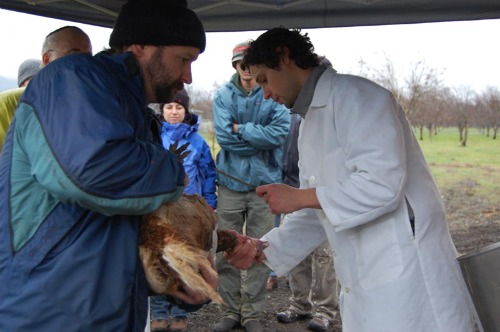
By December he had more practice, and the turkey shechting went smoothly. The rest of the group split into two, with half of us assigned to hang up the just-slaughtered birds and pull out their feathers, while a smaller, braver group did the evisceration, pulling out the internal organs and plunging the turkeys into a plastic bin filled with water. To kasher and prepare the the birds, we had to soak them for half an hour, then cover them in salt for another hour, rinse them three times, and seal and pack them up for transport to the convention center.
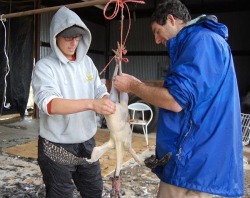
The ground inside the storage shed where we worked quickly filled with flying feathers. As I concentrated on my task, I noticed that each bird I plucked felt farther removed from the living animal it had so recently been. Was that something my own consciousness was doing, to protect my emotions? Or was it the same phenomenon I observed when I worked on an assembly line in a kibbutz factory, where after a while automation leads to objectification?
I also thought about my grandmother, who bought her chickens from a kosher butcher in Perth Amboy, N.J., glad they were already plucked and gutted. How she would have shook her head and laughed at us, a bunch of city folk with romantic notions about the beauty of killing and cleaning our own meat. Who needs it, she would have chuckled.
But that Friday in the dining hall, when I looked at the roast turkey leg on my plate, I felt a giddy sense of pride. I found myself eating more slowly, savoring each bite as I remembered the hours of hard work involved in getting that bird to this table. I thought about the Jewish tradition of honoring the Shabbat by serving the best food one can afford, including meat, even if one avoids it the rest of the week. And I was struck once again by how Judaism takes note of the eternal cycle of life and death, commanding us to bless the food that sustains us before we put it into our mouths.
And it made sense.
This posting originally appeared on the Jewish Book Council Blog.
Sue Fishkoff: The New Jewish Food Movement: Jews Who Meet What They Eat
Kosher Nation by Sue Fishkoff - Hardcover - Random House
Just Call Me Chaviva: It's a Kosher, Kosher Nation
heeb'n'vegan: Vegetarian Food and Kosher Meat in a Kosher Nation
Benyamin Cohen: 'Kosher Nation': An Interview with Sue Fishkoff
Noshin' Review: "Kosher Nation" by Sue Fishkoff | TC Jewfolk
Kosher Nation | New York Journal of Books
Jewish food movement comes of age | JTA - Jewish & Israel News
Sue Fishkoff: The New Jewish Food Movement: Jews Who Meet What ...
And I'm not supporting or castigating one religion over another.
War, incredibly horrific and sad, is another matter entirely. But killing someone else just because you feel like eating them -- it's not like we're living in the wilderness and need to kill animals to survive or anything -- is shameful and says much more about you and your chosen religion than anything else does.
If I was God I would not take the shortcut of having everything eat everything else.... makes me think if God really made everything on earth.. that he was in too much of a hurry.
You know if meat is so necessary... and people want their cake and eat it too.. there could be a big business in un-killed meat.
It would be very prestigious... even more than Kobe beef.
With modern pain free surgical techniques and animal prosthesis meat could be humanely harvested and animals could live out their days on wonderful retirement farms .on wheels etc....
And they'd be happy.
By the way what kind of an animal is a Shabbat?
"Killing, Blessing, and Eating Shabbat Dinner"
and why is Shabbat coming up as miss-spelled on spell-check?
First, according to Jewish law, your suggestion of slowly eating an animal a limb at a time is both repulsive and forbidden. The whole point of the ritual slaughter is to make it as quick and painless a death as possible, to hack a limb off a living animal is torture.
Shabbat is the Jewish sabbath, from Friday 20 minutes before sundown until Saturday night 40 minutes after sundown. It is not an animal.
Your spell check is not Jewish.
I still wonder about God being in a hurry... what did he do it in .. only 6 days?
No wonder he had to economize and have everything killing and eating each other.
Maybe he should have taken a few more days and made sunlight and air more nourishing or something. He could have rested on maybe the tenth or eleventh day.
So if ritual slaughter is "as painless as possible"... is stunning first OK? I guess that is as painless as possible- if your going to kill them.
And just out of curiosity.. what about Santeria? Is their ritual killing OK with you.. for them?
It is religious for them too.. right? So should not ban that.... yes or no?
\
To this day, I can not eat Gefiltie fish. I told my son they are extinct from to many Holidays.
Everything else? the worst blend of Hoohah and Hogwash.
Vegetarian and proud of it.
Jewish values ARE expressed through a concern for the rights of workers, good health, humane treatment of animals, environmental protection and food access for the poor. It is a great oversight to just connect these two with a measly, "as well as"
We are free to do more but more of what? Many of us live like kings and like slaves at the same time. We are slaves to our jobs and we order finely prepared meals sometimes or eat ready made food that we put in the microwave. Our gas is piped in if we want cook something and our electricity provides the lighting.
Everything is at our fingertips more and more. Then what do we do? Experience life? Watch a movie? Go see a show? Then what? Work to build up the 401k or savings? Then what? Plan retirement? Then what?...
I remember, in Europe, people would just stare at a roaming oddball singer/performer on the street... as if they were going to learn something useful or beneficial, as if they had nothing better to do with their llives.They do other things, don"t get me wrong, but you would think there would be something better to do to fill one's life.
Shabbat is nice because at least your mind is on the more significant things in life and you can stop to consider everything. The things of this earth lose their significance when we contemplate everything in light of eternity. What really matters in life? The only thing that I can think of is Truth.
As for blessing the food, let's be clear that it may make the humans feel good but it's all the same to the turkey.
From the very beginning God sacrificed animals to cover the shame of Adam and Eve. The rest is His-story of His provision for us. No other teaching or belief has a perfect covering for us.
It does not exist anywhere other than the Bible and that is to be expected because our Creator is the only One who can do anything for us because there is no one else.
She only said, "before we put it into our mouths."