
Over the past decade, the events of 9/11 have been the catalyst for all kinds of political actions, from warmongering and militarization to social mobilizations for inclusion and justice. On the island of Cuba, the events provided a new platform for young people involved in the movement of Cuban rap. Echoing the words of their leader Fidel Castro, Cuban rappers took the opportunity to reflect on the state of world politics. But in the aftermath of the events, rappers also saw a chance to become bolder in speaking out about the issues affecting young black Cubans.
On September 11, 2001, I was living in Havana, carrying out research on the movement of Cuban rap when the planes hit the towers. The grandmother in the house where I stayed flicked between the two channels available on state TV. The images of planes crashing into buildings were unreal. None of the commentators seemed to know what was going on. It was several hours later that the news came through about the hijackers of four planes who had reduced the twin towers to rubble, and crashed into the side of the Pentagon and an empty field in rural Pennsylvania.
Like many others, I sat before the television, watching the grainy images of the towers imploding over and over again. Fidel was involved in the inauguration of a new school that evening. I watched the live broadcast from the school where Fidel addressed a packed hall of elementary school kids. Resplendent in his military fatigues, for three hours Fidel cajoled, provoked, and meditated on the events of the day before a group of 10 and 11 year olds. He expressed his sympathies for the American people. He offered the resources of the country to assist in treatment of the victims. And he urged caution on the part of the American government.
"Whenever there is a tragedy like this one, no matter how difficult to avoid it may be, I see no other way but to keep calm," advised Fidel. "And if at some point I am allowed to make a suggestion to an adversary who has been tough with us for many years, we would advise the leaders of the powerful empire to keep their composure, to act calmly, not to be carried away by a fit of rage or hatred and not to start hunting people down, dropping bombs just anywhere." He paused. "Put down that pencil," he reprimanded a young schoolgirl in the audience. "Don't doodle. Try to pay attention while I'm talking."
In the year following the 9/11 attacks, the world changed irrevocably. Almost immediately, all U.S. airspace was closed to passenger planes leaving Cuba. Canada-bound planes with tourists who had been in Cuba were forced to fly an extra nine hours along the coast of the U.S., a harbinger of what was to follow. The U.S. declared a global war on terror, and the charges that Cuba is a terrorist nation resurfaced, with accusations that the island was harboring fugitives, selling biotechnology, and trading with the enemies of the U.S.. Five Cuban nationals carrying out counter-terrorism work in U.S. were convicted in a federal court in Miami and sentenced to prison. There were stepped up efforts by U.S. officials to find and prosecute former Black Panthers in Cuba. Assata Shakur -- who was given political asylum in Cuba following her escape from jail in 1979 -- would soon be classified by the FBI as a "domestic terrorist" with a bounty of $1 million dollars on her head. Cuban rappers denounced the U.S. war on terror in their lyrics, taking on the slogan of Hip Hop Revolución. But they also turned their critical gaze inward, speaking more openly to issues of racism and marginality in their own country.
In July 2002, rapper Sekou Umoja from the group Anónimo Consejo spoke passionately to a gathered crowd at the Casa de la Cultura. Sekou, formerly known as Yosmel Sarrías, had taken on an African name to emphasize his spiritual connections with Africa. "You have people saying, 'You're Cuban, you're Cuban, but they're not, they're not.' Well then, where did 'they' come from? They come from Africa. We have Afro-Cubans in Cuba, Afro-Americans in America, Afro-British in England, and if you're born in Russia with this color skin, are you gonna come to Cuba and try to say that I'm Russian?" He paused. There were laughs from the audience, the irony of that last comparison was not lost on them. "You're separating yourself from who you are. This is who you are. When someone feels marginalized it's never because they wanted to feel that way. If the government wants us to respect [independence hero] José Martí, if they say we are all human, then first they have to respect us." The crowd burst into cheers and whistles.
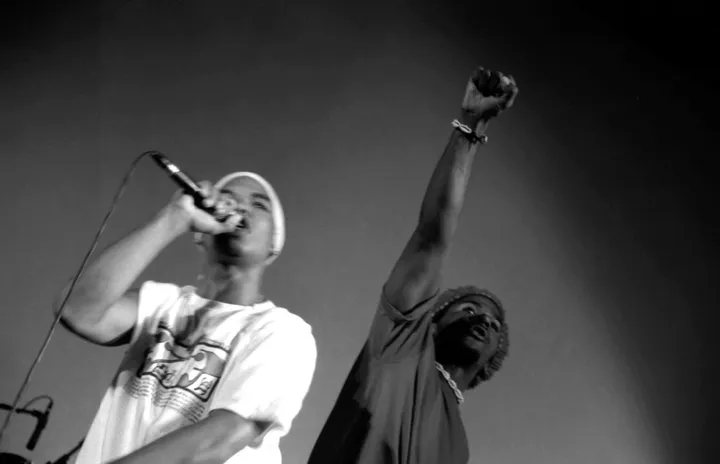
"Afghanistan has been the first casualty of the war on terror," Sekou told the crowd. "Who will be next? Iraq? Maybe Cuba? We, as Hip Hop, say no to war and imperialism. Anónimo Consejo Revolución!" The crowd cheered. "Hip Hop Revolución. Put your fist in the air." More cheers and whistles. The aging sound equipment came to life with a few static groans. As the beat kicked in, Anónimo Consejo launched into their song, "No more war! No more deaths!/ Talkin' 'bout something real, this ain't a game/ Prepare yourself for what's coming/ I know what it is, stay calm, I take action." I recognized the phrases from Fidel's speech on the night of 9/11. As the world was yet again subject to arbitrary acts of American imperial power, Fidel's words resonated with Cuban rappers.
In a former mansion turned culture house, technology courtesy of the Soviets, Cuban rappers were reworking the crisis of 9/11 to encompass the kinds of changes they wanted to see as a local and global movement. The Hip Hop Revolución drew inspiration from the Cuban Revolution and from Fidel, but it was also connected to the motherland. And perhaps this imagined connection to Africa was what kept rappers somewhat outside the orbit of the state, even as they continued to collaborate with it. As I argue in my new book, Close to the Edge: In Search of the Global Hip Hop Generation (Verso, 2011), hip hoppers around the globe drew on the idea of a hip hop planet to boost their local claims for recognition. Seeing themselves as part of a global movement fighting against war and injustice gave them greater leverage to communicate their specific experiences.
"Hip Hop Cuba with Africa!," said rapper Amehel from the group Profundo, to a serious and focused audience with their fists raised in the air. "Hip Hop Cuba with Vieques! The undergroun' protests Israeli repression of Palestinian children." There was a shout from someone in the audience, "Free Mumia Abu Jamal. Libertad."