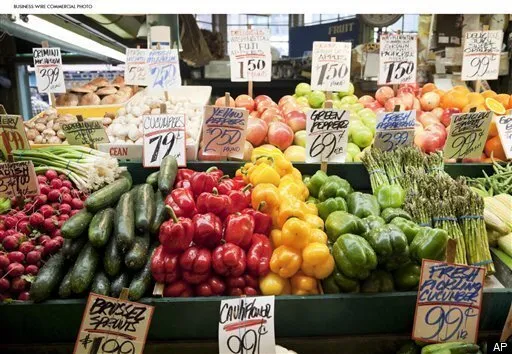
Any bipartisan agreement that our badly broken food system is in dire need of repair is a step in the right direction, and so thank you and congratulations to the Democrats and Republicans in the House and Senate who voted to pass the Food Safety bill yesterday. However, I think it will take a while for any sort of change, and funding will depend upon next year's Republican controlled House.
Currently, a thrice-daily activity -- eating -- is fraught with the potential dangers of illness, pai, and even death. According to the latest Center For Disease Control (CDC) estimates, each year 40 million people suffer from food related illnesses, resulting in 128,000 hospitalizations and 3,000 deaths.
We suffer financially as well. A recent report from Georgetown University estimates the cost of those food-related illnesses to be $152 billion annually. It seems beyond dispute that we need to overhaul the way food is handled and distributed in America, and the most positive thing about this bill is that both sides of the aisle agree.
Until the late 1800s, there were no government agencies to regulate food safety on any level. At that time there were few foods being imported and no large factory farms, but there were still plenty of inherent dangers at mealtime. In the days before refrigeration, putrefaction of many foods was commonplace, and suppliers were dumping a variety of chemicals into the food supply to prevent or cover up the decay. In 1906, the first Food and Drugs Act was passed -- banning interstate shipment of those potentially harmful rations, and the USDA Bureau of Chemistry (now the FDA) was created to enforce the law. (Dr. Harvey Washington Wiley, the chemist hired as head of the new organization, quit in 1912 when he could no longer take all of the bureaucracy. He spent the rest of his life as an activist attacking government food policy, and as head of the Good Housekeeping Research Institute, advocating for pure food and drugs).
In terms of the globalization of the food system, importers will now be required to "perform food safety verification activities" to ensure that "imported foods are as safe as those manufactured in the United States," and inspections are set to double in 2012. However, importers who are currently complying with "existing seafood, juice and low-acid canned food* regulations are exempted," which seem like a dangerously free inspection pass to some of the biggest suppliers.
On the domestic front, there is also funding for increased inspections of food related facilities. This sounds excellent until you read the bill and realize that it means an inspection of a "high risk facility" only once in up to five years after the bill is passed into law, and only once every three years thereafter. In our very recent history, we have had severe food related illnesses and deaths from consuming, among other items, peanut butter and eggs. We learned that the filthy, contaminated plants that were responsible had either never been inspected, or perhaps had been looked at and even cited for multiple violations, but not revisited. It is shocking to realize that these potentially toxic plants were left unmonitored, but not all that comforting to know that now they will be checked only once in up to the next five years. This severely limited inspection schedule is a compromise -- the original House bill called for once a year inspection of high-risk facilities. By the way, a facility considered "low risk" is to be inspected once in up to seven years.
The FDA will now be allowed to do a mandatory recall of tainted food "when a company fails to voluntarily recall the contaminated product upon FDA's request." Although a company not complying with a mandatory recall is rare, if it should occur, how many people will become ill or even die during that time lapse? Why not give the FDA immediate and primary authority over a poisoned food supply?
In 1931, the FDA was separated from the USDA. That is why the name of this bill is The FDA Food Safety Modernization Act. It only affects that agency, which is responsible for the safety of cosmetics, drugs, tobacco and all food except animal foods. Last year Cargill's American Chef's Selection Angus Beef Patties were so infected with E.coli bacteria that a children's dance instructor became paralyzed after consuming some of the meat. As it turned out, the patties contained ground beef from Nebraska, Texas, South Dakota and Uruguay, some of which had been treated with ammonia to reduce the numbers of bacteria to non-detectable levels. (Michael Moss. "E.Coli Path Shows Flaws in Beef Inspection," New York Times, October 4, 2009).
The ammonia trick is reminiscent of 1906, before there were any food laws, and the year a Meat Inspection Act was passed in addition to the Food and Drug act. Perhaps the most important question is how will the safety of our meat and poultry be improved in 2011? Maybe not at all.
A bill called The Food Safety Act should touch on every aspect of our national food safety problems, and do so from a position of strength and empowerment. Hopefully this is a step towards getting that sort of legislation passed. Right now, a nation hungry for change has been given half a loaf of factory-produced white bread, with all the health benefits that implies.
*Foods that contain too little natural acid to prevent botulism unless adequately processed are termed low-acid, for example, canned beans.
Follow Susan Yager on Twitter: www.twitter.com/susanyager
Dan Glickman: Year End Success... Our Government Can Actually Work. Is Nirvana Here?
EatingWell: The Top 5 Food Stories of 2010
S. 510: FDA Food Safety Modernization Act (GovTrack.us)
Urgent: Democrats attempting to pass Food Safety Act by hiding it ...
Digest this: the new food safety act (and some very weird rumors ...
We see what a great job the FDA has done in the past; allowed statins even though they were proven to be related to heart disease and death and other such wonderful failings.
3 years in between inspections for high risk? Tell me what that prevents?
Let's not even forget that the CDC itself only attributed 1809 deaths in America specifically to foodborne transmission
AND MOST IMPORTANTLY this bill doesn't do a single thing to address the most dangerous foods in our country: meat, eggs and poultry.
It is ridiculous to state that this bill accomplishes anything except protect us from the dastardly evil food companies that aren't American....American companies are doing a good enough job on their own. It's ridiculous to say we're protected now
James Madison
Also, why was there ever a voluntary recall system in the first place? Expecting a for-profit company to hurt their profit in the name of public safety is ridiculous. They're worried about the profitablity of their organization, not the safety of the consumers.
If you mix 10,000 cattle or 100,000 birds into one giant feedlot, the disease of one becomes the disease of them all -- and turns food "safety" into a question of massive chemical and biological "safety" measures. These giant operations are run by accountants focused on just one thing: how to keep prices as low as possible in order to compete with other suppliers who could be located anywhere in the world.
Give me fresh, local food any day, and I'll pay for it.
Remember, studies show that for every dollar that you spend on cheap unhealthy food, you will spend two dollars in health care costs. So spend two dollars on good food, enjoy good healthy and it'll save you time and money when you don't get sick.
This bill is groundbreaking, like healthcare, because it is the First bill to be signed into law on this matter in Decades. But WE must ensure that the "logjam being broken" is just the Beginning, and not the End, of the story!
It's up to Us to keep pressure on Congress (especially Republicans) and the Administration to "fight, cajole, co-opt" Big Ag into seeing that Real food safety is key to their future bottom line - and then to enact Real safety measures (not politically possible to do it in the inverse).
It's a shame that the actual Deaths and harm to individual Americans is "not enough" to overcome the Spin in defense of Profits in this scenario.
I guess it's part of America's love for "Cheap Goods" across the board. We don't seem to care where they come from, what the working conditions are that produce them, what the Quality is, how many American jobs are displaced: As Long As It's CHEAP!
Yeah, I'm talking to You Walmart/Costco/Dollar Store, etc. Shoppers!
We cut our own noses to spite our own faces....
Perhaps a beloved-Famous-Person's contaminated-food--caused "demise" is the Only hope for actually focusing attention on this growing debacle?!?
Keep growing, correctly.
Us rich folks Want their goods, at Any price. Tell them to Get their Goods to Us!
Also, tell them to think "out of the box" and get a van to go into the cities' rich AND poor neighborhoods! (Eliminate fear!)
We rich will pay cash, and if they would do the paperwork to get WIC & SNAP (Food Stamp) qualified, they can charge their prices to "the poor" also - who Desperately need quality food! Detroit's "Eastern Market" has established a "token" system where the poor can buy the Farmer's food & the Farmers get paid!!! It's a Michigan/state program.
Throw in some photocopied recipes coz too many Americans have forgotten how to Cook! (Although, a lot of "poor" people still remember their grandmothers' Depression recipes -- if they could only Get some Farm Quality food!)
Tell the Farmers that their "regular" customers will Pour In and grow!
Come directly to the people....
Wait and see - soon the EPA will find a way to ration electrical use, and gas - coal - anything and everything we use will be subject to rationing. Making us completely subject to the g'ment whims. We are headed for a socialist society that will reduce our daily lives to the level of 3rd world countries, and NO ONE will be spared except the elite few -
The elite few will find themselves soon enough reduced to the common standards-- as socialism only works well as long as the money continues - the elite few will spend others monies no matter where it comes from.
So those of you that think you are above the common level will only be there for a short while - enjoy it while you can - cause obama will suck you dry as well.
You throw the term "socialism" around when it's obvious you have no clue what it really means. Turn off Faux news and take a class or read a non-glenn beck book. You might learn something.
I want to be able to trust the food I put in my and my family's mouth, no matter where it comes from.
Do you really trust a for-profit-at-any-cost corporation to be in charge of the quality and availability of your food, health, and environment? If you do, please explain this to me because it's one of the most puzzling issues I've ever encountered. "Government" is all of us working together to build a better society ... a corporation is dedicated to the least quality at the highest profit. So, why would you want them in control of nearly everything that matters?
Yes, the elite few - those helping corporations to bilk the rest of us - will be living well at the expense of the many.
BTW, both Socialism and Communism concentrate power and resources equally in the hands of all. You really should learn the definitions of the words you use. What we have in this country right now is an Oligarchy/Plutocracy ... & both concentrate power and resources in the hands of a very few.
You also say that the government is all of us. I disagree. The federal government in particular makes one size fits all choices for everybody and if you do not agree, you can face repercussions. Personally, I trust small businesses and families doing what is best for them over some elite elected official sitting in an office in Washington making deals with corporations and figuring out ways to make sure that they stay in office. The only way to take the power away from the corporations that you do not like is to limit government's power to hand out favors to those corporations.
The only way that you would be at the mercy of any corporation is if the government helps them by passing regulations or tax code that favors one business over another.
Otherwise, competition allows you choices to take your business elsewhere. Name any monopoly and you will find government regulation that helped them to be in that position of power. The healthcare industry is a prime example. Things like making health costs tax deductible by companies, not individuals and The HMO Act of 1973 have taken the control of healthcare from the individual.
So let's start calling them out and fighting them!
I call out MONSANTO!
And I put my money & actions where my mouth is!