
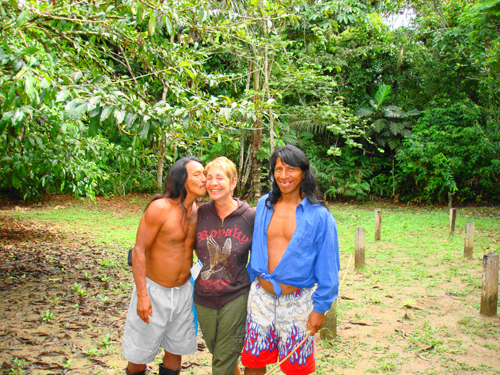
Juninto extended a hand and hauled me from the sludge in which I was helplessly sinking as I struggled up the muddy hill from the Cononaco River below. Wearing nothing but rubber boots and a traditional comé (a string supporting the genitals), his lips curled in a curious smile, long obsidian hair billowing down a muscular brown back. "Huaponi" he uttered. "Hello."
We are deep in the Ecuadorian Amazon, a world away from the slightly less alien world of the country's more visible indigenous cultures. After a spine-crushing three hour journey from the small city of Coca in an open-air ranchero, a motorized canoe transported us 150 miles from civilization into the remotest bowels of the jungle.
Guided by dazzling troupes of flying, swimming and land-borne mascots -- king and white herons, eagles, agutis, cappivara, tapir, kaiman, turtles, nine species of monkeys and a kaleidoscopic battalion of butterflies -- the deafening silence was only periodically shattered by dissonant cries of scarlet, military or yellow macaws as we ventured further into the heart of darkness.
Juninto (pronounced: Geento) is one of an estimated 1,200 surviving Huaorani Indians, a fabled group of hunter-gatherer warriors once pejoratively known as Aucas ("savage" in the Quechua language). The Huaoranis - meaning "human" in their native tongue -- still live in virtual self-imposed isolation in a territory about the size of Massachusetts in the Ecuadorian Amazon's Oriente region.
Traditionally a nomadic people, the dwindling tribe (once numbering in the tens of thousands) settled into villages about 50 years ago. Today they struggle to maintain their culture, integrity and autonomy in the face of changing times and decades of logging and oil infringement. The Huaoranis once -- and perhaps still -- referred to outsiders as cowode or cannibals, believing that strangers would eat them. Ironically, the attempted capitalistic incursion has been threatening to do just that.
The Huaoranis are an ardently proud and independent people renowned equally for their knowledge of the jungle's bounty as for their legendary ferocity. They live outside both societal and Ecuadorian laws and have engaged in spear-wielding tribal warfare as recently as 2005. The story goes that the chief of one Huaorani village kidnapped a young Tagaeri woman -- a Huaorani splinter group that maintains total seclusion - which ended in the slaughter of some 24 Tagaeri clansmen.
Garnering international attention, that episode further fostered the group's violent reputation resulting from a well-documented incident involving the spearing deaths of five North American Summer Institute of Linguistics (SIL) missionaries in 1956.
Since their earliest recorded contact with European society in the 1600s, followed by 19th century rubber barons and oil explorers who encroached in the 1940s, brutality and bloodshed has characterized the tribe's relationships with the external world. The intrusion of white society resulted in both cultural disruption and death as the Huaoranis succumbed to diseases to which they lacked natural immunity. To defend their interests, the tribal community formed the Organization of the Huaorani Nation of the Ecuadorian Amazon (ONHAE) in 1990.
Although our guide Julio repeatedly intoned that an angry Huaorani is a dangerous Huaorani, I found it difficult to envision these smiling, friendly people thusly transformed. Even the diminutive chief, in all his naked glory, toyed with me as he posed for a snapshot. Suddenly, without warning, the small man about-faced and planted one on my cheek seconds before the camera clicked. Mischievously beckoning his wife to look at the picture, the fiercest man in the village (which is how one becomes chief) affectionately weaved his arm through that of his tiny topless spouse and giggled as we immortalized the couple on film.
"This is unusual," Julio said. "They seem to really like you guys." Thankfully so, apparently.
Juninto lives in a village called Bameno with between 80 and 120 other people. The thatched-roof dwellings occupy small parcels of cleared land on both sides of the river. There is a rudimentary schoolhouse and a landing strip for propeller planes. The Red Cross provides occasional medical checkups and an infrequently used emergency radio stands at the ready. One generator, rarely activated, was left behind by a visiting film crew.
Few Huaoranis have ventured beyond their closed society. Auwa, the matriarchal elder has visited Cuenca, a modern Ecuadorian city, for a tribal conference while at the time of our visit her husband, the chief's brother, was attending an indigenous summit in Europe. She didn't know where exactly or for how long he would be gone. Our concepts of time and geography simply do not figure into their daily concerns.
52 year old Juninto has either four or six children, some of them married. Although this is not a misogynistic society, the precise number is difficult to ascertain as Huaoranis cite only male offspring. His wife left him several years ago for a man in another tribe, a story which surprised me in its unfortunate Western feel. Traditionally, Huaorani families engage in endogamy -- especially cross-cousin marriages. Polygamy is also an accepted practice.
Over the eight days we spent together, Juninto and I forged an extraordinary bond -- inexplicable in its nonverbal intensity and one which belies logic and comprehension. This nonphysical, heart-soul connection -- a testament to the cohesion of the human spirit -- somehow bridged cultural, language and experiential barriers and continues to mystify and move me in a way that I find difficult to articulate.
"Suzan, "I've known Juninto for many years and have never seen him so expressive," marveled Julio the Guide after my Huaorani warrior hugged and kissed me with lingering sadness when we departed. "It is," Julio determined," because you possess an open heart and mind." I nodded, swiping at my tears, as Juninto handed me a parting gift of brilliant macaw feathers.
The canoe's small engine belched and we slowly headed upstream, leaving Juninto behind with the silver ring I had placed on his pinkie while the chief and other villagers waved from the river bank across the way.
I don't know when, but I will return. To the heart of the jungle and the spirit of unspoken amity.
Thanks to the visionary folks at Kempery Travel -- who are admirably training the Huaoranis to take ownership of Bataburri Lodge -- for making this remarkable journey possible. www.kemperty.com; kempery@kempery.com; (593-2) 2226-583
If you have further interest in the Huaorani culture, check out Joe Kane's acclaimed book "Savages."