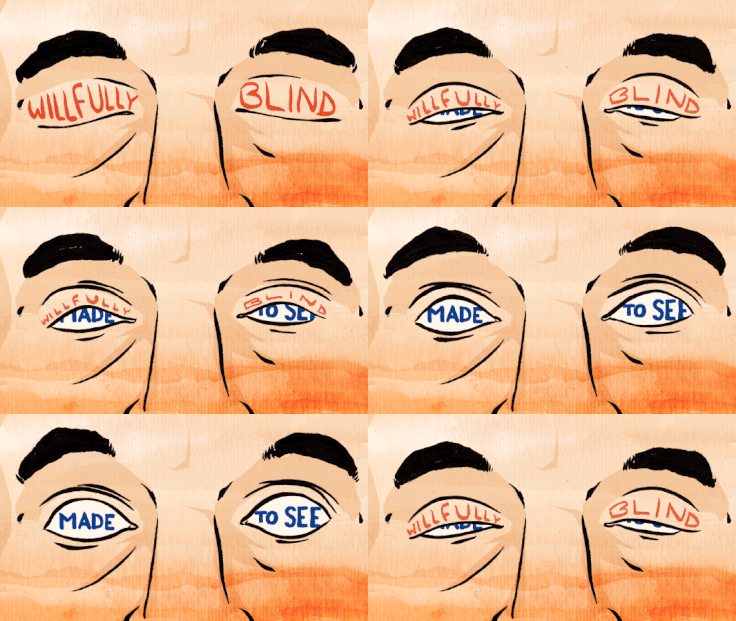
There are two great centers of unaccountable power in the American political-economic system today -- places where decisions that significantly affect large numbers of Americans are made in secret, and are unchecked either by effective democratic oversight or by market competition.
I began to teach my children to take responsibility for their own lives, their own choices, and their own decisions. In teaching them I learned that what I had been doing nearly my entire adult life was "caretaking," which masquerades as being responsible.
So ladies, I am going to say it like it is. If you do not take responsibility for your role in all that has and will happen in your life and love, you will never gain what you truly need to have everything you want as you move forward.
If you can think of even one positive thing that ever occurred from blaming others, please continue doing so. We can't change others, but we can change the way in which we act and react. Maybe people would benefit from accepting responsibility, instead of blaming others.
Religious ideas, leaders, institutions and communities are missing links in much of the public conversation about public integrity. That is not as it should be.
For those who think I'm exaggerating, look at one of the most horrifically incompetent efforts in recent years, the attempt to clean up sexual misconduct in the armed forces. Why haven't chiefs of staff been fired? Why haven't service secretaries resigned?
When kids first learn to cross the street, we tell them to stop, look both ways and assess the traffic before they proceed. Similarly, when it comes to decisions affecting the education of millions of our nation's public school students, we should exercise the same common sense.
Setting goals puts you in the driver's seat, giving you the power to transform your life or take a company into the future. As enticing as that sounds, it is more common than not those goals are abandoned.
I understand that there is a rich culture of guns in the United States and that weapons are often passed on to children as heirlooms. Also understandably, parents want to teach their children how to use those guns safely. But none of this training needs to start at the age of five.
Honest feedback is vital. But to hold back a third-grader next year based on a wildly new test that neither he nor his teachers were prepared for isn't the right way to start. And what do we need to add to the agenda?
In American politics, the rigorous subjecting of political statements to fact-checking is a relatively recent phenomenon. Promoting accountability is never an easy task, particularly in countries just emerging from authoritarianism.
It is with great sadness that I reflect on what is a significant anniversary for all involved in the struggle to advance human rights: this year's 25th anniversary of the United States signing of the UN Convention Against Torture.
Every year the nonprofits I give to send me their annual report, saying they helped tons of people. But how do I know if I actually invested in a solution to the problem? How do I know my donor dollars really changed people's lives?
What about IP generation or seizing the advantages of technological disruption? What does innovation mean to the Church? And how does it reconcile an ethos of forgiveness and salvation with a disciplined and unflinching response to clergy who have been molesters?
It's not just Bush and Cheney who violated international law; now it's Obama, too. The report is blistering about the cover-up. The end result is a society in moral disarray.
Texans realized early on that for their kids to compete against students from Beijing and Bangalore, they needed to take rigorous classes in high school. However, after several years of steady progress, state lawmakers are poised to gut what Texas got right before anybody else.
My third grade teacher was fabulous; in fact, in my 20 years of education I had a lot of really wonderful teachers. However, it is Mrs. Mason who inspired me to take on the challenging work of reforming the way teachers are evaluated, compensated, hired and retained.
Real progress comes from young renegades thinking outside the box willing to take risks to challenge the status quo. It is this kind of science that gets lost in the shuffle every time the giant pork machine dispenses its largesse to the usual suspects.
While economic growth has lifted many people out of poverty, some regions can now be singled out as places where large numbers remain below the extreme poverty line.
Most of us have been lucky enough to have had at least one great teacher in our lifetime. But what makes a teacher great? And who gets to decide? Students? Parents? Fellow teachers? Principals?
Given the enormous changes, challenges and opportunities facing the entire educational industry and every individual college, a critical foundation of effective organizational stewardship that will foster the imperatives of change is harmony.