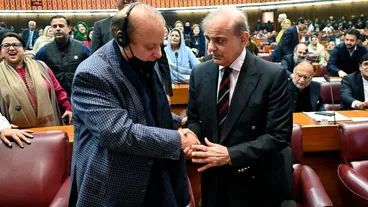
Never before has one democratically elected government handed power to another. However, recent events suggest the election could make history of a very different kind -- Pakistan's most violent ballot ever.
Given these grave challenges, Pakistan's upcoming parliamentary elections constitute a crucial test for its fragile democracy. Will the country's new government be able to address the rapidly deteriorating state of affairs in the country?
Eight young women from Shimshal, Hunza, lead by Karachi-based, independent filmmaker, Shehrbano Saiyid, broke several records when they conquered three peaks with temperatures dipping -10 or less, at the Karakoram Range, in Gilgit-Baltistan region.
Many have noted a profound belief in a new path for Pakistan that could soon be realized. It is not a question of change eventually, but of change now.
I'm going to Pakistan to investigate what life is like for those living under drones. Critical questions must be asked. Do these drone strikes make the United States any safer, or are they a prime recruitment tool resulting in more militancy?
There has always been friction between the military and the elected government in Pakistan, but we now also see friction between the different components of the formal, constitutional branches of government.
The Pakistan Peoples Party seems incapable of finding leaders outside the Bhutto clan. Why must there be a glass ceiling for leadership in the party that carries disproportionately more power?
No matter how attractive or sought after a job can be, it is never easy taking on a role that immediately requires damage control on multiple fronts. By becoming the new Director General of Pakistan's notorious intelligence agency, the Inter-Service Intelligence.
Members of Congress must clearly convey their intentions when taking on potentially contentious issues that risk undermining one of the Obama administration's most important strategic partnerships. Balochistan is clearly one of those issues.
In 2011, there were few on the outside who could find space for optimism with Pakistan, even some of my Pakistani friends living in the States. "Peopl...
Don't be fooled. Pakistan is too fractured to experience an Arab Spring-style mass movement. Pakistan's four provinces are often at odds, and ethnic and sectarian tensions are rife.
There has been much speculation about the future of democracy in Pakistan these days. Prophets of gloom are seeing generals at the ready. Optimists are hoping for a reconciliation. Reality lies between the two extremes.
Steve Inskeep, co-host of NPR's Morning Edition, has written a most readable, informative, entertaining, and provocative narrative of contemporary Karachi. I recently had an email discussion with Inskeep about the city and the region.
To me, the most striking thing about the text, which has both an authentic and an artificial ring, is the Pakistani obsession with and anger toward the Osama bin Laden operation.
Imran Khan has populist appeal with his stand against corruption and his criticism of US policy in Pakistan. But will he have enough support and gravitas to lead his country out of its economic slump and lack of moral direction?
Contrary to popular opinion among U.S. foreign policymakers, the way to undermine growth of insurgencies in Pakistan is not through drone strikes, air and night raids, or covert operations,
Pakistan needs new leadership to take the country out of this spiral down into further poverty and despair, which historically leads to anger and extremist violence. More spending on the military will not prevent violence; it will only make it worse.
"Now's the time for the United States to adjust its ways and try more to engage with the people of Pakistan through their representatives in the shape of the country's mainstream political parties."
America should engage Pakistan's emerging civilian centers of power. The most likely path to a stable Pakistan involves empowering civilians to exert control over its security and foreign policies.
Politicians negotiating positions, impassioned youth taking to the streets, public debate about important issues -- these are the signs that the people of Pakistan have embraced democracy, not that they are turning it away.