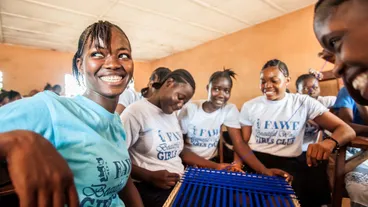
I was born in the beautiful city of Monrovia, Liberia. In my earliest memories as a child, the city was very peaceful. But then war broke out, and we eventually lost everything we had: peace, happiness, family members, communication, and our home.
When President Koroma of Sierra Leone visits Washington this Thursday, President Obama will rightly praise his counterpart for a decade of democracy, and for recovering from a devastating civil war. But Sierra Leone's progress is precarious.
Last year, I went to Sierra Leone on a trip with the State Department and stumbled into a problem that eats away at all the happiness of the last few weeks. I learned that in Sierra Leone, one in eight women die in childbirth.
Today, 30 adults sit in row after row of benches, some bending forward with heads propped on elbows as if they have been waiting a long time. And they have. These are community health volunteers, and they are heroes in my eyes.
In many parts of the world, young girls are lured with promises, or simply carried off to be sold as sex slaves. Born in poverty, they are condemned to live a sad and hopeless life. The cries of these throwaway girls have been largely ignored until recent years.
Resources, leadership and long-term commitments are necessary to close persistent gender gaps and improve the rights and well-being of millions of girls around the world.
Ending the conflict minerals trade in eastern Congo and replacing it with a legitimate mining sector is an achievable goal. But it can't be accomplished by local communities, governments and advocacy groups alone.
It may be hard to imagine a world without tweets, texts, or television. But in a forgotten corner of west Africa, nearly six million people in Sierra Leone rely on radio broadcasts for basic information.
If anyone had ever told me just six years ago that paradise was awaiting me in the West African country of Sierra Leone, I would have never believed them.
I've learned that in order to appreciate all that this country and its people have to offer, you have to learn how not to see things here through Western eyes.
On Friday night, I land in Sierra Leone and the first important thing I do will be to gather my son Tejan in my arms and hope that this is last time he will be greeting me, instead of accompanying me, to Africa.
This Mother's Day, we are offering cards on our site to fund surgeries for women in need. In honor of mothers all over the world who work hard to take care of their families each day, Samahope enables anyone to give the gift of saving a woman's life.
Rape, invisible and ubiquitous, is perceived as sexual and inevitable, and we tend to think of children and women as collaterally damaged during war. In truth, all over the world, girls and women are fully, bodily engaged in conflict.
I took more than a passing interest in the recent news that Charles Taylor had been convicted on 11 counts of war crimes and crimes against humanity by the Special Court for Sierra Leone, meeting in The Hague.
The Peace Project is not just a social movement currently doing work in Sierra Leone, Africa -- it's a very personal project and I've seen (and experienced) in the most tangible and fantastic ways the power it has to transform lives, starting with my own.
Human-rights activist John Caulker was convinced that within the broken traditions of his native country -- the culture of vital connection, of truth-telling and forgiveness -- lay the seeds of reconciliation. He knew that virtually everyone in Sierra Leone longed for reconciliation.
So Africa is not a country and Africans don't speak "African." What about the most pernicious stereotype -- that in the face of ongoing civil war and unending famine, "Africans" are powerless and need our help?
Sierra Leone and Liberia have some of the highest maternal mortality rates in the world, with 15-24 year olds accounting for 40 percent of such deaths...