Back in the '80s, Keystone Light commercials focused on a curious affliction: bitter-beer face. The faces of folks who sipped so-called "bitter beer" scrunched up like sideshow freaks. "Don't grab a bitter beer... grab a better beer!" the announcer exclaimed, as a swig of innocuous Keystone made their normal expressions bounce back.
But in this era of craft beer, drinkers are shunning simple brews like Keystone and Coors for coffee-seasoned stouts, burly Belgian ales and, most of all, bitter beers like the India Pale Ale, a.k.a., the IPA. According to lore, the IPA is so-called because eighteen- and nineteenth-century sailors alighted from England to India with pale ales fortified with with extra doses of hops -- a climbing plant's fragrant flowering cones that act as preservatives and impart bitterness.
The "pale ale for India" eventually became the IPA. Now, the beer style has caught fire with American consumers craving bigger, bolder and ever more bitter beers. Brewers have responded by concocting potent imperial IPAs with IBUs -- the international bitterness unit, a measurement of a beer's perceived bitterness -- that crest triple digits. (Comparatively, Budweiser packs about 10 IBUs.)
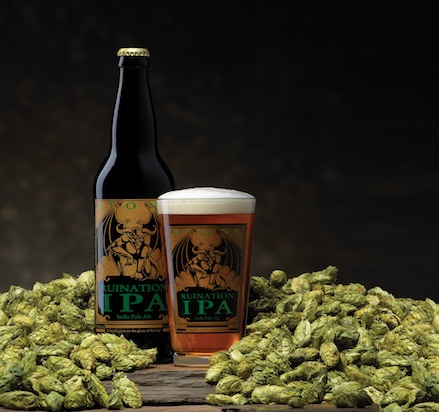
One of the hot spots of the hoppy-beer movement is Southern California, where Escondido's Stone Brewing Co. deliciously pummels palates with its aptly named Ruination IPA. It offers 100-plus bold, bitter IBUs matched by a sturdy malt backbone. Still, this trend isn't confined to California. In Akron, Ohio, Hoppin' Frog Brewery makes the massive Mean Manalishi Double IPA, a caramel monster boasting a dizzying 168 IBUs.
Yet on the international stage, 168 IBUs is merely a stepping stone. Dutch brewery Mikkeller offers the eye-popping 1000 IBU -- a theoretical number, given that the bitterness doesn't sky that high. Despite the wishful thinking, this beer still "tasted like chewing on a hop field," wrote brewer Mikkel Borg Bjergsø. "I personally loved it." Would you? Give these American-made IPAs a taste to see if you too subscribe to the "bitter is better" school of thought.
- Joshua M. Bernstein, The Daily Meal
More stories from The Daily Meal:
Best of the Vintage Beer Commercials
5 Beer Bottle Opener Alternatives
8 Exclusive Beer Sommelier Restaurants
What Brew Is Right For You?
Follow The Daily Meal on Twitter: www.twitter.com/thedailymeal
It might seem weird at first, but your favourite drink might have more than just alcohol in it.
Brewmasters, winemakers, and distillers may include animal ingredients in their products directly, or they might use them in the processing and filtration.
When making the product, dairy, honey, and other things (including, in one case, a whole chicken dropped in the tank) are ingredients in the final recipe.
When filtering the drinks prior to bottling, companies can use things like isinglass (from fish bladder,) gelatin, egg whites, and sea shells, among other things. These products grab onto the impurities and make it easier to catch them in the filters, though there are many animal-free alternatives in use.
These ingredients don't usually show up on the label, so the only way to find out is to ask.
The Barnivore Vegan Alcohol Directory is here to help.
Our 1220 entries have been checked and often double or triple checked by the Barnivore community and are gathered here for you to enjoy...
http://www.barnivore.com/
I've also tried the Stone and Dogfish Head examples, and while I think Stone's brews, Ruination in particular, are too strongly flavored, Dogfish Head pulls off the impossible with that 120 minute, being an eminently drinkable beer despite being 18% ABV. It's truly delicious, and you only need two of em to give yourself a whole new perspective on life.
As for my prefences, Firestone Walker's Double Jack and Ninkasi's Tricerahops are good examples of well-made, well-balanced Double IPA's. Southern Tier's Unearthly and Speakeasy's Big Daddy are really good for singles.
It's not so much a question of balance -- bitterness, malts, flavor/aroma hopping, etc -- as it is a matter of taste in the CHOICE of hops. Local NW varieties tend toward the citrus side (with a dash of pine of course) but the herbal options provide some real spice, if you'll excuse the pun.
REALLY? A little bird told me Mr. Mubarak actually DID go to the lovely Sharm!
but now most of them taste like molasses to me.
I want someone to combine the mouth feel of a Belhaven Scottish Ale with the flavor of a Sam Smith Oatmeal Stout. It'd be like drinking a milkshake.
Osker Blues makes a beer called Old Chub
http://www.oskarblues.com/the-brews/old-chub
It's damn good.