
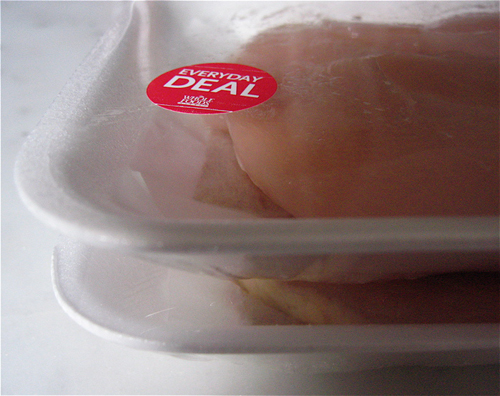
I was looking for three chicken breasts. Not eight. Or four. Just three. I was visiting my parents in Arizona and shopping for dinner. They're Canadian snow birds, flying south for the winter in search of sun and lower priced food. Due to a variety of reasons -- a lower population, higher food taxes,lower government subsidies to the farmers -- Canadian food is notoriously expensive -- especially meat and cheese.
I was at Basha's, the local super-sized super-market near Phoenix. It's a cavernous place that feels like an airplane hangar. Everything about it is big. The aisles are wide enough to drive a tractor through, the cereals are family-sized for a family of ten, the end-of-aisle displays are monolithic towers, screaming their offers out as you round the corner, "80% off when you buy two bags of Tostitos and dip!" This is grocery shopping in high definition. As vast as the store is though, it was also eerily empty. It felt like someone had thrown a huge party, put out all the food, but no one was showing up. The registers were lit but no one was paying. This only added to its bigness.
I know I'm comparing it to shopping in New York City where you shop with a hand basket over your forearm, and stores don't have parking lots and where you can buy bread in half-loaves, but still, this tipped the scales at over three football fields.
I rang the bell at the butcher counter. "I'm looking for just enough chicken for three people, but I only see big sizes." He came around the counter. "We actually don't carry small sizes, but we have a special on where you can get two two-pound packs of chicken breasts for the price of one." (Buying just one was not an option -- the second one was bound with cellophane to the first.) "So I can't buy just one of the packs and I can't request a smaller amount from you?" "No, but this is an excellent price and you're getting a lot of chicken." He was right. I was getting a lot of cheap chicken. The problem was, I didn't want a lot of cheap chicken.
We had split-pea soup for dinner.
There is something unsettling when enormous quantities of food are sold at bargain prices -- when food is so abundant that a restaurant can offer a double sized portion of your meal for $1 extra, or a store can sell a pound of Twizzlers for 50 cents or eight chicken breasts for $4.
Basha's left me wondering...Is food too cheap? Do we eat too much (in particular low nutrient-density food -- the cheapest of all), and waste too much, because we pay so little and therefore don't value it? In other words, we over-buy because it's cheap and over-eat because we've bought it. And what we don't eat, we toss, because we know we can buy it again. In the early 1900s we spent 25% of our income on food, today we spend less than 10%, and it's dropping. Over the past 25 years, the price of a McDonald's hamburger has gone down 30%. Is it any surprise our waist lines are expanding, and our illnesses worsening, with every dollar we save?
When did quantity trump quality? Why do we balk at paying $6 for a pound of grass-fed, small-farm, nutrient rich beef, but keep coming back to the $6 all-you-can-eat, pasta buffet. America has always been the land of plenty, but we have plenty of plenty. And that's the problem.
We have driven costs so far out of the food system that in so doing we have not only driven down nutritional value, but driven out the notion of food being a precious resource. And when we do encounter its preciousness, in the form of whole, "clean", fresh food, at a farmers market or if we're lucky, our local store, we pay exorbitantly for it. So is it any wonder most of us choose the lowest priced products (refined carbs and factory raised animals), eating more than we need, and getting fewer of the nutrients our bodies crave.
It makes the two-for-one special, start to look a lot less special.
Please share your thoughts, even if (especially if) you disagree.
Come visit The Sweet Beet . Learn more about healthy eating and share your thoughts with others!