More

Featuring fresh takes and real-time analysis from HuffPost's signature lineup of contributors

Your "Natural" Herbal Tea May Not Be So Natural


"If need to be known for a medical reason, your physician may contact us in writing."

This is what I was told when I asked the company about their "natural flavors."

Sweet and Spicy Tea and Herb Blend is the name. It comes in a box with a sketch of a man plowing a field with a horse. The trees are billowy, the colors faded -- compelling evidence of its purity. And lest there be doubt, the brand name references goodness and the planet. Oh and it says "natural" on the package.
2011-03-15-teabagonspoonfar.jpg


The tea is an unsweetened black tea with herbs, so logically (I reasoned) the "sweet" was coming from the herbs. I let it steep and cool and then sipped. It was Coca-Cola sweet!!

What was in this herb mixture?!

Rose hips: Not Sweet
Cinnamon: Can be sweet if there is enough
Chamomile: Not Sweet
Lemongrass: Not Sweet
Peppermint: Not Sweet
Papaya: Sweet when in papaya form, but water is not sweet when diffused with it
Jasmine tea: Not Sweet
Anise seed: Sweet but the amount here seemed too small to make it this sweet
Ginger root: Not Sweet
Orange peel: Not Sweet. Have you ever licked the outside of an orange?
Orange oil: Not Sweet

And then I saw it, Natural Flavors. I had glossed over it at first, but natural flavors was actually the very first ingredient listed after black tea (meaning the largest ingredient by volume of all the herbs).

I emailed Good Earth (the brand in my cup) and asked about their flavoring. This is what they said:

"The natural flavoring is a natural cinnamon flavor derived from the oil extractive, part or in whole, and from oil extracts of citrus which could include mandarin orange, orange, tangelo or tangerine. The specific components are proprietary. If need to be known for a medical reason, your physician may contact us in writing with the specific request. There is no MSG or gluten in the blend or flavors used."

The medical reason is that I want to know what's going into my body. I emailed Good Earth back to ask specifically how it was that the tea was so sweet and whether it was the flavors that were making it so.

No response.

For some reason, "flavor" in herbal teas bothers me more than"flavor" in other foods. And "sweet" as flavor bothers me even more than than a specific "food" flavor. My mouth can imagine tasting, say, cinnamon flavor, as it could logically be coming from the cinnamon, but when the flavor is telling my mouth"sweet" and there's nothing sweet there, there is too much of a disconnect between my "sensing" mouth and my "reasoning" brain.
2011-03-15-pileoftea.jpg

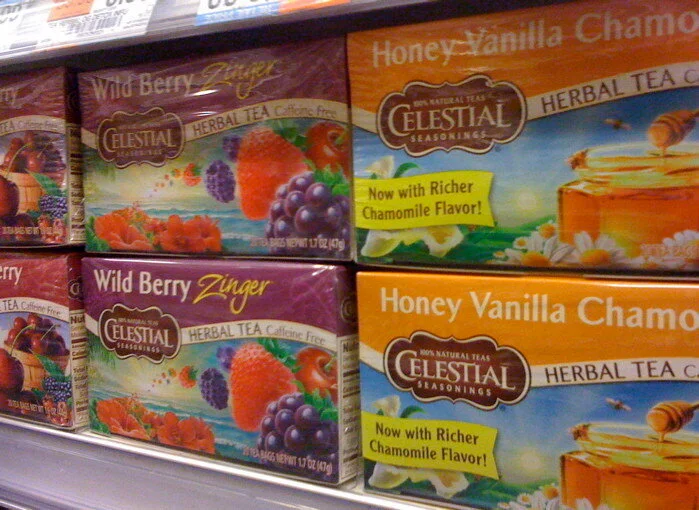
Tea brands that use "natural flavors" (Not all flavors used by these brands are used to make the tea sweet, and not ALL use natural flavors in ALL their teas, but ALL of them use flavors in SOME of their teas. That make sense?)

Allegro
Bigelow (Also uses artificial flavors)
Good Earth
Celestial Seasonings
Choice Organic Teas
Kusmi Tea
Lipton
Mighty Leaf
Salada
Stash
Tazo
Teavana
The Republic of Teas
Tulsi Tea
Twinings
Two Leaves and a Bud
Yogi

Tea brands that don't use "natural flavors" (They don't use flavors in ANY of their teas. The taste is from actual herbs, fruits and oils.)

Numi
Teatulia
Traditional Medicinals

It's lonely in the herb field -- that's because herbs, fruits and (non-tea) leaves, once dried, and infused in a cup of water are often quite bland. Unless it's mint, ginger or pure cinnamon that have some oomph, most are subtle, and unless exceptionally high quality, verge on tasteless. They also lose potency on store shelves, an inconvenient character "defect" not suffered by "flavors."

So why the concern over natural flavors anyway. Because they're not natural. The more natural a food claims to be, the less it usually is. A truly natural food, rarely calls itself "natural," it just calls itself "lemon" or "cinnamon." Moreover, the chemical called "flavor" is virtually identical whether natural or artificial. Banana flavor for example is created by distilling the flavor molecules from a banana using a chemical solvent, while artificial banana flavor is created by mixing chemicals, that result is the identical chemical output.

And what about MSG. To me they're spiritual cousins. Though MSG can be found as a naturally occurring chemical and is naturally present in many foods, when it is listed in ingredients, it is a concentrated additive created in a lab. It is created to enhance flavor in order to create an illusion of something that does not exist. Flavors are created in a lab to add flavor to create an illusion of something that does not exist. The sole purpose of this alchemy is to trick our taste buds -- the food equivalent of sleight of hand, dropped in from the sleeve when the mouth is focused on thinking that the taste is coming from the real thing.

So what to do when you want flavor in your herbal tea without chemicals? This is a tough one. I recently learned that Bengal Spice (a personal favorite) has natural flavors and some of these flavors make it sweet and that giving this up will have serious implications for my afternoons. But I'm going to switch to a pure ginger tea and add some bee-created honey.

What are your thoughts on "flavors" in teas?

For more food learning, come visit The Sweet Beet and enter to win $100 OXO kitchen tool for signing up for emailed posts!


Follow The Sweet Beet on Twitter: www.twitter.com/thesweetbeet

"If need to be known for a medical reason, your physician may contact us in writing." This is what I was told when I asked the company about their "natural flavors." Sweet and Spicy Tea and Herb B...
 
 
  • Comments
  • 67
  • Pending Comments
  • 0
  • View FAQ
Comments are closed for this entry
View All
Favorites
Bloggers
Recency  | 
Popularity
Page: 1 2  Next ›  Last »  (2 total)
01:35 PM on 03/28/2011
What about Zhena's teas?
photo
HUFFPOST BLOGGER
The Sweet Beet
02:27 PM on 03/28/2011
Some of their teas do and some don't - "Acai Berry" tea for example has "organic peach flavor". If a tea has a fruit in its name, there is a VERY high chance it contains flavors since its very hard to make a tea actually taste like a pungent fruit.
05:44 PM on 03/28/2011
I am not quite sure why I should be concerned about "organic peach flavor",
11:05 AM on 03/27/2011
I enjoy the tisanes available from the Tea Emporium:

http://www.theteaemporium.com/Fruit-and-Herbal.html

Canada's regulations also require that all ingredients and additives be listed and the their lists list of ingredients (both on the website and packaging) do not include "natural flavors" so I believe they are free of same.

Note, however, that it is a Canadian company so I am not sure if they are available at retail in the US but you may be able to procure supply through their website. Personally, I really enjoy "Sunburst Raspberry" and "Orange and Pineapple".

I was, however, disappointed to see that they may have jumped on the "unproven health claim" bandwagon but the quality of their teas and tisanes (as teas and tisanes) are very good.
10:32 AM on 03/27/2011
Ms. Madden has touched upon an important issue for many consumers, which is the absence of a clear definition and/or regulations over the use of the word "natural" (as well as "green" and "organic").

It is, however, difficult to define what is "natural" and what is not. Humans are no less a part of nature than other organisms. To what extent may human ingenuity be applied before something is no longer produced through "natural" processes?

Many would agree that honey is "natural". However, what if the honey is produced though large scale apiculture? What about the honey tainted by antibiotics and marked with false country of origin indications so that it may be smuggled into the country as reported by the Seattle Post Intelligencer (http://www.seattlepi.com/specials/honey/)? At what point does the honey cease to be "natural"?

Finally, "natural" does not necessarily mean "healthier". Many "natural" of products are harmful: there is no shortage of toxins produced by organisms. Although it makes sense to reduce one's unnecessary exposure to potentially harmful chemicals it seems fallacious to assume that a "natural" chemical is more or less healthy simply by virtue being "natural".
11:31 PM on 03/24/2011
The primary 2 ingredients in my Good Earth Caffeine Free Original Sweet & Spicy Herbal Tea are Red Rooibos & Chickory Root. Mine has NO BLACK TEA and tastes great, a little sweet & spicy just like the name! Perhaps you should try it . And what is so bad about oil extracts of citrus or cinnamon that make up the natural flavorings. Or do you think the folks at Good Earth are lying?
photo
HUFFPOST BLOGGER
The Sweet Beet
08:48 AM on 03/26/2011
So just to clarify what GE is saying, when they mention the oil extracts, what they're saying is that the flavors are DERIVED from those extracts but they are not the actual extracts themselves. If it was pure orange oil lets say, the ingredients would say, "orange oil" and not label them flavors. So GE is not lying, they are just attempting to make what goes INTO nat flavors, sound as pure as possible.
10:37 AM on 03/27/2011
Ms. Madden,

You may find this recent episode of CBC's Marketplace on "green" labeling of interest:

http://www.cbc.ca/marketplace/2011/lousylabels/

In that episode they show that many products labeled as "green" or "organic" do not differ materially from the "regular" formulations produced by the manufacturer. Although the episode focuses on non-food items I trust that you are equally concerned with those issues even if your blog is focused on food.
04:22 PM on 03/24/2011
There are junky additives in ANYTHING you buy that's pre-packaged. want good tea? go locally to a tea shop that does LOOSE tea. sure-it looks like vomit soup but it is WAY better-like the difference between sanka and kopi luwak- and good tea is good for you. plus any good tea place has all the teaware like pots and to-go mugs to keep your teeth leaf free. most times it's less expensive that boxed/bagged tea you get in the supermarket.

http://www.sippingstreams.com/

i've been an avid coffee drinker for almost 30 years and this place has converted me
This user has chosen to opt out of the Badges program
01:17 PM on 03/24/2011
Thanks for the article. I checked out my usual favs: Trade Joe's Duchess Grey has added natual flavors. TJ's Chamomile only has chamomile flowers - even mentioned "No added Flavorings".
This user has chosen to opt out of the Badges program
photo
10:47 AM on 03/24/2011
If you don't like natural extracts, don't drink tea (water extract) or infused oils (oil extract) or infused vodka (ethanol extract) and don't use jsarets reduced (concentrated) water extract either. Or vanilla extract, or peppermint oil or whatever else "nature" didn't make.
Licorice and stevia extracts can make things sweet.
photo
HUFFPOST COMMUNITY MODERATOR
LisaLisa1234
08:34 AM on 03/24/2011
That is surprising about Good Earth, but I like it so much that I'll keep drinking it. It's occasional for me anyway.
photo
HUFFPOST SUPER USER
cestpasvrai
Il n'y a pas de lézard.
06:42 AM on 03/24/2011
Trying to make something out of nothing.

I've got about 10 different boxes of tea from the brands listed and it's all much better for me than picking up a soda or drinking loads of sugary juice.

Water and unsweet tea is the way to go for me!
This user has chosen to opt out of the Badges program
photo
09:21 PM on 03/23/2011
I like to cut my own mint sprigs and hang them to dry. Then, I scrape the dried leaves from the stems and crumble them into a mason jar. You can do the same with chamomile flowers (or by them in bulk at the health food store). This way, I know my tea is natural, caffeine free and organic. When I want my herbal tea sweetened, I add a teaspoon of local raw honey to the pot as it steeps. Metal teaballs are easy to find and available in large and small, which can be pre-loaded and added to a cup of hot water when I am dining out or on the road.

Lemon balm is another good garden plant that you can put into either hot or cold water that makes a nice relaxing and refreshing drink on a hot summer's day.
10:39 AM on 03/24/2011
right on, with just a few square feet of growing space I can get enough tea herbs to last the winter
11:17 AM on 03/27/2011
Being an urban apartment dweller I envy your access to self-grown ingerdients. I find tea presses to be more effective than tea eggs and they allow you to also use chunks of fresh fruit (lemon, ginger, etc.) that would not fit within a tea egg.
This user has chosen to opt out of the Badges program
photo
12:36 PM on 03/27/2011
Thank you for mentioning tea presses. I had not heard of this before, but I will look them up. I wonder are they similar to garlic presses which are inexpensive and easy to find in secondhand stores?

I make a "tea" with ginger because it has a lot of medicinal uses. I have been slicing the root into tiny bits so that they fit into the tea ball and then infusing them with water from a rolling boil. It has worked pretty good so far.

Container gardening works okay for apartment dwellers provided you have some kind of porch or yard space with the right sunlight. However, there are community growing groups in my urban areas. These include local community farm cooperatives, farmer markets and community gardens. One of the things that works really well in my area is to keep a little pocket plant identification book with me when I travel around. I am always surprised by the amount of edible herbs and plants that I find growing in public access spaces that I can forage.
photo
HUFFPOST SUPER USER
MiamiMama
04:58 PM on 03/23/2011
Drink water and squeeze a lemon, lime or orange in it. It is better for you than depending on all these companies that continue to deceive the public.
This user has chosen to opt out of the Badges program
photo
09:32 PM on 03/23/2011
I like this suggestion although I can't eat or drink much citrus fruits.
11:19 AM on 03/24/2011
The best advice is always the advice that corporations don't like

ben

FB Liangcha
HUFFPOST SUPER USER
deltalady
04:24 PM on 03/23/2011
Well, I don't care....Celestial's honey vanilla chamomille is delicious, so I'll keep drinking it.
11:33 AM on 03/27/2011
I love Celestial's Tension Tamer!!! I don't care either.
photo
HUFFPOST SUPER USER
JennaS
Art Historian, Writer, Gallerist
02:46 PM on 03/23/2011
Why do companies have to mess with mother nature? what is comes down to is money? They buy low quality, old ingredients and then they need to add "natural flavorings" to enhance the tea that lost all of its innate qualities. In addition, the consumer should stay informed, like those in this forum, an demand from our brands higher expectations.

I guess I need to start experimenting with making my own herbal and fruit teas.
photo
HUFFPOST BLOGGER
The Sweet Beet
03:53 PM on 03/23/2011
Part of the issue is that manufacturers know that consumers want a no-caffeine version of "tea", and yet the leaves and herbs and bits of fruit that have no caffeine, often have little taste when they're simply infused in water! Your best bets for herbals teas without flavors are usually the pure mint or pure camomile - they tend to have fewer "flavors" than the fruit version, but read the ingred carefully!
11:21 AM on 03/24/2011
Then you have to wonder what are you really buying? We all should grow our own or get closer to the plants around us
HUFFPOST SUPER USER
vorpalmusic
11:21 AM on 03/23/2011
One of my favorite commercial tea companies is Rishi. The quality is remarkable for tea bought in a grocery store (I get the majority of my tea in bulk through a tea house that orders directly from Asian farmers).

I'm not particularly interested in "herbal teas," I only drink the camellie sinensis stuff, but I was very surprised to see that the herbal teas from this company include natural flavors in their ingredient list. They are also certified organic though. Does natural flavors always mean that there is some chemical additive, and if so, how are they certified organic when they contain this?

Here is a link to a particular tea and its ingredient list, note "natural flavors of blueberry and passion fruit and natural mango oil." :

http://www.rishi-tea.com/store/scarlet-organic-botanical-blend.html
photo
HUFFPOST BLOGGER
The Sweet Beet
01:31 PM on 03/23/2011
For a food to be labeled "organic" it need only contain 95% organic ingredients, so it can still be called organic and use non-organic natural flavors. Sometimes you will see "organic flavoring" - there are certain chemicals that can not be used for organic flavoring (that are used in "nat flavors", but at the end of the day, it's still made in a lab, using chemicals, created in a very concentrated amount, and added to foods where it does not occur naturally.
01:36 PM on 03/28/2011
What about Zhena's teas? Have you looked at them?
02:21 AM on 03/23/2011
"Natural flavors" is a term that is used on ingredient list that are essentially unregulated. Many companies claim they are proprietary ingredients, but many of them are simply additives and other chemically produced flavor enhancers.