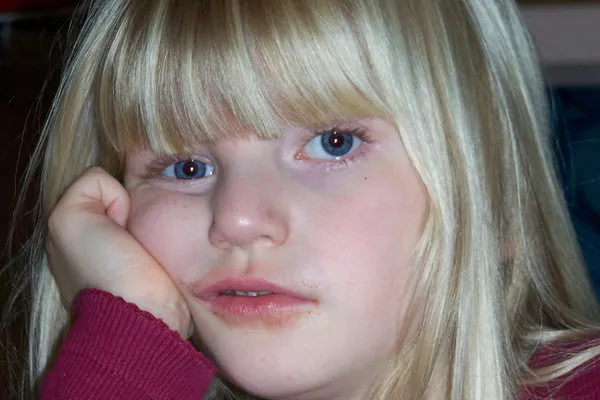
It's official. Depression is real among kids as young as three.
In a study lead by Dr. Joan Luby, a psychiatrist at Washington University in St. Louis, researchers found that preschoolers with depression had a 4 times greater likelihood of major depressive disorder one or two years later than preschoolers who didn't have depression. The study was funded by the National Institute of Mental Health and just published in the August issue of "Archives of General Psychiatry."
I know what most people are thinking, or at least I think I do because I heard plenty of opinions back when my son was exhibiting troublesome behavior in preschool, which felt like the terrible twos, threes, fours, and fives ... "Oh God, here we go again ... trying to fit the kids somewhere into the DSM-IV (shrink's Bible) so Big Pharma can get its greedy hands all over that innocent child.
I chose to exhaust the behavioral therapies that we, as a family, could learn, not because I don't believe that there is a place for medicine--friends of mine have put their kids on drugs and I think that was absolutely the best solution for them--but that David responded to a few adjustments in how we run the house, and to more structure. I'm aware of the lack of research available today on treating kids, and so I think if your kid can learn adopt some helpful cognitive behavioral techniques and behavioral modifications, then start there. But that doesn't work for everyone. Some kids need the medication to assist them with the other stuff. Thank God we have it for them.
Ultimately, I am glad this study was published and is getting some publicity. Not to scare all the moms out there with three-year-olds whose tantrums lasts an hour. But as a gentle prodding to pay careful attention to symptoms of overwhelming guilt, chronic sadness, persistent weepiness, extreme irritability, and temper tantrums that involve biting, kicking, or hitting.
I'm not saying parents should, upon recognizing these symptoms, lace their kids' peanut butter and jelly sandwiches with 5 milligrams of Prozac. But I do think it's worth investigating some behavioral strategies to relieve some of the sadness and anxiety.
I wish my mom had done that for me.
Not that I fault her for not taking me to a shrink when I was 4 or 5. Get real! I was 4! But the signs were very much there, from the beginning: insidious rituals, like praying four rosaries before breakfast, that I had to perform or else I would go to hell; nightmares that had me shrieking in the middle of the night; chronic crying; extreme separation anxiety; and guilt ... oh man, don't get me started on guilt. Over the stupidest things! Like accidentally plucking a blade of grass from my neighbor's lawn. Had I been taught--through some cognitive behavioral strategies--to manage my emotions, then maybe, just maybe, I might have dodged the serious mood disorder I have today.
One theory of depression suggests that any major disruption early in life, like trauma, abuse, or neglect, may contribute to permanent changes in the brain that lead to an overproduction of cotropin-releasing factor (CRF), which in turn stimulates the pituitary gland to release hormones that cause depression. According to psychiatric geneticist James Potash, M.D., stress can trigger a cascade of steroid hormones that likely alters the hippocampus--belonging to the brain's limbic system, the seat of human emotions--and retard its new growth.
That's why it's so important to treat depression at a young age. So that the tender brain doesn't start form under that stress, and predict a life of depression.
Dr. David Fassler, a University of Vermont psychiatry professor says that depression in the very young is still pretty rare, but without treatment "can have a devastating and often lasting effect on a child's social and emotional development."
I can provide proof of that.
Originally published on Beyond Blue at Beliefnet.com. To read more of Therese, visit her blog, Beyond Blue at Beliefnet.com, or subscribe here. You may also find her at www.thereseborchard.com.
Follow Therese Borchard on Twitter: www.twitter.com/thereseborchard
I am a mother of 4 children and believe that disorders can be detected at an earlier age. I also know the brain does not fully develop until age 25, and hopefully with help, some of these kids can grow up to be healthy and happy adults.
Thanks for your hard work.
Kari
Of course there's big money in pharmaceuticals, you can't escape that, but wouldn't you rather have them available, than not exist at all? Think of all the people who would be suffering needlessly!
And two year old children do not get depressed. This is the worst disease-mongering I've seen!
I can't help but think that technology in particular, with the attendent Radio Frequency waves, cell phone towers, processed food, and of course pollution of air, water, and soil have everything to do with the perception of parents that their kids are somehow "not right" and need fixing with pharmaceuticals.
Some of those things parents can change. Never give a cell phone to a child. Their brains are not completely developed. Who's to say that 10 years down the road we will not be told this and given warnings that came so hard fought by the industries involved for tobacco, trans fats, etc.?
Get them outside for play and exercise. Turn off the TV. Feed them real food. And do some research into the still great unknown potential consequences of medicating children with psychotropic drugs.
their children have A.D.D.
Now here comes another one. Does this psychiatrist think this will
drum up more business.
Whatever happened to the tantrums that 2 and 3 yr. olds have.
Does everything have to have a special label.
It sounds like a discipline problem. Maybe the parents are the ones
who need an appt. with a psychiatrist.
This country seems to go farther and farther off the deep end.
Maybe we need a longer pier or do we just need to shorten the one that was very adequate until this generation came along. Go figure
"Spare the rod and spoil the child"
This does not mean Beating the child to death, it can mean however a quick slap on the butt to break the "tantrum". A meaningful scold - looking angry and firmly punishing the child ( room, NOW!) etc.
However, under the watchful eye of neighbors with too little to do, and the useless posturings of child psychologists, the average parent cannot discipline their child physically. It is now even considered "immoral" Well, you are reaping the fruits of your disobedience to basic parental principles - at home and also at SCHOOL.
You will have to drug them, because, in the good old days, a trip to the woodshed established a pain that would not be readily voluntarily revisited due to bad behavior....give them a chill pill, and get back to your martinis and shut up about it.
The researchers concluded that although a child was more likely to comply with parental demands immediately after being hit, he or she did not learn the desired good behaviour and so the threat of further corporal punishment was necessary to maintain it.
The analysis also showed that while not all children experience long term negative effects, overall the negative consequences of corporal punishment outweigh its seemingly positive short term consequences. The use of corporal punishment is associated with significant increases in physical abuse, long term antisocial behaviour, and later as an adult the abuse of a partner or child, as well as significant decreases in beneficial outcomes including moral internalisation, conscience, and empathy.
Treat the child in a holistic manner, drugs should be the LAST option.
Nutrition can build a healthy brain and cure depression along with love and a nurturing environment.
While I don't doubt that their are parents that are overeager in "fixing" their kid - many of us are doing with the absolute best that we can with children that have disabilities. My child has Asperger's and was diagnosed around 3. Do you think that most of us want a label for our children? That somehow shuttling the child off to OT, Speech therapy, appointments, reading stacks of books to figure how to help your child be successful at some of the basic stuff that their peers are capable of is all in avoidance of common sense parenting? In my experience, the professionals helping us are perhaps too quick to suggest medication, but I have never met a parent that took that step without a lot of agonizing and ALWAYS after so many other treatments and environmental changes at home and school have been implemented. If you don't have a child that has a disability - you don't have a clue as to what some families face. My experience working with lots of other families has been humbling - I know my day to day is a cakewalk, especially because I got my child the treatment he needed early and that has made all of the difference.
and dadw5boys, "head cases"? that's classy.
Then, you can give responsibility to someone else for making your children happy, and be as unreal as you want to.
As soon as I read this I immediately thought "The Catholic Church!" It does a number on kids' heads that lasts a lifetime. I should know, I was raised with their doctrine. And I suffer from similar maladies that you wrote about yourself. As a parent, I had to work hard to overcome the strict authoritarian parenting style I was raised under. I too had terrible nightmares, also extreme temper tantrums, etc. And the ever present guilt...
New parents would be wise to learn how to be an "authoritative" parent. Boundaries and structure are still present, but widen as one's child(ren) reach different stages of development. Autonomy is supported, as is a safety net the child knows he/she has if they "wander" too far afield.
I support this type of parenting style, as well as the need to medicate a child, if required.
I have never seen any Catholic four year old pray rosaries before breakfast....if she were Hindu, we would just assume she is a reincarnation of some holy woman, and let her alone.
But NO, we Americans have to tag everything. And BLAME someone- this child's mind would have had her doing suicide bombings at age 2 if she had been grown as a Muslim, had her drowning herself in the Ganges at age 3 if she were Hindu and nailing herself to a cross at age 5 if she were Protestant.
Blame the usual suspect ( the poor, poor mother) and get on with life. Leave the Church alone.
Hm.
Yet other countries are exceedingly beating our students academically and they are the future that the world will rely on. So we should allow our lack of education to grow so that the gap is further along?
As cute as your statement is, it doesn't match with reality. Yes, children should be allowed to play and be kids but brain research shows that early exposure to new experiences creates more synapses. Those synapses which become the memory base for all future experiences which help children build knowledge upon knowledge. All of which helps enhance intelligence.
What ur stating is that play is more important. Play is equally important because without a break, students cannot learn properly. Fun, mental breaks are important to the assimilation of new knowledge. HOWEVER, ' slowing the whole education thing' down is a poor recommendation. The right recommendation is BALANCE including a nice healthy amount of daily playtime, social interaction, and learning.
Hm.
Yet other countries are exceedingly beating our students academically and they are the future that the world will rely on. So we should allow our lack of education to grow so that the gap is furthered along?
As cute as the statement is, it doesn't match with reality. Yes, children should be allowed to play and be kids but brain research shows that early exposure to new experiences creates more synapses. Those synapses which become the memory base for all future experiences which help children build knowledge upon knowledge. All of which helps enhance intelligence.
What ur stating is that play is more important. Play is equally important because without a break, students cannot learn properly. Fun, mental breaks are important to the assimilation of new knowledge. HOWEVER, ' slowing the whole education thing' down is a poor recommendation. The right recommendation is BALANCE including a nice healthy amount of daily playtime, social interaction, and learning.
Why is that?
In higher primates, the toddlers are on the move and playing constantly.
Does not sound like the life this parent presented the kid with.
Now every kid is different. And there are kids with real problems.
And I never saw the kids discussed above.
But I think many imbalances throughout life could be moderated with exercise that would be considered normal activity 100 years ago.
At least someone could have tried.
While I would find it very difficult to medicate my kid, I wouldn't rule it out as an option, especially when all other avenues have been exhausted. And I definitely don't think parents should be made to feel inadequate for considering it.
There's normal behavior for a child and than there's abnormal behavior for a child. Sometimes it's not just a kid being a kid.
Drugging the kids is for hospitals and doctors not something you want to do every day.
Been there STOPPED THAT !
Unless you envision a kid who just eats, sleeps and goes to school. No signs of life in the kids just BLAH everyday.